
Hardscaping, Pavers & Landscape Design Garrett Park
Germantown Hardscape & Pavers serves homeowners in Garrett Park, MD from our base in Germantown. We help property owners choose a project footprint that improves usability while respecting the landscape features the homeowner wants to retain — so the work concentrates on what needs to change rather than reworking the whole yard.
A modest, well-placed project can make a yard noticeably more usable without a full renovation. A new path, a small seating area, or a targeted planting change can address the actual inconvenience while leaving mature trees, established beds, and useful existing features in place. The goal is the smallest useful footprint that solves the problem.
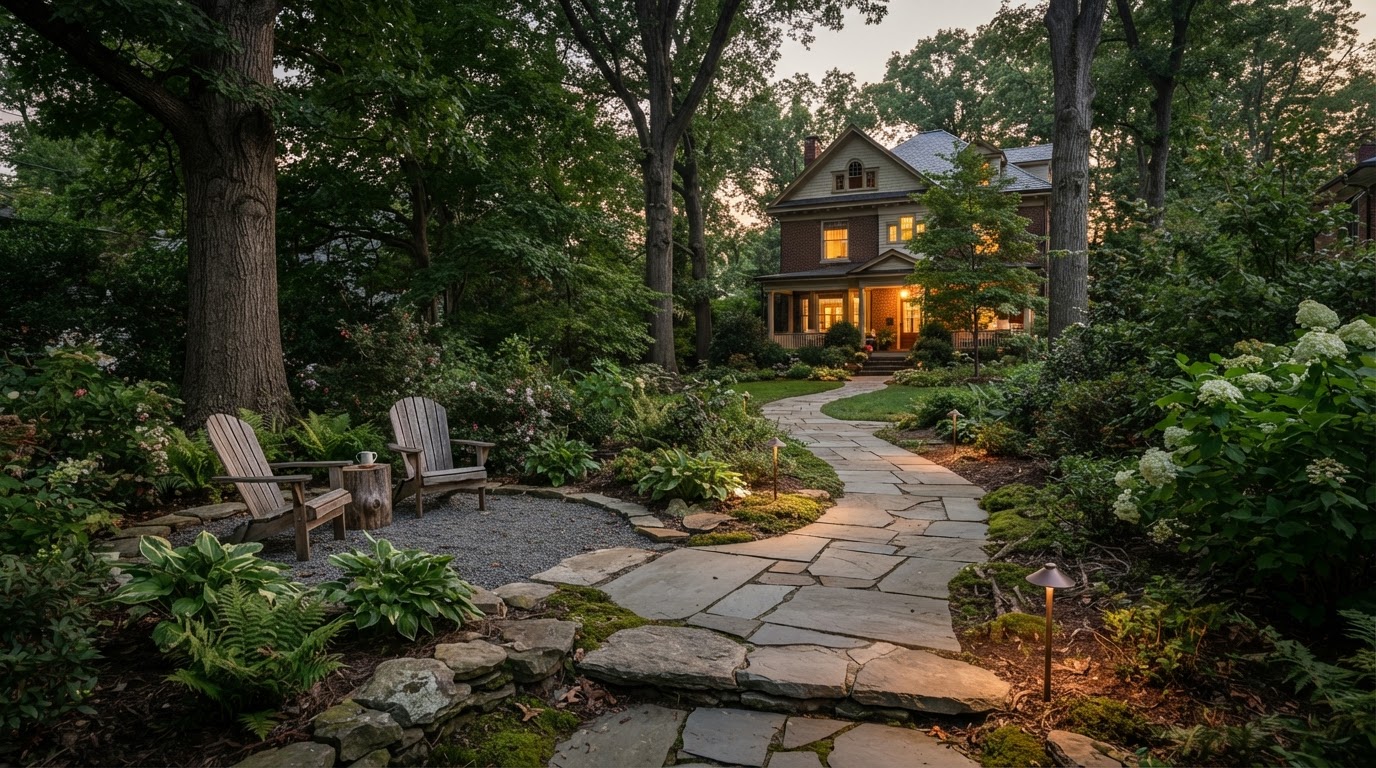
Design inspiration: Garrett Park stone walkway integrated with retained mature planting
Hardscape and Paver Applications in Garrett Park
A concentrated improvement focuses on the area that needs to change — a new path to a destination, a small patio where the use actually happens, a bed adjustment where access is difficult — and leaves the rest of the yard alone. A more extensive reorganization reworks the layout, the circulation, and the planting across the property. The difference is one of disturbance, access, retained features, and sequencing: a concentrated project disturbs less, preserves more, and can be completed without disrupting the features that already work.
The comparison turns on what the homeowner values and what the yard actually needs. A mature tree that shades the seating area, a bed that frames the entry, or an existing path that works well may all be worth retaining, and a layout that works around them disturbs less than one that clears and rebuilds. Where the whole layout is the problem, a reorganization may be the right answer; where a single area is the issue, a concentrated footprint is often enough.
Root-sensitive areas, access for equipment, and the sequencing of the work all favor the smallest useful footprint. Less disturbance means less to restore, fewer roots to protect, and less disruption to the features the homeowner wants to keep.
Concentrated seating area
Adding a small Garrett Park patio or path where the use actually happens, rather than reworking the whole yard, so the improvement is proportional to the need.
Retaining mature features
Planning the layout around mature trees, established beds, and useful existing surfaces so the work preserves what the homeowner values rather than clearing it.
Path adjustment for access
Rerouting or shortening a path to reduce disturbance and improve circulation without rebuilding the full landscape.
Selective renovation
Choosing the smallest useful project footprint that solves the actual problem, rather than a reorganization that disturbs more than it needs to.
Landscape Design and Outdoor Living Near Garrett Park
What is retained shapes the plan as much as what is built. A mature tree that shades the patio, a hedge that screens the boundary, or a bed that frames the entry all influence where a new path or seating area should go. Planning the layout around the features worth keeping produces a result that feels like an improvement to the existing yard rather than a replacement of it.
Lighting and planting changes can be added selectively, too — a few fixtures where they help most, a bed adjustment where access is the issue — rather than as part of a full overhaul.
Root-aware layout
Paths and seating positioned to avoid compacting or severing the roots of mature trees the homeowner wants to retain.
Selective lighting
A few path or step fixtures added where they extend usability most, rather than a full lighting plan installed across the whole yard.
Retained-bed framing
Established beds kept and worked into the new layout so the project improves the yard rather than clearing it.
Community Context and Property Planning in Garrett Park
Garrett Park properties vary in tree coverage, layout, and review path, and not every property carries the same municipal, historic, or tree-protection considerations. A selective project should respond to the actual yard and the actual features the homeowner values, rather than to a general description of the community.
Where a designation or review requirement is relevant to the address, it should be verified before it is applied — a locality-level designation does not automatically resolve the requirements for a specific parcel.
Garrett Park is an incorporated town in Montgomery County, and properties vary in tree coverage, lot layout, and applicable review requirements. Because a selective project responds to the actual yard and the features the homeowner values, the footprint should be planned from the specific site rather than from a community description. Any municipal, historic, or tree-protection requirement should be verified for the specific parcel before it is applied to the project, as a locality-level designation does not automatically resolve the requirements for an individual property. Verified sources: Town of Garrett Park (municipal government and recognized historic district); Maryland Historical Trust. Verification date: October 2026. Limitation: the town's historic and municipal status does not resolve the tree, lot, or review requirements of an individual parcel.
Drainage, Grading, and Site Conditions in Garrett Park
Drainage and access both favor the smallest useful footprint. A concentrated project disturbs less grade and less established planting, which means less disruption to the water movement and the roots the yard already relies on. Where the work requires a grade change or a new surface, the drainage review keeps the new section integrated with the existing flow.
Root zones and existing drainage paths should be identified before the footprint is set, so the project does not create a new drainage or root problem while it solves the original issue.
Planning a Hardscape Project in Garrett Park
A useful sequence identifies the features to retain, locates the smallest useful project area, assesses access and site constraints, and compares options before expanding the scope. This keeps the improvement concentrated where it is needed.
Identify features to retain
List the mature trees, established beds, and existing surfaces the homeowner wants to keep, so the layout works around them rather than removing them.
Locate the smallest useful area
Find the minimum footprint that solves the actual problem — a path to a destination, a small seating area, a bed adjustment — rather than a larger reorganization.
Assess access and constraints
Review equipment access, root zones, drainage, and boundaries so the footprint avoids disturbance it does not need to cause.
Compare options before expanding scope
Weigh the concentrated improvement against a broader renovation so the homeowner chooses the scope that fits the need and the budget without overbuilding.
Plan the project to be expandable
If a later phase may follow, design the first footprint so it stands on its own and the next phase can be added without rework.
Related Services and Nearby Service Areas
Related completed services provide more detail on the individual features of a selective project. Nearby service areas may share similar renovation or retention considerations, and each link goes to a page with its own focused guidance.
Explore All Service Areas
View our regional service locations across Maryland.
Before & After Hardscape, Paver & Landscape Transformations Near Garrett Park, MD
These interactive before-and-after comparisons illustrate common hardscape, paver, and landscape transformations Germantown Hardscape & Pavers plans for homeowners in Garrett Park and surrounding Maryland communities — including paver patio installation, paver walkways and driveways, retaining walls, yard grading and drainage, landscape design and planting, sod installation, outdoor fire pits, and patio seating walls. Drag the slider on each example to compare existing conditions with a coordinated finished layout. The comparisons show how a bare or problem yard can become a usable patio, a stable retaining wall, a clean walkway connection, or a drained and graded surface. Actual scope, materials, and access depend on your specific Garrett Park property, so each project is evaluated on site before construction begins.
Interactive images are representative service examples intended to illustrate common hardscape, paver, retaining-wall, drainage, grading, and landscape transformations. They are not documented Germantown Hardscape & Pavers customer projects. Actual project appearance varies by property, materials, and site conditions.
Paver Patio Installation & Replacement in Garrett Park
Replacing a bare or worn backyard surface with a properly based paver patio can create a stable, usable outdoor room. Planning considers base preparation, paver pattern, edge restraint, drainage slope, and how the patio connects to the house, walkway, and surrounding planting.
Bare backyard transformed into a paver patio with a seating wall and planted borders.
Explore paver patio installation and replacement in Garrett ParkPaver Walkway Installation Near Garrett Park
A worn dirt footpath can become a clean, stable paver walkway that connects the driveway, entry, and landscape. Walkway planning addresses width, transitions, base and slope, border detailing, and coordination with adjacent planting beds.
Worn footpath replaced with a bordered paver walkway and trimmed landscape edges.
View paver walkway installation near Garrett ParkPaver Driveway Installation in Garrett Park
Cracked, stained asphalt can be replaced with a paver driveway built on a compacted base. Driveway planning considers vehicle loads, base depth, drainage, paving pattern, edge restraint, and the transition to the garage and approach.
Cracked asphalt driveway replaced with a herringbone paver driveway and dark border.
Explore paver driveway installation in Garrett ParkRetaining Wall Installation & Slope Repair Near Garrett Park
An eroding slope can be stabilized with a segmental retaining wall that creates a usable level terrace. Wall planning considers height, setback, drainage behind the wall, base preparation, and any required structural design for the grade change.
Eroding slope stabilized with a segmental retaining wall and a level planted terrace.
Learn about retaining wall installation near Garrett ParkLandscape Design & Planting Installation in Garrett Park
A bare yard can become a layered landscape with coordinated garden beds, lawn edges, and foundation planting. Design planning organizes planting, circulation, and outdoor features around the property's sun exposure, soil, and maintenance preferences.
Bare yard transformed into layered garden beds, clean lawn edge, and foundation planting.
Explore landscape design and installation in Garrett ParkYard Grading & Leveling Near Garrett Park
Uneven, rutted ground with standing water can be regraded to a smooth, consistent slope that directs surface water away from the house. Grading planning addresses elevations, drainage direction, access, and preparation for sod or planting.
Uneven rutted yard regraded to a smooth, consistently sloped surface ready for sod.
View yard grading and leveling near Garrett ParkYard Drainage & French Drain Installation in Garrett Park
A persistently soggy area near a downspout can be corrected with a French drain or surface drain that collects and routes water to a suitable discharge point. Drainage planning evaluates where water originates, how it moves, and the appropriate collection and discharge route.
Saturated downspout area corrected with a gravel French drain and flush surface grate.
Explore yard drainage solutions in Garrett ParkOutdoor Fire Pit Installation Near Garrett Park
A bare backyard corner can become a gathering spot with a built-in stone fire pit on a small paver pad and a surrounding seating wall. Fire pit planning brings together seating clearance, materials, fuel choice, and placement appropriate for the property.
Bare corner transformed into a stone fire pit with a surrounding seating wall.
Learn about outdoor fire pit installation near Garrett ParkSod Installation & Lawn Restoration in Garrett Park
Bare prepared soil can be transformed into an immediate mature lawn with freshly laid sod. Sod planning follows grading, confirms a clean soil surface and straight edges, and considers sun exposure and watering access for establishment.
Bare graded soil transformed into a freshly laid, uniform sod lawn.
View sod installation and lawn restoration in Garrett ParkPatio Seating Wall Installation Near Garrett Park
An open patio edge dropping to lawn can be finished with a low matching seating wall that defines the space and adds usable seating. Seating wall planning considers wall height, cap alignment, drainage, and coordination with the patio surface and base.
Open patio edge finished with a low matching block seating wall and clean lawn transition.
Explore patio seating wall installation near Garrett ParkStart Your Hardscape, Paver or Landscape Transformation in Garrett Park
Contact Germantown Hardscape & Pavers to discuss the hardscape features, property conditions, and type of work you need in Garrett Park. Sharing photographs of the project area, approximate dimensions, the requested service, existing conditions, and your preferred timeline helps the team understand the scope before scheduling the next step.
Also explore hardscape, paver, and landscape services near Kensington, Silver Spring, and Bethesda, MD.
Garrett Park Hardscaping & Landscape Questions
Can a modest project improve usability without changing the whole yard?↓
Yes, and that is often the better choice. A new path to a destination, a small seating area where the use actually happens, or a targeted bed adjustment can solve the real problem while leaving mature trees, established beds, and useful existing features in place. The smallest useful footprint disturbs less, costs less to restore, and keeps the yard feeling like an improvement rather than a replacement. The key is identifying the actual inconvenience before planning the scope, so the work is proportional to the need.
How should existing trees and planting influence the layout?↓
They should shape where the new work goes. A mature tree that shades the seating area, a hedge that screens the boundary, or a bed that frames the entry all tell you where a path or patio should — and should not — be placed. Planning the layout around the features worth keeping preserves the character of the yard and avoids disturbing root zones and established drainage. The layout should work with the retained landscape, not over it.
Can a path be adjusted to reduce disturbance?↓
Often, yes. Rerouting or shortening a path can improve circulation and access without rebuilding the full landscape. A path that avoids a root zone or an established bed disturbs less than one that runs through them, and a shorter route may serve the use just as well. The goal is the smallest useful change, so the improvement does not create more disturbance than the original problem warranted.
What should be checked before changing a planted area near roots?↓
The root zone, the drainage, and the access. Cutting significant roots or compacting the soil over them can damage a tree the homeowner wanted to keep, and changing the grade can alter how water reaches those roots. Identifying the root spread and the existing drainage before the bed or path is installed keeps the work from creating a new problem — a stressed tree, a redirected flow — while it solves the original one. Where the work is near a mature tree, an awareness of the root zone keeps both the planting and the tree stable.
When should local review requirements be confirmed?↓
Before any municipal, historic, or tree-protection rule is described as applying to the project. Requirements can depend on the specific address and the scope of the work, and a locality-level designation does not automatically resolve what a specific parcel needs to address. Confirming the actual requirements for the property — rather than assuming them from the community name — keeps the plan honest about what the project will need to complete.
Can the project be expanded later?↓
Yes, if the first footprint is designed to stand on its own. A concentrated project that solves the immediate problem can be planned so a later phase — more planting, lighting, or a second surface — can be added without rework. The key is identifying what is most useful now and what can follow, so the first phase is complete on its own and the next phase connects cleanly rather than requiring the first to be redone.
Discuss Your Garrett Park Project
Call to talk through your property, or request an estimate to begin evaluating scope, materials, and site conditions.