
Paver Driveway Installation Germantown
A paver driveway is a vehicular surface, and that changes almost everything about how it must be built. Paver driveway installation in Germantown, MD is planned around the loads a vehicle places on the surface, the turning and parking patterns the layout must support, and the drainage that keeps both the driveway and the adjoining structures sound. Germantown Hardscape & Pavers helps property owners evaluate whether pavers suit their access and how to prepare a base that will hold under repeated vehicle weight.
Because a driveway carries loads a patio or walkway never sees, the products, the base, the edge restraint, and the drainage are all specified for that use. A surface that looks like a patio but is not built for vehicles will not stay flat for long.
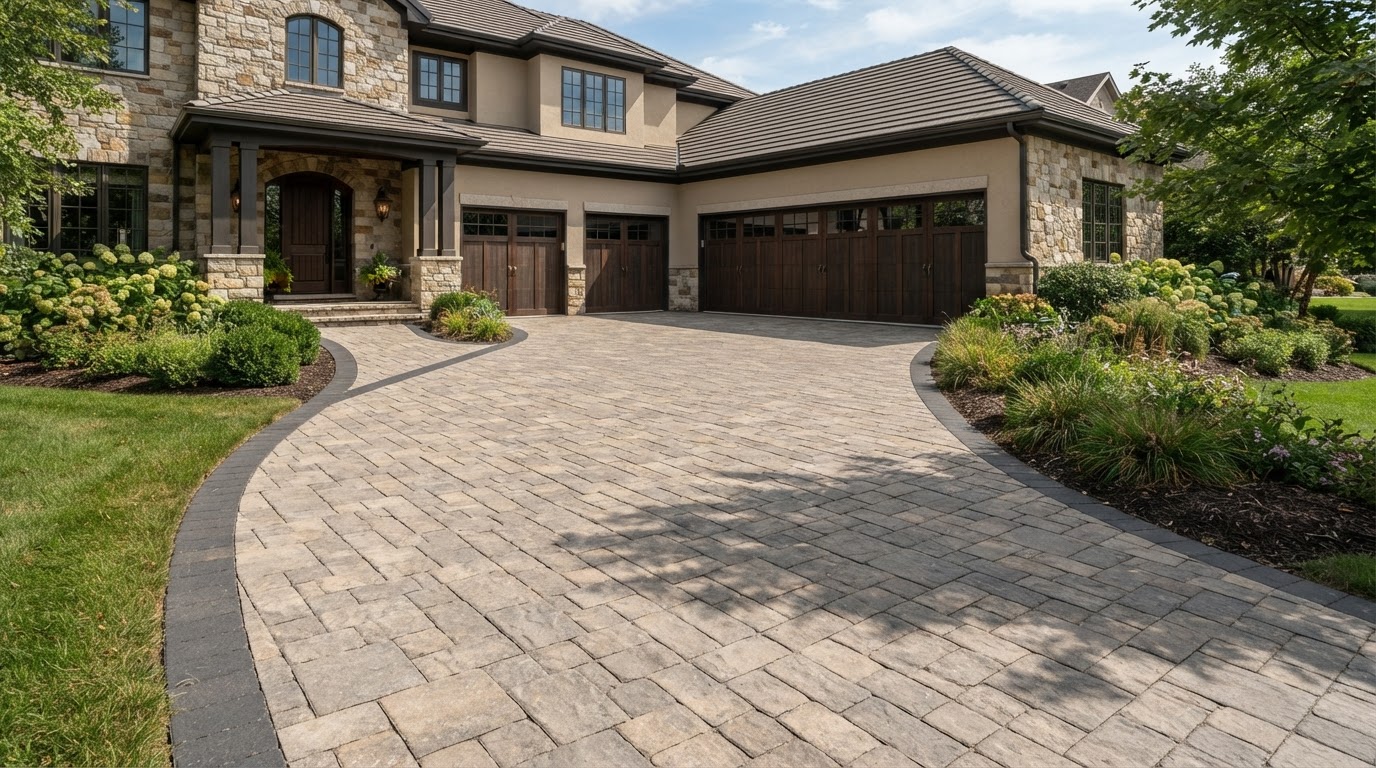
Concept visualization: Paver driveway with vehicular-scale geometry and edge restraint
Provenance: Concept visualizationScope, Applications, and Homeowner Goals
This service covers new paver driveway installation, including the evaluation of vehicle use and loading, the existing driveway condition, excavation and base preparation, product selection for the intended vehicular application, turning and parking layout, edge restraint and perimeter stability, drainage, and transitions to garages, sidewalks, and the roadway. It is distinct from permeable paver installation, which has its own page and addresses a different stormwater approach.
The decisions that define a driveway project are structural and access-related: what loads the surface must carry, how the layout supports turning and parking, how water moves off and around it, and how it meets the garage, the sidewalk, and the street. Those choices are specific to the property and the way the household uses the drive.
A driveway is also a visible part of the front yard, so borders, patterns, and visual integration with the home and a front walkway are part of the scope — but they follow the structural and drainage decisions, not the other way around.
Vehicle use and loading
The products and base are specified for the weight and frequency of the vehicles the driveway will carry, not assumed from a pedestrian standard.
Existing driveway condition
The current surface and base are evaluated to see whether they can be incorporated or must be removed, and what they reveal about the subgrade.
Site-dependent excavation and base
Excavation depth and base composition depend on existing soil, drainage, and the loads the drive will carry — there is no universal base depth.
Products for the application
Pavers are chosen for vehicular suitability; not every paver is rated for driveway use, and the selection reflects the intended load.
Turning, parking, and connections
The layout supports how vehicles enter, turn, and park, and connects cleanly to the garage, sidewalk, and roadway.
Edge restraint and drainage
A robust perimeter restraint keeps the field from spreading under vehicle loads, and drainage is planned around the drive and adjoining structures.
Materials, Methods, and Design Choices
Driveway pavers are selected first for vehicular suitability and second for appearance. Thickness, shape, and interlock all affect how a paver holds up under a turning tire or a parked vehicle. Color, pattern, and border then shape how the drive reads against the home and the front walkway — but a paver that is not rated for the load will fail no matter how good it looks.
A useful comparison for a driveway project is between replacing an existing surface in place and changing the layout or footprint, because the second introduces questions the first does not.
| Consideration | Replace surface in place | Change layout or footprint |
|---|---|---|
| Existing base | Base may be reusable if sound | New base and subgrade work required |
| Access and grading | Established grades retained | New grades, slopes, and drainage to plan |
| Drainage | Existing drainage largely preserved | Runoff pattern may change significantly |
| Approvals | Fewer jurisdictional questions | May trigger apron, setback, or permit questions |
| Roadway connection | Apron generally unchanged | Apron modification may need separate approval |
Vehicular-rated pavers
Pavers selected for thickness and interlock suited to the loads the drive will carry, so the surface stays flat under repeated vehicle weight.
Pattern and border
Patterns that interlock well for vehicular loads, with borders that define the edge and frame the drive against the home and landscape.
Perimeter restraint
A robust edge restraint at the perimeter keeps the field from spreading where tires turn and where the drive meets lawn or sidewalk.
Site Assessment and Project Planning
Driveway assessment is structural and access-focused. Existing surface and base, vehicle loading, turning and parking, drainage around the drive and adjoining structures, transitions to the garage and the roadway, and any apron or sidewalk connections all influence the approach. These are evaluated at the property because a driveway that looks right but drains toward the foundation, or that cannot support the household's vehicles, is a problem waiting to happen.
Permeable paver installation is a distinct service with its own page; standard pavers are not a permeable system, and the stormwater approach differs. Roadway or apron modifications are not automatically approved and may require separate coordination with the jurisdiction. Applicable property approvals depend on scope and jurisdiction and should be checked before construction.
Existing surface and base
What is there now, is the base sound enough to reuse, and what does the current condition reveal about the subgrade?
Vehicle loading
What vehicles use the drive — sedans, SUVs, heavier trucks — and how does that inform product and base selection?
Turning and parking
How do vehicles enter, turn, and park, and does the layout support that movement without forcing awkward maneuvering?
Drainage around the drive
Where does runoff go now, and how will the new surface direct water away from the garage, foundation, and neighboring properties?
Transitions
How does the drive meet the garage floor, the sidewalk, and the roadway apron, and do those junctions line up cleanly?
Approvals and apron
What permit or HOA requirements apply, and does the project touch the roadway apron in a way that needs separate approval?
Germantown Context and Related Services
Driveways in Germantown and Montgomery County, MD face winter freeze-thaw, summer storms, and the occasional heavy vehicle. A base and drainage planned for the specific property — its soil, slope, and the loads it will carry — is what keeps a paver driveway flat over years. Conditions vary by neighborhood, so the preparation is site-specific, not assumed.
A driveway often connects to the front walkway and the home. Related completed pages describe the coordinated hardscape plan it may be part of and the paver walkway that leads from the drive to the door.
Related Completed Services
Paver Driveway Installation Questions
A paver driveway is a structural surface as much as an aesthetic one, so the planning deserves the same care as the visible part. Call to discuss the loads, layout, and drainage for your drive, or request an estimate to begin.
What makes driveway paving different from patio paving?↓
A driveway carries vehicle loads a patio never sees, so the pavers, the base, the edge restraint, and the drainage are all specified for that use. Driveway pavers are selected for thickness and interlock, the base is prepared for repeated weight, and the perimeter restraint is more robust. A surface built to patio standards will not hold up under vehicles.
Can pavers replace an existing driveway?↓
Yes, when the existing base is sound or can be re-established and the layout is retained. The old surface and base are evaluated first to see what can be reused and what the subgrade reveals. Replacing in place is often simpler than changing the footprint, though the drainage should still be re-evaluated.
How is drainage considered in a driveway project?↓
Drainage is planned around the drive and the structures it adjoins — the garage, the foundation, and neighboring properties. Slope directs runoff off the surface and away from the building, and the layout avoids channeling water toward the garage or the street in a way that causes problems. Drainage is part of the design, not an afterthought.
Are all pavers suitable for vehicle traffic?↓
No. Pavers vary in thickness, shape, and interlock, and not all are rated for vehicular loads. The selection reflects the vehicles the drive will carry. Using a paver that is not suited to the load is a common cause of early settling and edge failure, so product choice follows the application.
Can a driveway coordinate with a front walkway?↓
Yes. A front walkway that meets the driveway can match or complement the paver, and the junction can be planned so foot traffic and vehicle movement stay clear of each other. Coordinating the two surfaces makes the front yard read as one design rather than two separate projects.
What information helps define a driveway estimate?↓
The size and layout, the vehicles that use it, the existing surface and base, access for construction, drainage conditions, paver selection, and any transitions to the garage, sidewalk, or roadway apron. Each of these changes the preparation and material involved, so the estimate reflects the specific property and the way the drive is used.
Discuss Your Project
Call our team based in Germantown, MD to talk through scope, site considerations, and next steps — or request an estimate and we will follow up.