
Paver Walkway Installation Germantown
A paver walkway is the connective tissue of a yard — the path that carries people from the driveway to the door, from the patio to the garden, and from the front yard to the back. Paver walkway installation in Germantown, MD is about building that connection so it is safe, stable, and consistent with the rest of the landscape. Germantown Hardscape & Pavers helps property owners plan walkway routes, slopes, edges, and materials that fit the way the yard is actually used.
A good walkway feels obvious: you walk it without thinking about the route. That only happens when the path is planned for real movement — direct where direct makes sense, gently curved where a straight line would fight the landscape — and built on a base that keeps it flat over time.
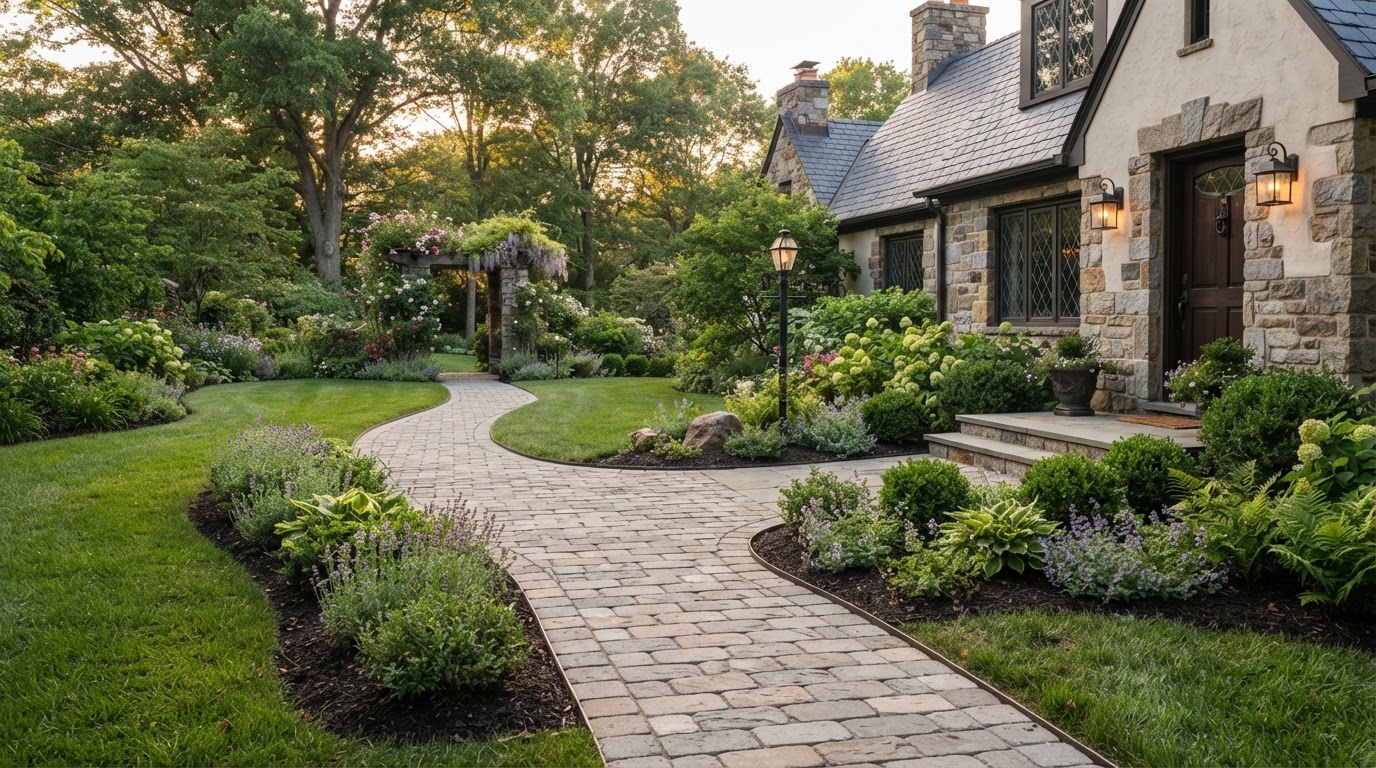
Concept visualization: Curving paver walkway connecting entry and garden
Provenance: Concept visualizationScope, Applications, and Homeowner Goals
This service covers new paver walkway construction, from the route and the base to the paver pattern, edging, joints, and drainage along the path. It includes front-entry approaches, side-yard access, connections between driveways and patios, and garden circulation. It is distinct from natural stone walkways, which have their own material and layout considerations, and from walkway repair, which addresses an existing path.
The decisions that define a walkway project are about movement and connection: where the path should go, how wide it should be for the traffic it carries, how it handles slopes and transitions, and how it relates to the paving and planting around it. A primary entry walk serves a very different purpose than a secondary garden path, and the design should reflect that.
Material coordination with existing paving matters here. A walkway that meets a patio or a driveway should relate to those surfaces — matching or complementing the paver — so the connection reads as intentional rather than as a patch from a different project.
Front-entry approaches
The main path from the driveway or street to the front door, sized and styled as a welcoming arrival route.
Side-yard and backyard access
Secondary paths that connect the front and back of the property, the garage, or outbuildings without crossing the lawn.
Driveway-to-patio connections
Paths that link vehicular and gathering areas so guests and family move between them cleanly.
Garden circulation
Routes through planting beds and garden areas that let you maintain and enjoy the landscape without compacting soil or crushing plants.
Direct versus curved routing
The path follows the natural line of movement — direct where that reads well, gently curved where a straight line would fight the landscape.
Material coordination
Paver color and pattern are chosen to coordinate with an existing patio, driveway, or the home's architecture.
Materials, Methods, and Design Choices
Walkway pavers share the same families as patio pavers, but the layout considerations are different. A walkway is a line, not a field, so pattern, width, and edging read differently on a narrow path than they do across a broad patio. A running bond that looks calm on a patio can look busy on a walkway, and a border that frames a patio can overwhelm a narrow path.
The useful comparison for a walkway is between a primary entry path and a secondary garden path, because the two serve different purposes and deserve different treatment.
| Factor | Primary entry walkway | Secondary garden path |
|---|---|---|
| Frequency of use | Daily, by everyone | Occasional, by a few |
| Desired route | Direct, efficient | Gently curved, exploratory |
| Surface continuity | Coordinates with driveway and entry | Coordinates with planting and patio |
| Visual emphasis | Clear arrival statement | Quiet garden detail |
| Maintenance consideration | Kept clear and clean year-round | May border mulch or groundcover |
Width and pattern
Walkway width is chosen for the traffic it carries, and the pattern is kept simple enough to read cleanly along a narrow line rather than competing with the route.
Edges and joints
A defined edge keeps the path crisp against lawn or beds, and compatible joint sand holds the pavers steady along the line of travel.
Drainage along the path
Slope and edge drainage keep water from sheeting across the walkway or pooling at the low points where the path meets a door or a driveway.
Site Assessment and Project Planning
Several factors shape a walkway. The route, the slope, the existing surfaces it meets, the roots and planting along the way, and the connection points at the door and the driveway all influence the design. These are evaluated at the property because the right path follows the actual movement and grade of the site, not a line drawn without walking it.
Where a walkway meets a driveway or a door, the transition deserves attention: a mismatch in elevation or a slope that sends water toward the entry can turn a nice path into a problem. Applicable property approvals depend on project scope and jurisdiction and should be checked before construction begins.
Route and alignment
Does the proposed route follow how people actually move, and does it align visually with the entry and outdoor features it connects?
Slopes and elevation changes
Are there grade changes along the path, and how will the walkway handle them without a steep or uneven surface?
Surface transitions
How does the path meet the driveway, the patio, and the door, and do those junctions line up in elevation and material?
Roots and nearby planting
Are there tree roots or beds the path must avoid or work around, and will the base be affected by root growth over time?
Drainage along and across
Where does water cross the path, and how will slope and edging keep the walkway clear rather than channeling runoff along it?
Connection to the driveway
Where the walkway meets the driveway, is there a clean apron transition, and does the layout keep foot traffic clear of the parking area?
Germantown Context and Related Services
Walkways in Germantown and across Montgomery County, MD deal with real seasonal conditions — ice and leaf litter in winter, heavy rain in summer. A path built on a sound base with proper slope stays safer and more usable through all of them. Slope and soil vary by property, so the route and drainage are planned for the specific site.
A paver walkway often connects to other features. Related completed pages describe the coordinated hardscape plan it may be part of, the patio it leads to, the driveway it crosses, and the natural stone walkway alternative.
Paver Walkway Installation Questions
A walkway that follows real movement and meets its connections cleanly changes how a yard feels to use every day. Call to talk through the route and materials, or request an estimate to begin.
What should determine the route of a new walkway?↓
The route should follow how people actually move through the yard — the line you would wear into the lawn if there were no path. A direct route suits a daily entry walk; a gently curved route suits a garden path. Alignment with the door, driveway, and destination also matters, so the path reads as intentional rather than arbitrary.
Can walkway pavers coordinate with an existing patio?↓
Yes. Matching or complementing the patio paver keeps the connection intentional, and coordinating the pattern transition and the edge keeps the two surfaces reading as one design. If the existing patio has a different elevation or drainage issue, that is evaluated at the junction so the walkway does not inherit the problem.
How are slopes or changes in elevation considered?↓
Grade changes are handled through the path's slope, steps, or a slight reroute so the surface stays comfortable to walk. A path that is too steep or that drops suddenly at a transition becomes a trip hazard, so the elevation is planned along the whole route, not just at the ends.
What is the difference between a paver walkway and a natural stone path?↓
Paver walkways use manufactured units with consistent sizes and tight joints, giving a uniform, crisp line. Natural stone paths use irregular or cut stone with more variation in shape and joint width, giving a more organic look. A paver walkway tends to read as more formal; a stone path tends to read as more natural.
Can an existing walkway be replaced along the same route?↓
Often, yes. Replacing a walkway along the same route lets us reuse the established line of travel, though the base and drainage should be re-evaluated since the old path may have settled or routed water poorly. Sometimes a small adjustment to the route improves the connection or the slope.
What should be evaluated where a walkway meets a driveway?↓
The transition in elevation, the material relationship, and the drainage across the junction. The walkway should meet the driveway cleanly, coordinate in paver or edge, and not channel runoff toward the garage or the front door. That junction is one of the most-traveled points on the property, so it deserves particular attention.
Discuss Your Project
Call our team based in Germantown, MD to talk through scope, site considerations, and next steps — or request an estimate and we will follow up.