
Pool Deck Paver Installation Germantown
A pool deck is the walking and gathering surface around a pool, and it has to perform in conditions a patio never sees: barefoot traffic, constant wetness, pool chemicals, and direct sun on a surface that may be hot to the touch. Pool deck paver installation in Germantown, MD is planned around those conditions — circulation around the pool, surface texture and heat, drainage at the deck, and the transition where the paver meets the pool coping. Germantown Hardscape & Pavers helps property owners choose and install a pool surround that fits the pool and the way the space is used.
This page is about the surface around the pool. It does not include pool-shell construction, pool equipment work, or licensed electrical work, all of which belong to other trades. The paver deck is the layer that ties the pool to the rest of the yard, and getting it right depends on the pool that is already there or being built.
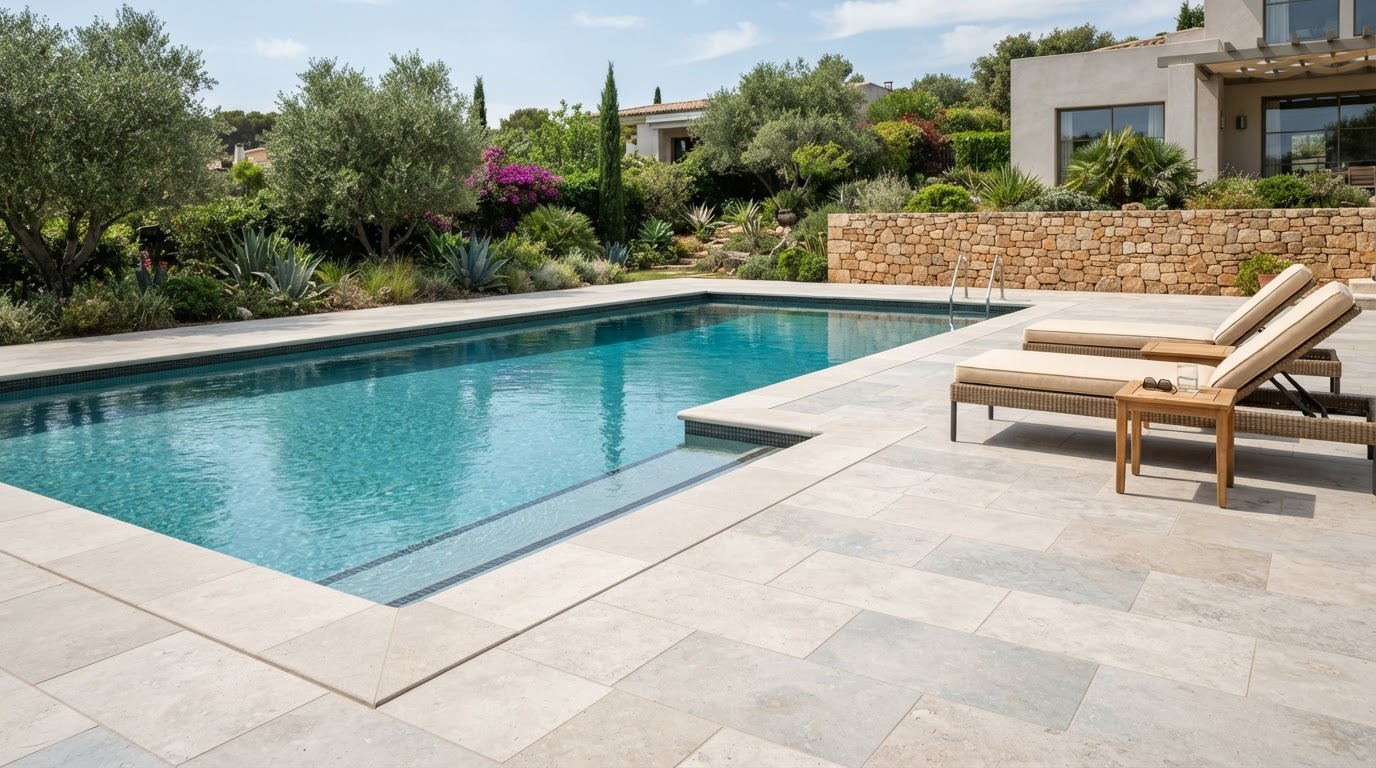
Concept visualization: Pool deck paver surface with coping transition and drainage
Provenance: Concept visualizationScope, Applications, and Homeowner Goals
This service covers new paver pool deck installation, including circulation around the pool, connections to seating and adjacent patios, surface texture and wet-condition considerations, heat exposure as a material and site factor, drainage around the deck, elevation relationships and coping interfaces, access to equipment and service areas, and coordination with existing surrounding surfaces. It is distinct from a standard patio because the pool edge, the wet environment, and the safety questions change the material and layout decisions.
The decisions that define a pool deck project center on the pool: how the deck meets the coping, how water sheds off the deck and away from the pool, how the surface feels and performs wet and barefoot, and how the deck connects to the rest of the yard. Product suitability must be checked for the intended application — not every paver belongs around a pool.
Where a pool deck meets an adjacent patio, the transition is planned so the two surfaces read as one design and line up in elevation. Replacement of an existing pool surround is also in scope, and coordinating with the existing pool edge is part of evaluating that work.
Circulation around the pool
The deck is laid out for the way people move around the pool — entering, exiting, walking to seating, and reaching the shallow and deep ends without dead ends.
Connections to seating and patios
Transitions to lounge chairs, dining areas, and any adjacent patio are planned so the pool deck reads as part of the larger outdoor space.
Surface texture and wet conditions
Surface texture is considered for wet, barefoot use — though no surface is guaranteed slip-proof — and the selection reflects the real conditions of a pool surround.
Heat exposure
Surface temperature varies with material, finish, sunlight, and weather, so heat is treated as a material and site consideration rather than ignored.
Drainage around the deck
Slope and drainage keep water off the deck and away from the pool and the house, rather than sheeting across the walking surface.
Coping interfaces and equipment access
The transition where paver meets pool coping is planned, and access to pool equipment and service areas is preserved.
Materials, Methods, and Design Choices
Pool deck pavers are chosen with the pool environment in mind. Lighter colors tend to stay cooler in direct sun, textured surfaces perform better wet, and the paver must be compatible with the coping and the manufacturer's guidance for pool surrounds. The useful comparison is between common poolside material choices, because each balances texture, color, heat, maintenance, and compatibility differently.
Careful wording matters here: no surface is guaranteed slip-proof, surface temperatures vary with material and conditions, product suitability must be checked for the intended application, and barrier, bonding, electrical, and other pool-related requirements depend on scope and jurisdiction.
| Factor | Light-colored concrete paver | Darker textured paver | Natural stone |
|---|---|---|---|
| Heat in direct sun | Stays cooler | Can become hot | Varies by stone type |
| Wet-condition texture | Depends on finish | Better grip when wet | Varies by surface |
| Color in the sun | Bright, reflective | Rich, absorbs light | Natural earth tones |
| Coping compatibility | Often matched systems | May need custom coping | Often custom cut |
| Maintenance | Standard paver care | Standard paver care | Stone-specific care |
Color and heat
Lighter pavers generally stay cooler underfoot in direct sun, while darker pavers absorb more heat. The choice balances appearance against how the surface feels on a hot day.
Texture and wet use
A more textured surface performs better when wet, though no surface is slip-proof. The finish is chosen for the real, wet, barefoot conditions of a pool surround.
Coping compatibility
The paver must work with the pool coping — the edge the deck meets — and with the manufacturer's guidance for pool surrounds, so the transition is clean and stable.
Site Assessment and Project Planning
A pool deck assessment looks at the pool itself as much as the yard. The existing coping, the elevation relationship between deck and pool edge, drainage around the deck, access to equipment and service areas, and any barrier, bonding, or electrical requirements all shape the approach. These are evaluated at the property because the deck must fit the pool that is there.
Barrier, bonding, electrical, and other pool-related requirements depend on project scope and jurisdiction and should be checked before work begins. Those requirements are not part of the paver deck itself, but they affect what can be done around the pool and should be confirmed with the appropriate authority.
Existing coping and pool edge
What coping is in place, and how will the new paver meet it cleanly in elevation and material?
Elevation relationship
How does the deck height relate to the pool edge, the surrounding grade, and any adjacent patio?
Drainage around the deck
Where does water go now, and how will the deck slope direct it away from the pool and the house?
Equipment and service access
Where is the pool equipment, and does the deck layout preserve access for service and maintenance?
Heat and sun exposure
How much direct sun does the deck see, and how does that inform the color and material choice?
Pool-related requirements
What barrier, bonding, electrical, or other pool-related requirements apply, and how are they confirmed?
Germantown Context and Related Services
Pool decks in Germantown and across Montgomery County, MD face hot, humid summers with strong sun, plus the wet environment of the pool itself. A surface and drainage planned for those conditions stays more comfortable and more usable through the season. Sun exposure and yard orientation vary by property, so the heat and drainage considerations are site-specific.
A pool deck often connects to an adjacent patio. Related completed pages describe the coordinated hardscape plan it may be part of and the paver patio it leads to.
Related Completed Services
Pool Deck Paver Installation Questions
A pool deck has to perform in wet, barefoot, sun-exposed conditions a patio never sees, so the planning deserves that care. Call to talk through the surface, drainage, and coping for your pool, or request an estimate to begin.
What should be considered when choosing pool deck pavers?↓
Consider how the surface feels and performs wet and barefoot, how hot it gets in direct sun, how it meets the pool coping, how water drains off the deck, and how it connects to adjacent patios. Product suitability must be checked for the intended application — not every paver belongs around a pool. The choice balances texture, color, heat, maintenance, and coping compatibility.
Can an existing pool surround be replaced with pavers?↓
Often, yes. The existing coping and elevation are evaluated so the new paver meets the pool edge cleanly, and the drainage is re-evaluated since the old surround may have shed water poorly. Replacement is coordinated with the pool that is there, and access to equipment and service areas is preserved.
How are drainage and pool-edge transitions evaluated?↓
Drainage is planned so water sheds off the deck and away from the pool and the house, and the transition where paver meets coping is planned in elevation and material. The goal is a surface that stays clear and dry rather than sheeting water across the walking area or toward the pool.
Will the surface become hot in direct sunlight?↓
Surface temperature varies with material, finish, sunlight, and weather. Lighter-colored pavers generally stay cooler; darker ones can become hot to the touch. Heat is a real consideration for a pool deck, so the color and material choice reflects how much direct sun the surface will see.
Can pool deck paving connect to a patio?↓
Yes. A pool deck and an adjacent patio can share or complement a paver so the two surfaces read as one design, and the transition is planned so they line up in elevation. Connecting the pool area to the rest of the yard is part of a coherent outdoor layout.
What should be reviewed before changing the poolside layout?↓
The coping and pool edge, the elevation relationship, drainage, equipment access, and any barrier, bonding, or electrical requirements that depend on scope and jurisdiction. Those pool-related requirements are not part of the paver deck itself, but they affect what can be done around the pool and should be confirmed before work begins.
Discuss Your Project
Call our team based in Germantown, MD to talk through scope, site considerations, and next steps — or request an estimate and we will follow up.