
Dry Well Installation Germantown
A dry well is a subsurface infiltration feature that receives collected runoff and allows it to percolate into the surrounding soil over time. It is not a buried container that makes water disappear — it depends on the soil's ability to accept water at a rate that keeps up with inflow. Germantown Hardscape & Pavers helps property owners in Germantown, MD evaluate whether a dry well suits the property, the runoff source, and the site conditions before any installation is planned.
The main decision is whether the site can actually infiltrate water safely. A property with standing water is not automatically a candidate for a dry well; the conditions that cause that water to collect may be the same conditions that prevent infiltration. Understanding that distinction early determines whether infiltration is the right approach or whether a different water-management method fits the property.
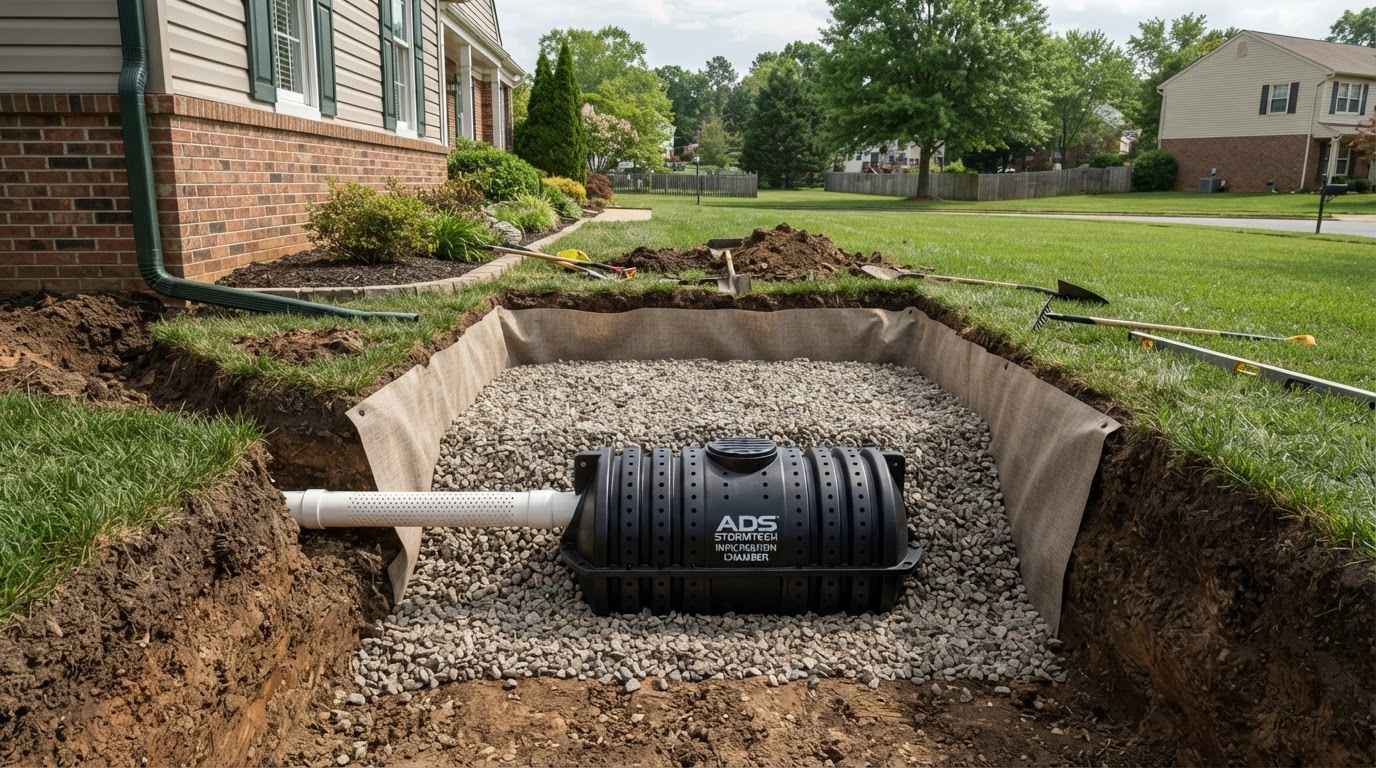
Concept visualization: Dry well stormwater infiltration chamber
Provenance: Concept visualizationScope, Applications, and Homeowner Goals
This service addresses the evaluation and installation of a subsurface infiltration feature for a defined runoff source. It includes assessing the intended runoff source, soil infiltration characteristics, groundwater or other limiting conditions, available space, relationships to buildings and utilities, sediment management, storage and overflow planning, maintenance access, and applicable review or approval requirements.
This page is distinct from the broad yard drainage solutions page, which evaluates overall water problems and selects an approach. A dry well is one potential destination within a broader plan — not a universal answer for standing water. Underground downspout drainage may convey roof runoff to a dry well when site conditions support it, but the suitability of that connection depends on the property.
Not every wet yard suits infiltration. Soils that drain slowly, high groundwater, limited space, or proximity to foundations may make a dry well unsuitable. The decision depends on site-specific evaluation, not on an assumption that any property with a drainage problem can accept a dry well.
Runoff source
Evaluate the intended water source — roof runoff, surface flow, or another origin — and whether infiltration is appropriate for it.
Soil infiltration
Assess whether the soil can accept water at a rate that keeps up with inflow during storms.
Limiting conditions
Check for high groundwater, shallow bedrock, or other conditions that prevent effective infiltration.
Capacity and overflow
Plan storage volume and an overflow path for when inflow exceeds the system's capacity.
Materials, Methods, and Design Choices
A dry well is appropriate only when the site supports infiltration. The decision guide below frames the questions that determine suitability — it is not a self-diagnosis checklist that guarantees a dry well will work.
| Factor | May support infiltration | May need another approach |
|---|---|---|
| Soil drainage | Well-drained soil that accepts water readily | Heavy or saturated soil that percolates slowly |
| Groundwater depth | Sufficient separation below the system | High seasonal groundwater near the surface |
| Space available | Room for the system with appropriate setbacks | Limited space near foundations or boundaries |
| Runoff source | Suitable runoff that can be infiltrated safely | Polluted or unsuitable runoff for infiltration |
| Overflow planning | A path for excess water when capacity is exceeded | No consideration of what happens during large storms |
Sediment management
Sediment entering a dry well can reduce infiltration over time; pre-treatment or separation may be needed.
Overflow path
When inflow exceeds capacity, the water needs a planned overflow route rather than backing up.
Maintenance access
Access for inspection and sediment removal should be planned from the start.
Site Assessment and Project Planning
Before defining the work, several factors must be evaluated: soil infiltration characteristics, groundwater or other limiting conditions, available space, relationships to buildings and property boundaries, sediment management, and applicable review or approval requirements. A dry well beside a foundation without proper evaluation can create more problems than it solves.
Soil suitability
The soil must accept water at a rate that keeps up with inflow; slow-draining soil may make infiltration unsuitable.
Groundwater and bedrock
High seasonal groundwater or shallow bedrock can prevent effective infiltration and must be checked.
Setbacks
Relationships to foundations, property boundaries, wells, and other features must be evaluated; infiltration beside a foundation needs careful assessment.
Capacity and overflow
Storage volume and an overflow path must be planned for storms that exceed the system's capacity.
Runoff quality
The runoff source must be suitable for infiltration; polluted or contaminated water should not be infiltrated.
Review requirements
Applicable stormwater, building, or local approval requirements should be checked before installation.
Germantown Context and Related Services
Soil conditions across Germantown and Montgomery County, MD vary widely — some properties drain well, others have heavy clay or seasonal groundwater that limits infiltration. Whether a dry well suits a given property depends on the actual soil and site conditions, not on a universal assumption.
Related completed pages: yard drainage solutions provides the broader assessment framework, and underground downspout drainage may convey roof runoff to a dry well when conditions support it. Permeable paving offers a surface-level infiltration alternative for some properties.
Related Completed Services
Dry Well Installation Questions
A dry well is a suitability and infiltration decision, not a universal fix for standing water. Call to talk through your soil conditions and runoff source, or request an estimate to begin evaluating whether infiltration fits your property.
What is a dry well intended to do?↓
A dry well receives collected runoff and allows it to percolate into the surrounding soil over time. It provides temporary storage and infiltration — it does not make water disappear. The system only works when the soil can accept water at a suitable rate.
How is site suitability evaluated?↓
Site suitability depends on soil infiltration characteristics, groundwater depth, available space, setbacks from foundations and boundaries, and the runoff source. These factors must be evaluated before installation — a property with standing water is not automatically a candidate for a dry well.
Does every wet yard suit infiltration?↓
No. Heavy or saturated soil, high seasonal groundwater, limited space, or proximity to foundations may make infiltration unsuitable. The conditions that cause water to collect may be the same conditions that prevent a dry well from functioning.
What happens when inflow exceeds the system's capacity?↓
When a storm delivers more water than the dry well can accept, the excess needs a planned overflow route. Without an overflow path, the water backs up and may surface where it is not wanted. Overflow planning is part of the design, not an afterthought.
What maintenance and access should be considered?↓
A dry well may need periodic inspection and sediment removal to maintain infiltration over time. Access for maintenance should be planned from the start. Sediment entering the system can reduce its capacity, so pre-treatment or debris separation may be appropriate.
Discuss Your Project
Call our team based in Germantown, MD to talk through scope, site considerations, and next steps — or request an estimate and we will follow up.