
Permeable Paver Installation Germantown
Permeable paving is a complete system, not simply a conventional paver surface with visible joints. A permeable paver installation is designed to receive water through its surface, where the pavers, the joint aggregate, and the underlying layers all work together to move stormwater down into the ground beneath. Germantown Hardscape & Pavers helps property owners in Germantown, MD evaluate whether a permeable system suits their site and how to plan one around real soil and drainage conditions.
Suitability is the main decision. Not every property can infiltrate water safely, and not every paver installation qualifies as permeable. The right approach depends on what lies beneath the surface — the soil's ability to drain, the slope of the yard, the relationship to buildings and property lines, and how water already moves through the site.
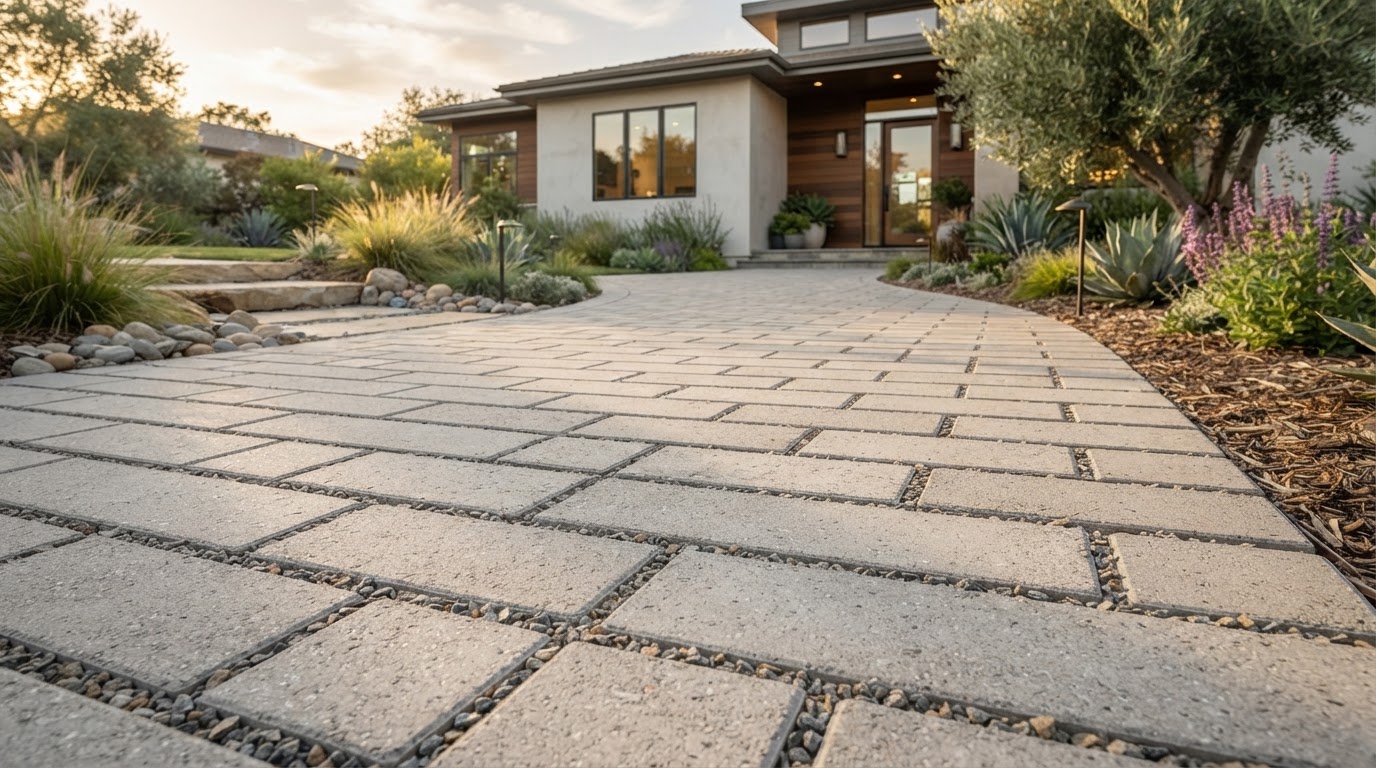
Concept visualization: Permeable paving system with aggregate-filled joints for stormwater infiltration
Provenance: Concept visualizationScope, Applications, and Homeowner Goals
This service covers the installation of purpose-designed permeable paving systems, including the evaluation of compatible pavers, joint aggregate, and underlying layers intended to receive and infiltrate water. It includes the site-specific assessment of soils, infiltration capacity, grading, and water movement that determines whether a permeable system is appropriate for a given property. It is distinct from conventional paver installation, which is designed to shed water off the surface rather than receive it.
The decisions that define a permeable project are site-driven: whether the soil can infiltrate water at a useful rate, whether the slope and grading move water where it should go, whether existing runoff patterns and utility locations allow a infiltration system, and whether the intended use — patio, walkway, or driveway — is compatible with a permeable surface and its maintenance needs.
Permeable paving can be used for patios, walkways, and driveways when the site supports it, but the system must be designed as a whole. A conventional paver laid with standard joint sand is not a permeable installation, and the distinction matters for stormwater performance, maintenance, and any applicable jurisdictional requirements.
System, not just a surface
The pavers, the joint aggregate, and the underlying layers are designed together so water moves through the surface and into the ground, rather than running off the top.
Compatible pavers and joints
Pavers with widened joints and clean, open-graded aggregate are selected so the joints stay clear and continue to pass water, rather than sealing shut over time.
Site-specific infiltration evaluation
Soil type, infiltration rate, slope, and water table are evaluated at the property to determine whether a permeable system can function safely and effectively.
Relationships to buildings and boundaries
Distance to foundations, property lines, utilities, and existing runoff paths is considered because a permeable system changes where water goes, not just how it looks.
Maintenance considerations
Permeable joints need to stay clear of sediment to function, so ongoing care — keeping joints clean, periodic aggregate inspection — is part of owning a permeable surface.
Materials, Methods, and Design Choices
The difference between conventional paver paving and a purpose-designed permeable system is not visible from the surface alone. A permeable installation uses specific pavers, specific joint aggregate, and specific underlying layers — all chosen so the assembly receives water and moves it downward. A conventional paver surface, by contrast, is designed to shed water off the edges through slope and tight joints. The comparison below shows why a permeable system is a distinct project type, not just a different paver choice.
This distinction also matters for maintenance. Conventional joint sand, polymeric sealers, and surface treatments designed for standard pavers may not be compatible with a permeable system. The materials and care methods selected for a permeable installation should be chosen with the system's function in mind.
| Consideration | Conventional paver paving | Purpose-designed permeable paving |
|---|---|---|
| How water moves | Sheds off the surface by slope | Passes through joints into underlying layers |
| System components | Pavers, tight joints, standard base | Permeable pavers, open aggregate, infiltration layers |
| Site evaluation | Slope and drainage to manage runoff | Soil infiltration, water table, and runoff paths |
| Maintenance | Standard cleaning and optional sealing | Joints kept clear of sediment to function |
| Limitations | Runoff still leaves the property | Not every soil or site can infiltrate safely |
Permeable paver units
Pavers designed with widened joints or drainage openings so water passes through the surface rather than running off, selected for the intended patio, walkway, or driveway use.
Open-graded joint aggregate
Clean, angular stone aggregate fills the joints and stays open enough to pass water over time, unlike fine joint sand that can seal a permeable surface shut.
Infiltration layers beneath
Underlying aggregate layers are designed to receive and hold water temporarily while it moves into the soil, with depth and composition based on site-specific conditions.
Site Assessment and Project Planning
A permeable paver assessment is fundamentally a site assessment. The soil's infiltration rate, the slope, the water table, the distance to foundations and property lines, the location of utilities, and the existing runoff patterns all determine whether a permeable system is appropriate and how it should be designed. These are evaluated at the property because a permeable surface that looks right but cannot drain will hold water on the surface rather than infiltrating it.
Conditions that may require additional drainage design include slow-draining soils, high water tables, steep slopes that channel water rather than spreading it, and sites where infiltrated water could move toward a foundation rather than away from it. Sediment management is also a consideration, because a permeable system clogged with fine soil stops functioning. Applicable stormwater, permit, or jurisdictional requirements depend on the property and project scope and should be confirmed before work begins.
Soil and infiltration rate
What is the soil type at the property, and can it infiltrate water at a rate that makes a permeable system useful, or will water simply pool on the surface?
Slope and grading
How does the yard slope, and will the layout spread water across the permeable area or channel it past the surface before it can infiltrate?
Distance to buildings and boundaries
How far is the planned system from foundations, property lines, and neighboring structures, and will infiltrated water move away from buildings rather than toward them?
Utilities and existing runoff
Where are underground utilities and existing drainage paths, and does a permeable system interact safely with them?
Sediment and maintenance access
How much sediment reaches the surface, and can the joints be kept clear through ongoing maintenance so the system keeps functioning?
Jurisdictional requirements
What permit, stormwater, or jurisdictional requirements apply to a permeable installation at this property, and how are they confirmed before construction?
Germantown Context and Related Services
Properties in Germantown and across Montgomery County, MD vary widely in soil type, slope, and water table. Some yards drain well and may support a permeable system; others have heavy clay or high seasonal water that makes infiltration impractical. A permeable paver installation is planned around the specific site's ability to handle water, not assumed suitable for every property in the area.
When a permeable system is appropriate, it often connects to other features. Related completed pages describe the coordinated hardscape plan it may be part of, the paver patio or driveway it could serve, and the paver cleaning and sealing page for understanding maintenance compatibility.
Permeable Paver Installation Questions
A permeable paving system is a site-specific decision, so the right place to start is an evaluation of your property's soil, slope, and drainage. Call to talk through whether a permeable system suits your yard, or request an estimate to begin that assessment.
What makes a paver installation permeable?↓
A permeable installation is designed as a system where water passes through the surface — through widened joints filled with open aggregate — and into underlying layers that receive and infiltrate it. The pavers, the joint material, and the base layers are all selected for that purpose. A conventional paver surface with tight joints and standard base is not a permeable system, even if it looks similar from above.
Can permeable pavers be used for patios or driveways?↓
Yes, when the site supports it. Permeable pavers can serve patios, walkways, and driveways, but the pavers and the underlying system must be selected for the intended use and loading. A permeable driveway, for example, needs pavers rated for vehicular loads and a base designed for both drainage and structural performance. The application drives the product and system choice.
Does every property suit permeable paving?↓
No. A permeable system depends on the soil's ability to infiltrate water at a useful rate, the slope, the water table, and the distance to foundations and property lines. Heavy clay soils, high water tables, or steep slopes may prevent a permeable system from functioning. Suitability is evaluated at the property before choosing a permeable surface.
How does maintenance differ from conventional pavers?↓
Permeable joints need to stay clear of sediment to keep passing water, so ongoing care involves keeping joints clean and periodically inspecting the aggregate. Conventional sealing or joint treatments designed for standard pavers may not be compatible with a permeable system. The maintenance plan follows the system's function, not just the surface's appearance.
Can permeable paving replace the need for all other drainage work?↓
No. A permeable system manages water that falls on its surface, but it does not eliminate all runoff or solve every drainage problem on a property. Conditions such as slow-draining soils, high water tables, or water from upslope may require additional drainage design. Permeable paving is one tool within a broader drainage approach, evaluated for the specific site.
What should be evaluated before choosing a permeable system?↓
Soil type and infiltration rate, slope and grading, the water table, distance to foundations and property lines, utility locations, existing runoff patterns, sediment exposure, and any applicable permit or stormwater requirements. Each of these determines whether a permeable system will function and what additional design it may need.
Discuss Your Project
Call our team based in Germantown, MD to talk through scope, site considerations, and next steps — or request an estimate and we will follow up.