
Underground Downspout Drainage Installation Germantown
Underground downspout drainage conveys roof runoff from the base of a downspout through a buried pipe to a suitable destination. The goal is to move water away from the foundation and surrounding surfaces in a controlled path rather than letting it discharge across the ground. Germantown Hardscape & Pavers helps property owners in Germantown, MD evaluate whether underground conveyance fits the property and where the water should go.
The main decision is not whether to bury the pipe but where the water goes after it leaves the downspout. A buried extension without a planned destination is not a functioning drainage plan. Understanding that distinction early determines whether underground routing is the right approach or whether a suitable above-ground discharge would serve the property better.
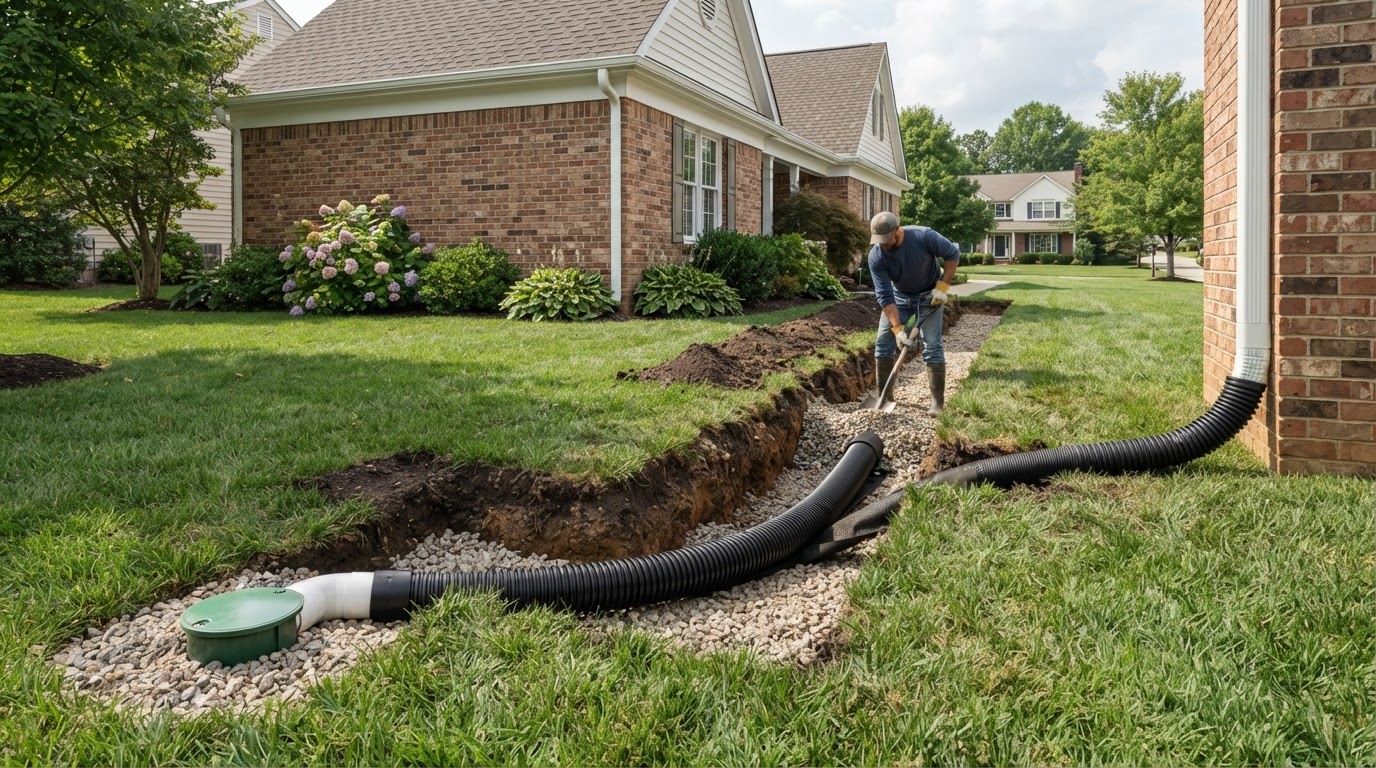
Concept visualization: Underground downspout drainage with buried pipe
Provenance: Concept visualizationScope, Applications, and Homeowner Goals
This service addresses roof runoff after it leaves the downspout. It includes evaluating existing downspout locations, where runoff currently goes, the proposed underground route, elevations along the path, utilities and roots, and the appropriate destination for the collected water. Access for inspection and cleaning, debris management, surface restoration, and overflow or blockage considerations are all part of the assessment.
This page is distinct from the broad yard drainage solutions page, which evaluates overall water problems and selects an approach. Underground downspout drainage is a specific conveyance method for roof runoff. A dry well, if site conditions support infiltration, may serve as a conditional destination — but only after the property is evaluated for suitability.
Not every property needs buried downspout lines. A suitable above-ground discharge arrangement may be simpler, more maintainable, and equally effective. The choice depends on the site, the destination options, and the maintenance the homeowner is prepared to manage.
Downspout locations
Evaluate where roof runoff currently discharges and whether underground routing is the right approach for each point.
Underground route
Plan the pipe path considering elevations, utilities, roots, and the destination for collected water.
Drainage destination
Determine where the water goes after conveyance — a destination is not optional.
Access and maintenance
Plan cleanout access and debris management so the system can be maintained.
Materials, Methods, and Design Choices
Underground routing is a conveyance decision, not a default. The comparison below helps clarify when a buried route fits the property and when a suitable above-ground discharge may serve just as well.
| Consideration | Above-ground discharge | Underground conveyance |
|---|---|---|
| Routing | Surface extension to a suitable discharge point | Buried pipe from downspout to a planned destination |
| Surface use | Visible across the surface | Frees surface area but requires excavation |
| Maintenance access | Visible and easy to inspect | Needs cleanout access for inspection and clearing |
| Site constraints | Limited by surface obstructions | Must avoid utilities, roots, and foundations |
| Destination | Must still reach a suitable point | Must still reach a suitable point |
Pipe and route
The underground path must account for elevations, utilities, roots, and the distance to a suitable destination.
Debris management
Downspout water carries leaves and grit; cleanout access and debris separation should be planned.
Surface restoration
Excavation through lawn or landscape requires restoration after installation.
Site Assessment and Project Planning
Before defining the work, several factors shape the approach: existing downspout discharge points, the available destinations, utility locations, elevations along the route, and the maintenance the homeowner is prepared to manage. Burying an extension does not by itself establish a functioning or appropriate drainage plan.
Current discharge points
Where roof runoff currently goes determines whether underground routing is needed at each downspout.
Destination evaluation
The destination matters as much as the pipe route — water cannot be discharged onto neighboring property or into an unavailable connection.
Utilities and roots
Underground excavation must avoid utility lines and significant tree roots; locations must be confirmed before digging.
Elevations
The route must maintain appropriate slope for conveyance to the destination.
Access for maintenance
Cleanout access should be incorporated so the system can be inspected and cleared.
Overflow and blockage
What happens if the system clogs or inflow exceeds capacity must be considered in the plan.
Germantown Context and Related Services
Properties across Germantown and Montgomery County, MD produce significant roof runoff during storms. Whether underground downspout drainage fits a given property depends on the available destination, the site constraints, and the maintenance plan — not on a universal preference for buried pipe.
Related completed pages: yard drainage solutions provides the broader assessment framework, and yard grading and leveling addresses surface elevations that interact with downspout discharge. A dry well may serve as a conditional destination when site conditions support infiltration.
Related Completed Services
Underground Downspout Drainage Installation Questions
Downspout drainage is a conveyance and destination decision. Call to talk through where your roof runoff goes and whether underground routing fits your property, or request an estimate to begin evaluating the right approach.
When might underground downspout drainage be useful?↓
Underground routing can be useful when roof runoff discharges across a surface where it causes problems — near a foundation, across a patio, or onto a walkway — and a suitable destination is available for the collected water. It is not needed at every downspout by default.
Why does the destination matter as much as the pipe route?↓
A buried pipe only conveys water; it does not make water disappear. The water must reach a suitable destination, whether that is a safe surface discharge point, an infiltration feature, or an approved connection. Burying an extension without a planned destination is not a functioning drainage plan.
What should be checked before excavation?↓
Utility locations must be confirmed before digging. The route must avoid significant tree roots and maintain appropriate slope for conveyance. Elevations along the path and the distance to the destination must support the plan.
How can maintenance access be incorporated?↓
Cleanout access points allow the system to be inspected and cleared without excavation. Debris separation at the downspout inlet and periodic inspection help prevent clogs from accumulating in the buried line.
Does this service replace a broader drainage assessment?↓
No. Underground downspout drainage addresses roof runoff conveyance specifically. A broader yard drainage assessment evaluates overall water movement, surface grades, and other contributing sources. The two are related but address different parts of a drainage plan.
Discuss Your Project
Call our team based in Germantown, MD to talk through scope, site considerations, and next steps — or request an estimate and we will follow up.