
Channel Drain & Catch Basin Installation Germantown
Channel drains and catch basins collect surface water at the points where it actually crosses or pools on a property. A linear channel drain captures sheet flow across a broad surface like a driveway or patio edge, while a catch basin collects water at a concentrated low point. Neither is a complete solution on its own — both need a planned connection to downstream conveyance and a suitable destination for the collected water. Germantown Hardscape & Pavers helps property owners in Germantown, MD evaluate where collection is needed and what the collected water should connect to.
The main decision is where water enters the system, what loading the grate and inlet must withstand, and where the water goes after it is collected. Understanding those three questions early determines whether a linear drain, a point inlet, or a combination fits the property.
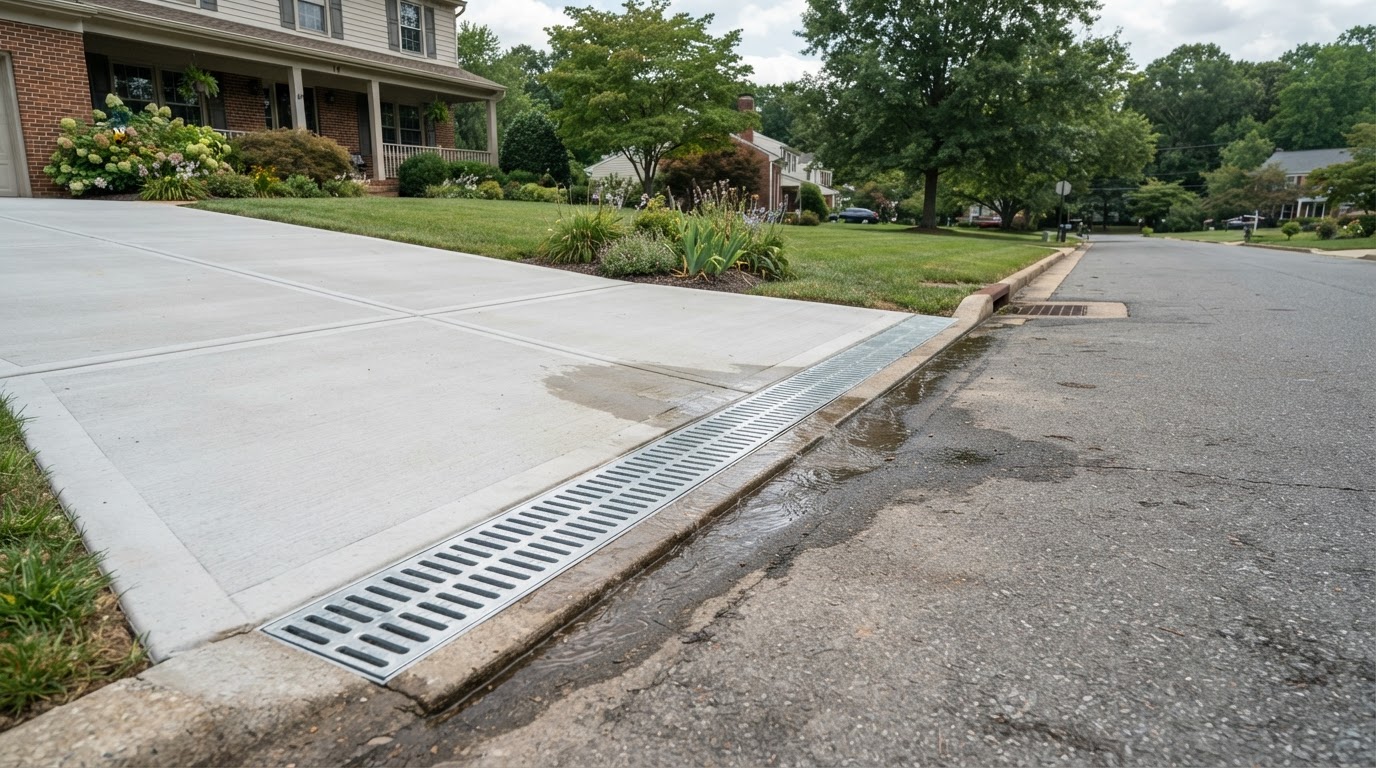
Concept visualization: Linear channel drain collecting surface flow at a driveway edge
Provenance: Concept visualizationScope, Applications, and Homeowner Goals
This service addresses surface water that crosses or collects on driveways, patios, walkways, lawn edges, and other outdoor surfaces. It includes evaluating where water enters the area, the existing surface elevations, where a drain should sit to collect efficiently, what loading the grate must handle, and how the collected water connects to a downstream component or destination. Sediment, debris, and maintenance access are part of the assessment.
This page is distinct from the broad yard drainage solutions page, which evaluates overall water problems and selects an approach. Channel drains and catch basins are specific collection tools within a broader plan. A French drain, by contrast, collects subsurface water through a buried aggregate and pipe assembly — a different collection role that may complement surface inlets rather than replace them.
Choosing between a linear channel drain and a point catch basin depends on how water arrives at the problem area. Sheet flow across a wide surface often suits a linear drain; concentrated flow at a low point may suit a catch basin. The right answer depends on the site, not on a universal preference for one product.
Linear channel drains
Capture sheet flow across a broad surface such as a driveway, patio edge, or walkway where water moves laterally.
Point catch basins
Collect water at a concentrated low point where flow naturally converges and pools.
Grate and product loading
Match the grate and inlet assembly to the expected pedestrian or vehicle loading at the location.
Downstream connection
Plan the conveyance from the inlet to a suitable drainage destination rather than treating the inlet alone as the solution.
Materials, Methods, and Design Choices
A surface drain is only as useful as its placement, its loading match, and its downstream connection. The comparison below helps clarify which collection type fits a given site — and why neither is a universal answer.
| Consideration | Linear channel drain | Point catch basin |
|---|---|---|
| How water arrives | Sheet flow across a broad surface | Concentrated flow at a low point |
| Placement | Across the flow path, often at a patio or driveway edge | At the lowest collection point where water converges |
| Loading match | Pedestrian or vehicle-rated grate selected for the surface | Grate rated for the expected traffic at the inlet location |
| Maintenance access | Regular cleaning of the channel and grate | Periodic basin cleaning to remove sediment and debris |
| What it cannot do alone | Does not establish a drainage destination | Does not eliminate downstream maintenance |
Grate selection
Grates are selected for the expected loading — a pedestrian patio grate is not the same as a driveway grate rated for vehicle traffic.
Sediment and debris
Surface inlets collect leaves, sediment, and debris. Maintenance access is part of the plan, not an afterthought.
Downstream conveyance
The collected water needs a pipe or channel connection to a suitable destination; the inlet alone does not solve the problem.
Site Assessment and Project Planning
Before defining the work, several factors shape the approach: existing surface elevations, the drainage destination, utility locations, and the integration with surrounding paving or landscape. A drain placed without considering where the water goes after collection is not a finished plan.
Surface elevations
Where water crosses or collects determines drain placement and whether a linear or point inlet fits the flow pattern.
Drainage destination
The destination for collected water must be evaluated first — the inlet is not the solution by itself.
Expected loading
Grate and assembly selection depends on whether the location sees pedestrian traffic, vehicle traffic, or both.
Downstream components
Connections to pipe, channel, or existing drainage must be compatible and appropriately sloped.
Maintenance access
Surface inlets collect sediment and debris; cleaning access must be planned from the start.
Paving integration
Where a drain sits in existing paving, the surrounding surface must be evaluated for compatible integration.
Germantown Context and Related Services
Properties across Germantown and Montgomery County, MD present a range of surface drainage situations — from driveway runoff to patio-edge pooling to lawn low spots. The right collection approach depends on the actual flow patterns at the property, not on a universal product preference.
Related completed pages: yard drainage solutions provides the broader assessment framework, and patio drainage correction addresses water collecting on or around an existing patio specifically. A French drain may complement surface inlets when subsurface collection is also needed.
Related Completed Services
Channel Drain & Catch Basin Installation Questions
Surface drainage is a collection, conveyance, and destination decision. Call to talk through where water is pooling and where it should go, or request an estimate to begin evaluating whether a channel drain, catch basin, or combination fits your property.
How does a channel drain differ from a catch basin?↓
A channel drain is a linear inlet that captures sheet flow across a broad surface like a driveway or patio edge. A catch basin is a point inlet that collects water at a concentrated low spot where flow converges. The right choice depends on how water arrives at the problem area.
What determines where a surface drain should be placed?↓
Drain placement depends on the existing surface elevations and where water naturally crosses or collects. A linear drain goes across a flow path; a catch basin goes at the lowest convergence point. The placement should match the actual flow pattern rather than a guess.
Does the drainage destination need to be evaluated first?↓
Yes. A surface inlet only collects water — it does not establish where the water goes after collection. The downstream conveyance and destination must be evaluated before the inlet is installed, or the collected water may simply create a new problem elsewhere.
Can drains be integrated into existing paving?↓
Often, yes, but the surrounding surface must be evaluated for compatible integration and the grate must be rated for the traffic at that location. A pedestrian patio grate is not the same as a driveway grate rated for vehicle loading.
What maintenance access should be planned?↓
Surface inlets collect sediment, leaves, and debris over time. Cleaning access should be planned from the start so the drain can be maintained without excavation. A catch basin may need periodic basin cleaning to remove accumulated sediment.
Discuss Your Project
Call our team based in Germantown, MD to talk through scope, site considerations, and next steps — or request an estimate and we will follow up.