
French Drain Installation Germantown
A French drain is a subsurface drainage system that collects water through a designed underground assembly — typically pipe, aggregate, and a separation material — and manages it through an appropriate outlet or other site-specific destination. It is one approach among several, suited to specific conditions rather than every drainage problem. Germantown Hardscape & Pavers helps property owners in Germantown, MD evaluate whether a French drain fits their site's elevations, soil, and water-management options before recommending installation.
The main decision is whether the site's conditions — elevations, soil, available outlet, and the nature of the water problem — support a subsurface collection system. A French drain does not work without a suitable place for water to go, and not every drainage problem is best addressed underground.
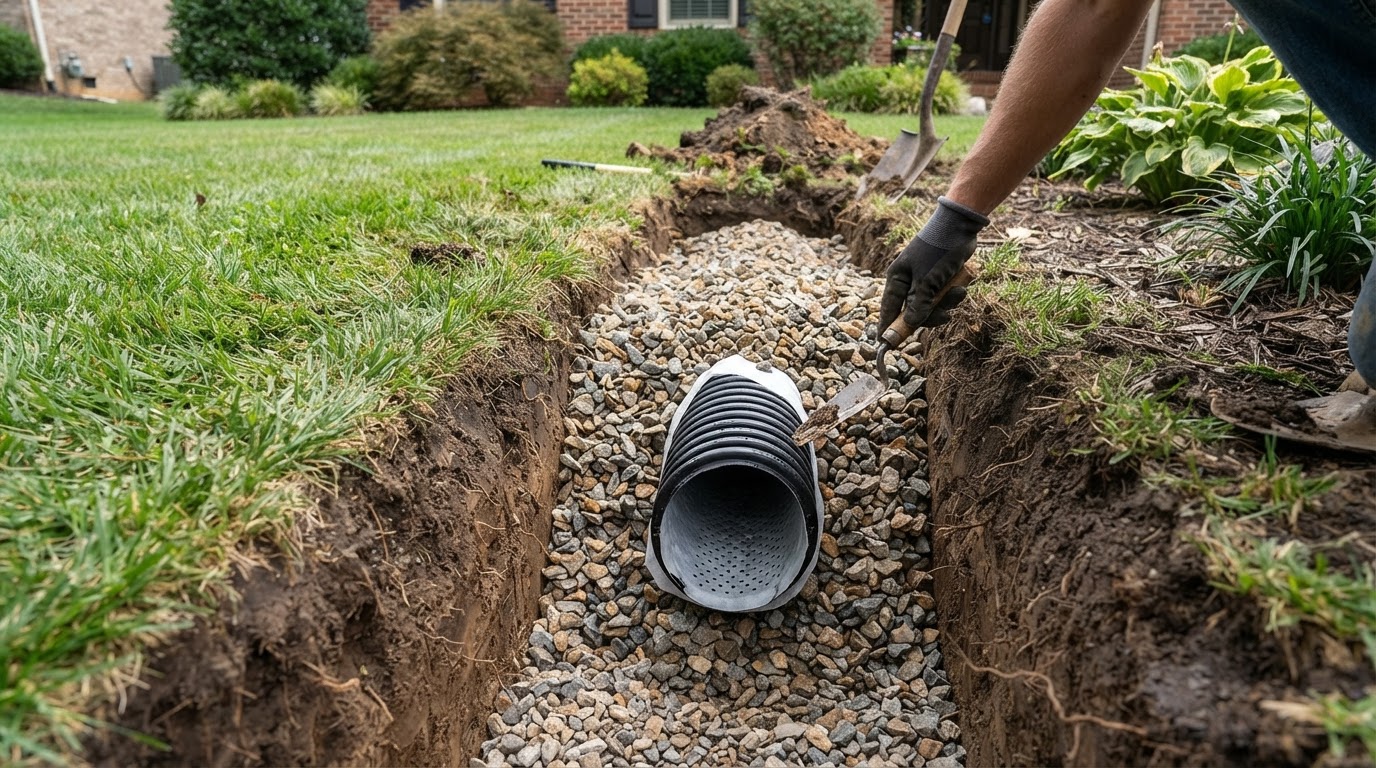
Concept visualization: Subsurface French drain with aggregate and perforated pipe
Provenance: Concept visualizationScope, Applications, and Homeowner Goals
This service evaluates and installs subsurface drainage systems where site conditions and an appropriate water-management destination support their use. It includes assessing the difference between subsurface water collection and capturing concentrated surface flow, the role of suitable pipe, aggregate, and separation materials, site elevations and potential outlet conditions, soil conditions, existing utilities, tree roots, access, surface restoration, and maintenance considerations.
This page is distinct from the yard drainage solutions page, which broadly evaluates drainage problems and selects from multiple approaches. A French drain is one of those approaches — a subsurface collection system suited to persistent saturation or groundwater where a suitable outlet exists. Not every drainage problem needs one, and the broader evaluation determines whether subsurface collection is the right path.
The scope also includes understanding the limitations of a French drain. Work near foundations or other structures may require additional qualified assessment. A French drain does not solve every drainage problem — surface flow may be better addressed by grading or surface collection, and infiltration may be unsuitable where soil or water-table conditions prevent it. The evaluation considers whether a subsurface system is appropriate or whether another approach fits better.
Subsurface water collection
A French drain collects water through a designed underground assembly of pipe, aggregate, and separation material — distinct from capturing concentrated surface flow at a point.
Suitable outlet required
A French drain needs a place for collected water to go — a storm sewer, daylight outlet, infiltration area, or other suitable destination. Without one, the system cannot function as intended.
Elevation-dependent
Subsurface drainage relies on gravity and elevations. The site must have the grade conditions to move water from the collection point to the outlet, or a suitable alternative must be available.
Soil and site conditions
Soil type, existing utilities, tree roots, and access for excavation are all evaluated before installation because these conditions determine whether a subsurface system is practical and how it is installed.
Maintenance and limitations
A French drain requires maintenance to remain functional and has limitations — it may not address surface flow, basement water intrusion, or problems requiring a different approach. These are part of the project discussion.
Materials, Methods, and Design Choices
The key distinction is between a subsurface French drain and a surface inlet or channel-drain approach. A French drain collects water underground through aggregate and pipe, suited to persistent saturation or groundwater where a suitable outlet exists. A surface inlet or channel drain captures concentrated flow at a point where water gathers on the surface — at a low spot, a patio edge, or a downspout discharge. The comparison below shows how these differ in what they collect, how they are placed, and what each requires.
Component explanations are educational, not a universal installation recipe. The specific pipe, aggregate size, separation material, trench depth, and slope depend on the site's elevations, soil, water volume, and outlet conditions — not a fixed specification that applies to every property. Work near foundations or other structures can require additional qualified assessment, and a French drain is not the same as foundation waterproofing. The right approach is determined by the site, not assumed from a single system type.
| Consideration | French drain (subsurface) | Surface inlet / channel drain |
|---|---|---|
| Water collected | Subsurface saturation and groundwater | Concentrated surface flow at a point |
| Placement | Underground trench with aggregate and pipe | Surface-level grate or channel at a low point |
| Outlet needed | Yes — gravity outlet or destination | Yes — pipe to suitable destination |
| Maintenance | Periodic inspection for clogging or sediment | Grate cleaning to prevent blockage |
| When another approach may fit | Surface flow, no suitable outlet, high water table | Subsurface saturation, broad area drainage |
Perforated pipe and aggregate
A subsurface assembly of perforated pipe in an aggregate trench, separated from surrounding soil by an appropriate material — the specific components depend on the site's soil, water volume, and outlet conditions, not a universal recipe.
Surface inlets and channel drains
Surface-level grates or channels that capture concentrated flow at key points — suited to surface pooling and low spots where water gathers, with a pipe connection to a suitable destination.
Combined approaches
Some drainage problems require both surface and subsurface components, or a combination of grading and collection. The evaluation determines what fits the specific conditions rather than assuming one system type.
Site Assessment and Project Planning
A French drain assessment evaluates the site elevations, soil conditions, existing utilities, tree roots, and the availability of a suitable outlet or water-management destination. The assessment distinguishes between subsurface saturation — where a French drain may help — and surface flow, which may be better addressed by grading or surface collection. The nature of the water problem, its source, and where water can go are all evaluated before recommending a subsurface system.
Work near foundations or other structures may require additional qualified assessment, and a French drain is not the same as foundation waterproofing. The assessment also considers maintenance access, surface restoration needs, and the limitations of a subsurface system — it may not address every drainage problem on the property. If the underlying problem requires a different approach, the assessment identifies that rather than installing a system that does not fit.
Water type and source
Is the concern subsurface saturation, groundwater, or surface flow? A French drain is suited to subsurface collection; surface flow may require a different approach. The source and type determine suitability.
Site elevations and outlet
Does the site have the grade conditions to move water from the collection point to a suitable outlet by gravity? Without an appropriate outlet or destination, a subsurface system cannot function.
Soil conditions
What is the soil type, and does it affect drainage performance? Clay soils may slow infiltration, sandy soils may not retain water, and the soil condition affects how the system is designed.
Utilities and tree roots
What underground utilities and tree roots are in the excavation path? Utilities must be located before digging, and tree roots may limit where a trench can be placed.
Foundation proximity
How close is the proposed drain to building foundations or other structures? Work near foundations may require additional qualified assessment and is not the same as foundation waterproofing.
Maintenance and restoration
What maintenance will the system need, and what surface restoration is required after installation? A French drain needs periodic inspection, and the lawn or landscape above the trench must be restored.
Germantown Context and Related Services
Properties in Germantown and across Montgomery County, MD vary in soil type, elevation, water table, and the availability of suitable drainage outlets. A French drain is evaluated for the specific property's conditions — not from a universal trench depth or pipe size assumed to work everywhere. The site's elevations, soil, and outlet options determine whether subsurface collection is practical.
French drain installation often connects to broader drainage work. Related completed pages describe the yard drainage solutions assessment that selects from multiple approaches and the yard grading that shapes surface flow alongside subsurface collection.
Related Completed Services
French Drain Installation Questions
A French drain is a subsurface drainage decision that depends on your site's elevations, soil, and outlet conditions. Call to talk through your yard's water problem and drainage goals, or request an estimate to begin evaluating whether a subsurface system fits your property.
What is a French drain intended to do?↓
A French drain collects subsurface water — saturation or groundwater — through a designed underground assembly of pipe, aggregate, and separation material, and conveys it to a suitable outlet or water-management destination. It is one drainage approach suited to specific conditions, not a universal solution for every water problem.
How does it differ from a surface drain?↓
A French drain collects water underground through aggregate and pipe, suited to subsurface saturation. A surface drain — a channel drain or grate — captures concentrated flow at a point where water gathers on the surface. They collect different types of water, are placed differently, and suit different conditions. Some properties need both.
Does a French drain need a suitable outlet or water-management destination?↓
Yes. A French drain relies on gravity to move water from the collection point to an outlet — a storm sewer, daylight discharge, infiltration area, or other suitable destination. Without an appropriate outlet, the system cannot function. The site's elevations and outlet availability are evaluated before recommending installation.
Can it be installed beneath an existing lawn?↓
Yes, a French drain can be installed beneath an existing lawn, but the installation requires excavation that disturbs the surface. The lawn above the trench is restored after installation. Existing utilities, tree roots, and access for equipment are evaluated before the work begins, and the surface restoration is part of the project.
What can make a French drain unsuitable for a particular problem?↓
A French drain may be unsuitable when the problem is surface flow rather than subsurface saturation, when no suitable outlet exists, when site elevations cannot move water by gravity to a destination, when soil or water-table conditions prevent effective collection, or when work near foundations requires additional qualified assessment. The evaluation determines suitability before installation.
What maintenance questions should be discussed?↓
How the system will be inspected for clogging or sediment buildup, whether access points are needed for cleaning, how the surface above the drain is maintained, and what signs indicate the system may need attention. A French drain is not install-and-forget — periodic inspection helps ensure it continues to function as intended.
Discuss Your Project
Call our team based in Germantown, MD to talk through scope, site considerations, and next steps — or request an estimate and we will follow up.