
Yard Grading & Leveling Germantown
Yard grading and leveling is about reshaping yard elevations to create an even, usable surface — not about making a property completely flat. A yard may need intentional slopes to manage water, and leveling corrects uneven areas, depressions, and surface irregularities while preserving the grades that keep water moving where it should. Germantown Hardscape & Pavers helps property owners in Germantown, MD evaluate when grading addresses the problem and when a different approach is needed.
The main decision is whether the concern is a localized uneven area or a broader grade issue that affects drainage, structures, or the usability of the yard. Understanding that distinction early determines whether limited surface smoothing is enough or whether broader regrading is the right path.
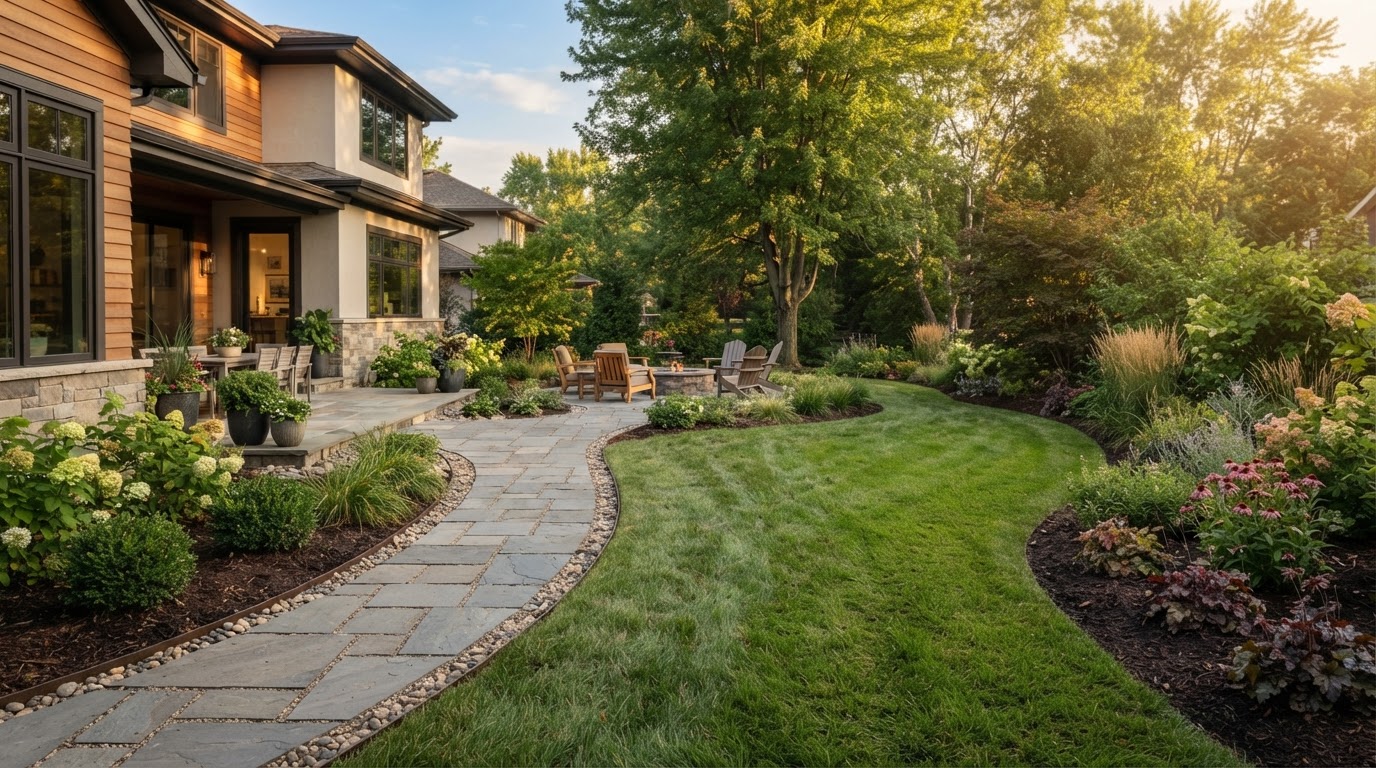
Concept visualization: Graded residential yard with smooth surface transitions and drainage grade
Provenance: Concept visualizationScope, Applications, and Homeowner Goals
This service addresses uneven lawn areas, depressions, surface irregularities, and grade changes associated with new landscape or hardscape work. It includes evaluating how water currently enters, crosses, and leaves the area, the existing grades around buildings and outdoor surfaces, and the connections to patios, walkways, driveways, and lawn. Soil condition, material suitability, access for equipment, existing trees and roots, utilities, and property boundaries are all part of the assessment.
This page is distinct from the yard drainage solutions page, which evaluates water problems and selects drainage approaches. Grading changes elevations and surface contours; drainage systems collect and convey water. The two are related and often combined, but they address different parts of a yard problem. It is also distinct from retaining wall installation, which addresses elevation changes that require structural holding.
Not every uneven area needs the same approach. A small lawn depression, a broad grade correction, and a slope stabilization project involve different scope, equipment, restoration, and assessment needs. The homeowner's goal — a smoother lawn surface, corrected drainage, or preparation for new sod or hardscape — defines the project.
Even, usable surfaces
Grading creates a smoother, more usable yard surface by addressing depressions, uneven areas, and irregular contours — but it does not mean eliminating all slope, which may be needed for drainage.
Water-managing grades
Final grades are evaluated in relation to buildings, adjacent properties, and existing drainage arrangements so that water continues to move where it should after grading.
Connections to existing features
Grades around patios, walkways, driveways, and lawn edges are evaluated so the corrected surface connects properly to existing outdoor features without creating new drainage or access problems.
Soil and material suitability
Soil condition and fill material suitability are assessed before grading because not every soil type or fill material is appropriate for every yard condition or intended use.
Restoration after earthwork
Surface stabilization and restoration — including sod, seed, or planting — are part of the project discussion because grading disturbs existing lawn and landscape surfaces.
Materials, Methods, and Design Choices
The key distinction is between localized lawn smoothing and broader yard regrading. Localized smoothing addresses a small depression or uneven area with limited earthwork and restoration — filling a low spot, correcting a settled area, or smoothing a surface before new sod. Broader regrading changes elevations across a larger area, may involve bringing in or removing significant fill, and interacts more directly with drainage, access, and existing features. The comparison below shows how these differ.
Final grades must be evaluated in relation to buildings, adjacent properties, existing drainage arrangements, and applicable requirements. A grade that moves water toward a foundation or onto a neighboring property creates a new problem. Fill material placed against siding or tree trunks can cause rot or girdling. The right approach depends on what the grade needs to accomplish, what the soil will support, and what the site allows — not a universal slope or depth that applies to every yard.
| Consideration | Localized lawn smoothing | Broader yard regrading |
|---|---|---|
| Problem addressed | Small depression or uneven area | Widespread grade or drainage-related issue |
| Elevation change | Limited — surface correction | Significant — reshaped contours |
| Drainage interaction | Minimal — existing grades preserved | Central — water movement re-planned |
| Site access | Lighter equipment possible | May require heavier equipment and access |
| Restoration needs | Sod or seed on corrected area | Broader lawn and landscape restoration |
Imported fill soil
Suitable fill material selected for the yard's soil condition and intended use — not every soil type is appropriate, and fill placed against buildings or trees requires careful evaluation.
On-site soil regrading
Existing soil recontoured to correct elevations without importing material, suitable when the existing soil is appropriate and the grade change is achievable with available material.
Surface stabilization
Sod, seed, or planting established after grading to stabilize the corrected surface and prevent erosion — the restoration approach depends on slope, season, and site conditions.
Site Assessment and Project Planning
A grading assessment looks at the existing grades, how water moves across the property, the soil condition, and the relationship to buildings, patios, walkways, and neighboring properties. Uneven areas are evaluated for their cause — settlement, erosion, poor original grading, or tree root activity — because the cause affects whether grading alone is sufficient or whether drainage or structural work is also needed.
Access for equipment, existing trees and root zones, underground utilities, and property boundaries are checked because grading work may be limited by these constraints. Fill material is evaluated for suitability, and final grades are planned in relation to structures and drainage so the corrected surface does not create new problems. Not every grade issue can be resolved with leveling alone — some require drainage, retaining, or a combination of approaches.
Existing grades and water movement
How does water currently enter, cross, and leave the area, and will the corrected grades maintain or improve that movement? Final grades are evaluated in relation to buildings and drainage.
Soil condition and fill suitability
What is the soil type, and is imported fill or on-site regrading appropriate for the yard's conditions? Not every soil or fill material suits every site or intended use.
Relationship to buildings and structures
How close is the grading area to foundations, siding, patios, and walkways? Fill placed against siding or foundations can cause moisture problems and must be evaluated.
Trees, roots, and utilities
What existing trees, root zones, and underground utilities are in the work area? Grading around trees must protect root zones, and utilities must be located before earthwork.
Property boundaries and adjacent drainage
How does the grade relate to property lines and neighboring drainage patterns? Water must not be redirected onto adjacent properties, and boundary conditions must be respected.
Restoration and stabilization
What surface stabilization — sod, seed, or planting — will the corrected area need, and is the season suitable for establishment? Grading disturbs existing surfaces and requires restoration.
Germantown Context and Related Services
Properties in Germantown and across Montgomery County, MD vary in soil type, slope, existing drainage, and the relationship between yard grades and building foundations. Yard grading is evaluated for the specific property's conditions — not from a universal slope or depth assumed to suit every yard. Clay soils, sloped lots, and properties with existing drainage patterns each present different grading considerations.
Grading often connects to other outdoor work. Related completed pages describe the sod installation that restores a graded surface, the coordinated hardscape design that may accompany broader regrading, and the retaining wall installation that addresses elevation changes requiring structural holding.
Related Completed Services
Yard Grading & Leveling Questions
Yard grading is an elevation and drainage decision, not just moving soil. Call to talk through your yard conditions and grading goals, or request an estimate to begin evaluating whether localized smoothing or broader regrading fits your property.
Does yard leveling mean making the yard completely flat?↓
No. Leveling corrects uneven areas, depressions, and surface irregularities to create a more usable surface, but a yard may need intentional slopes to manage water. Eliminating all slope can create drainage problems by allowing water to pool or move toward buildings. Final grades are evaluated in relation to drainage, buildings, and adjacent properties.
How does grading differ from installing a drain?↓
Grading changes the surface elevations and contours of the yard to manage how water flows across it. A drainage system collects and conveys water through a designed assembly such as a French drain or surface inlet. The two are related and often combined, but they address different parts of a yard problem — grading shapes the surface, drainage manages the water.
Can grading be planned before new sod or a patio?↓
Yes. Grading is often the first step before installing sod, seeding, or building a patio or walkway because the corrected surface needs to be properly shaped and drained before the new installation. Planning the grade first helps ensure the new surface connects properly to existing features and manages water as intended.
What should be checked near buildings, trees, and utilities?↓
The relationship of the grade to foundations and siding — fill placed against siding can cause rot. Existing tree root zones that must be protected during earthwork. Underground utility locations that must be confirmed before excavation. And property boundaries to ensure water is not redirected onto neighboring properties.
Can small lawn depressions and major grade changes need different approaches?↓
Yes. A small lawn depression may need limited fill and surface smoothing with lighter equipment and minimal restoration. A major grade change may involve significant earthwork, heavier equipment, drainage re-evaluation, and broader lawn and landscape restoration. The scope, access, assessment, and cost differ substantially between the two.
What information helps define a grading estimate?↓
Photos showing the uneven areas and their relationship to buildings and existing features, approximate dimensions of the area, observations about where water goes during rainfall, known utility locations, and the homeowner's goal — smoother lawn, corrected drainage, or preparation for new sod or hardscape. This information helps determine whether localized smoothing or broader regrading is the right approach.
Discuss Your Project
Call our team based in Germantown, MD to talk through scope, site considerations, and next steps — or request an estimate and we will follow up.