
Yard Drainage Solutions Germantown
Yard drainage solutions begin with evaluating where water is observed, whether the concern is surface flow, persistent saturation, or both, and what conditions contribute to the problem. A visible puddle is a symptom, not a complete diagnosis — the same puddle may come from poor grading, a blocked drain, roof runoff, or a high water table. Germantown Hardscape & Pavers helps property owners in Germantown, MD assess yard water problems and select an appropriate combination of drainage approaches rather than defaulting to one solution for every property.
The main decision is which combination of approaches — grading adjustments, surface collection, subsurface drainage, or infiltration — fits the specific conditions and where the collected water should go. Not every wet area needs a French drain, and not every drainage problem has the same solution.
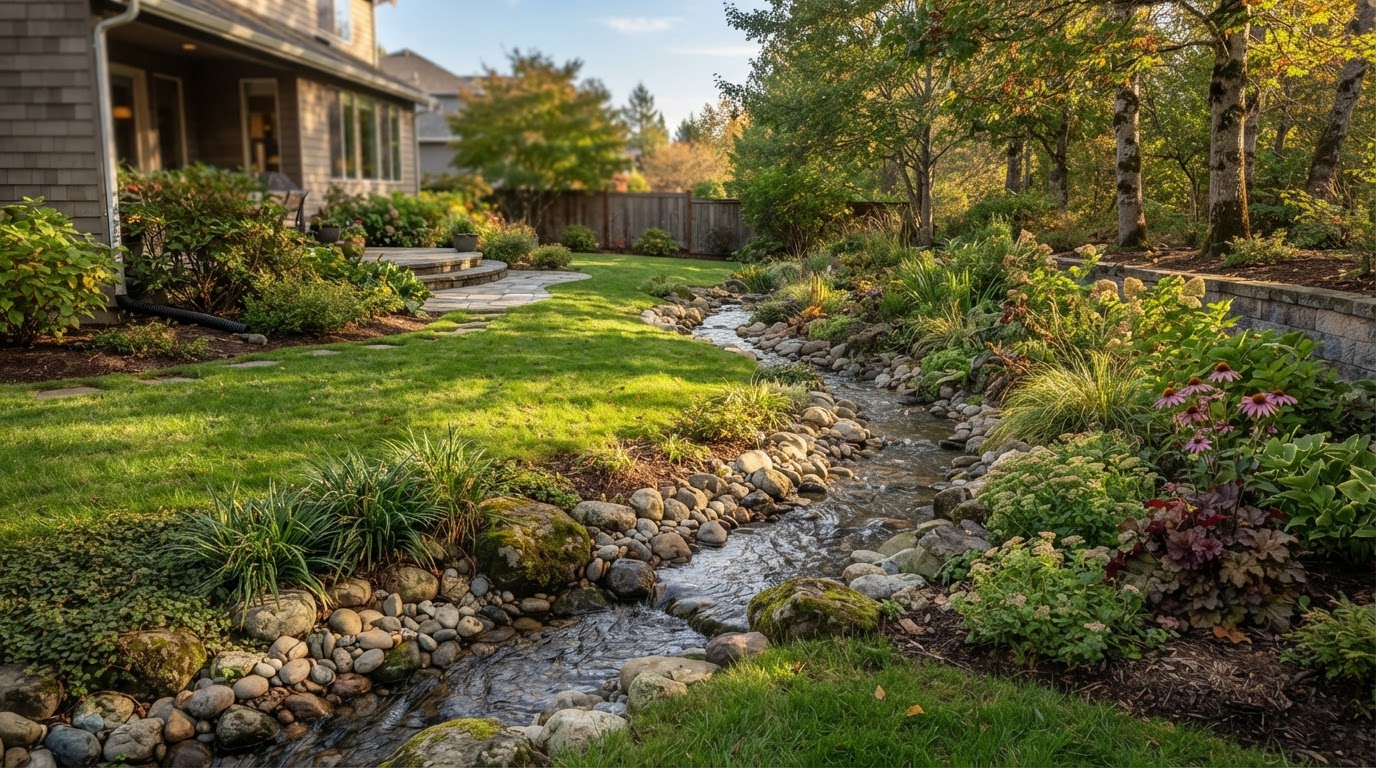
Concept visualization: Yard drainage swale integrated into lawn and landscape
Provenance: Concept visualizationScope, Applications, and Homeowner Goals
This service evaluates yard water problems and selects from available drainage approaches. It includes observing where water accumulates, whether the concern is surface flow or persistent saturation, conditions during and after rainfall, roof runoff and other contributing sources, existing grades, low areas, surface obstacles, and the condition of any existing drains. The assessment considers how a proposed solution interacts with buildings and neighboring properties, and what access and restoration the work requires.
This page is the broad drainage-assessment and solution-selection page. It is distinct from the French drain installation page, which addresses a specific subsurface collection system. Not every drainage problem needs a French drain — some require grading, surface inlets, infiltration, or a combination. The evaluation determines which approach fits the specific conditions rather than assuming one system suits every yard.
Future specialty pages will cover patio drainage correction, retaining-wall drainage repair, channel drains and catch basins, underground downspout drainage, dry wells, dry creek beds, and rain gardens. These are specific applications that may be part of a broader drainage plan. Mention them as relevant options without assuming any single approach is right for every property.
Symptom-to-cause evaluation
A visible puddle is a symptom, not a diagnosis. The assessment evaluates what causes the water — grading, runoff, saturation, blocked drains — before selecting a solution.
Multiple approaches considered
Grading adjustments, surface collection, subsurface drainage, and infiltration are each evaluated for the specific conditions rather than defaulting to one system for every yard.
Water destination matters
Where collected water goes — storm sewer, infiltration, surface discharge — must be evaluated because not every destination is available, suitable, or permitted at every property.
Building and neighbor relationships
A proposed solution is evaluated for how it interacts with building foundations and neighboring properties — water must not be redirected toward a foundation or onto adjacent land.
Access and restoration
Drainage work may require excavation, equipment access, and surface restoration. These needs are part of the project scope and affect how the work is approached.
Materials, Methods, and Design Choices
Different drainage approaches address different conditions. Grading and surface-flow adjustments reshape the yard to move water across the surface. Surface collection features — channel drains, catch basins, swales — capture concentrated flow at key points. Subsurface collection systems — French drains — gather water through a designed underground assembly. Infiltration approaches — dry wells, rain gardens, permeable paving — allow water to soak into the ground where soil and water-table conditions support it. The decision guide below compares these broad roles.
Each approach has conditions it may address, things that must be evaluated, and reasons it may not suit every property. A French drain needs a suitable outlet or water-management destination. Infiltration requires soil that absorbs water safely and a water table that allows it. Surface collection works where water concentrates but needs maintenance to stay clear. Grading alone may not solve saturation from a high water table. The right solution — or combination — depends on the specific property and the specific problem, not a one-size-fits-all recommendation.
| Approach | Conditions it may address | What must be evaluated | Why it may not suit every property |
|---|---|---|---|
| Grading adjustments | Surface flow and pooling | Slope, drainage paths, structures | May not resolve subsurface saturation |
| Surface collection | Concentrated runoff at key points | Capture points, outlet, maintenance | Requires maintenance to stay clear |
| Subsurface drainage | Persistent saturation, groundwater | Elevations, outlet, soil, utilities | Needs suitable outlet and elevation |
| Infiltration | Roof runoff, moderate volumes | Soil infiltration, water table, setbacks | Unsuitable where soil or water table prevents it |
Surface drainage
Grading, swales, channel drains, and catch basins that manage water flowing across the yard's surface — suited to concentrated runoff and surface pooling but requiring maintenance to stay clear.
Subsurface drainage
French drains and underground collection systems that gather water through a designed assembly — suited to persistent saturation but requiring a suitable outlet and elevation for water to go.
Infiltration approaches
Dry wells, rain gardens, and permeable surfaces that allow water to soak into the ground — suited where soil and water-table conditions support infiltration but unsuitable where they do not.
Site Assessment and Project Planning
A drainage assessment starts with observation — where water is seen, when it appears, how long it persists, and what happens during and after rainfall. Whether the concern is surface flow, persistent saturation, or both determines which approaches may help. Roof runoff, existing grades, low areas, surface obstacles, and the condition of existing drains are all evaluated because each may contribute to the observed problem.
The destination of collected water is a critical evaluation point. Not every property can discharge to a storm sewer, and not every site can infiltrate safely. Work near foundations or other structures may require additional qualified assessment. The assessment also considers access for equipment, restoration needs, and whether the problem extends beyond ordinary landscape drainage — such as basement water intrusion, which cannot be diagnosed from yard observations alone.
Water source and type
Is the concern surface flow, persistent saturation, or both? Where is water observed, when does it appear, and how long does it persist? The source and type determine which approaches may help.
Contributing sources
What contributes to the water — roof runoff, slope, grading, a blocked drain, or a high water table? Multiple sources may combine to create the observed problem.
Water destination
Where can collected water go — storm sewer, infiltration, surface discharge? Not every destination is available or suitable, and discharge rights and permits must be verified.
Building and neighbor relationships
How does the proposed solution interact with building foundations and neighboring properties? Water must not be redirected toward a foundation or onto adjacent land.
Existing drainage condition
Are existing drains present, and are they functioning or blocked? A clogged drain may be the actual problem, and cleaning or repair may address it without new installation.
Access and restoration
What equipment access and surface restoration does the work require? Drainage installation may involve excavation, and the restored surface — lawn, planting, or hardscape — is part of the project.
Germantown Context and Related Services
Properties in Germantown and across Montgomery County, MD vary in soil type, slope, water table, and the relationship between yard drainage and building foundations. Drainage solutions are evaluated for the specific property's conditions — not from a one-size-fits-all recommendation. Clay soils, sloped lots, and properties with existing stormwater connections each present different drainage considerations.
Drainage often connects to other outdoor work. Related completed pages describe the yard grading that shapes surface flow, the permeable paver systems that manage stormwater at the surface, and the patio installation that may need drainage addressed before paving.
Related Completed Services
Yard Drainage Solutions Questions
Yard drainage is an assessment and solution-selection decision, not a single product. Call to talk through your yard's water conditions and drainage goals, or request an estimate to begin evaluating which combination of approaches fits your property.
How do you determine which drainage approach may fit a yard?↓
By observing where water appears, when it persists, what contributes to it — roof runoff, grading, a blocked drain, or saturation — and where collected water can go. The assessment considers whether the concern is surface flow, persistent saturation, or both, and evaluates grading, surface collection, subsurface drainage, and infiltration approaches for the specific conditions rather than defaulting to one solution.
Does every wet area need a French drain?↓
No. A French drain is one subsurface drainage approach suited to persistent saturation where a suitable outlet or water-management destination exists. Some wet areas are better addressed by grading, surface collection, or infiltration. The right approach depends on the cause, the water source, the soil, and where the water can go — not a universal recommendation.
Can grading and drainage work be combined?↓
Yes. Grading shapes the surface to manage how water flows, and drainage systems collect and convey water. They are often combined because correcting surface grades and installing drainage work together to address both the cause and the movement of water. The combination depends on what the property needs.
Why does the destination of collected water matter?↓
Collected water must go somewhere appropriate — a storm sewer, an infiltration area, or a surface discharge point. Not every property can connect to a storm sewer, and not every site can infiltrate safely. Discharging water onto a neighboring property or toward a foundation creates a new problem. The destination is a critical part of the drainage plan.
What observations or photos help with an initial discussion?↓
Photos of the wet area during and after rainfall, observations about how long water persists, the location of existing downspouts and drains, and notes about what happens during heavy storms. Approximate dimensions and any known utility locations also help. This information supports a more informed initial discussion before a site assessment.
Should drainage be addressed before installing new hardscape or sod?↓
Yes — drainage is often addressed before installing a patio, walkway, or sod because the new surface may be affected by the same water problem. Installing hardscape or lawn over an unresolved drainage issue can lead to settling, surface damage, or ongoing saturation. Addressing drainage first helps protect the new installation.
Discuss Your Project
Call our team based in Germantown, MD to talk through scope, site considerations, and next steps — or request an estimate and we will follow up.