
Flagstone Patio Repair & Repointing Germantown
Flagstone surfaces fail in two places: the mortar joints between the stones and the bedding layer beneath them. Cracked, crumbling, or missing mortar lets water into the joints; loose or hollow stones signal that the bedding beneath has eroded or the stone was never fully supported. Germantown Hardscape & Pavers repairs and repoints flagstone patios in Germantown, MD by raking out the failed mortar, resetting loose stones on a sound bedding layer, and repointing the joints with mortar matched to the existing joint profile.
The main decision is whether the flagstone is wet-laid on a concrete base or dry-laid on a screeded sand and gravel bed. The two constructions fail differently and repair differently — a wet-laid surface with a cracked mortar joint needs a mortar repair, while a dry-laid surface with a hollow stone needs the bedding rebuilt.
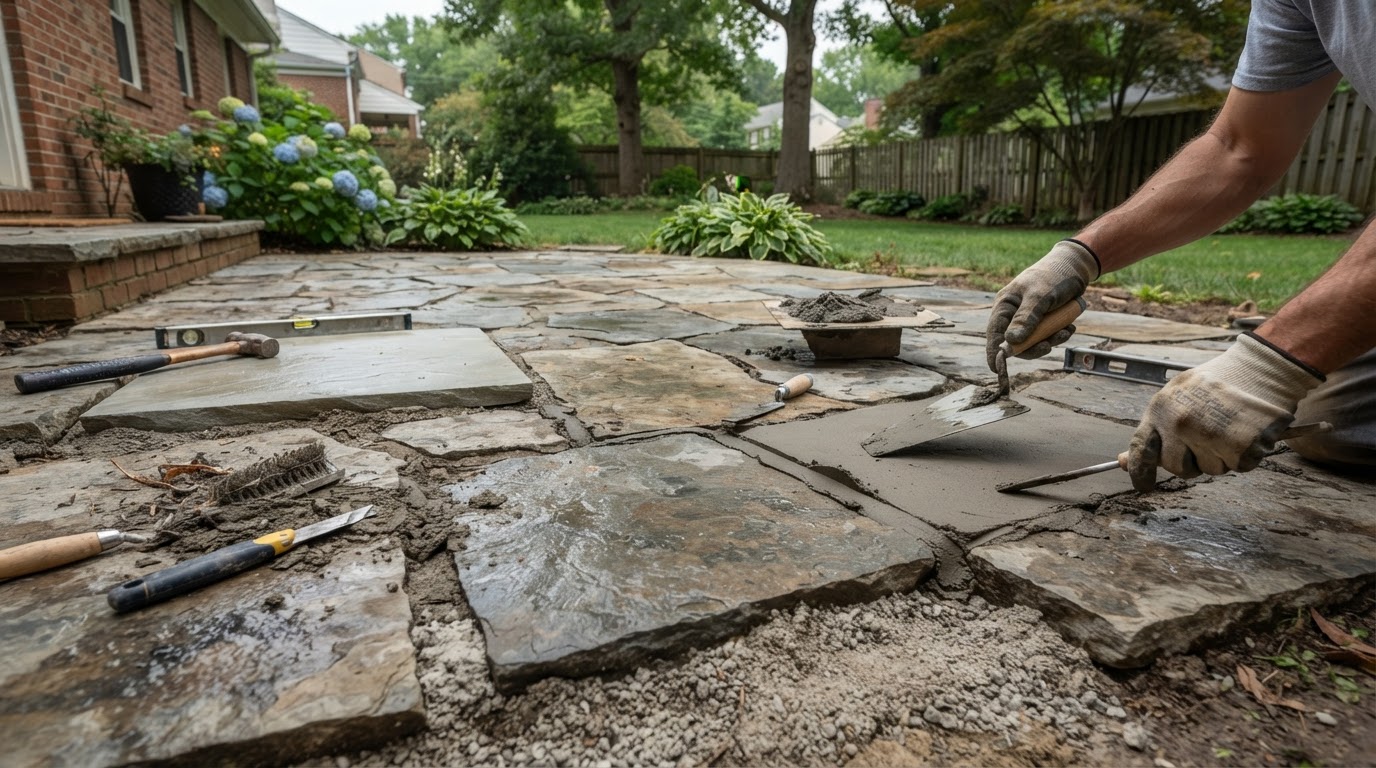
Concept visualization: Flagstone patio repair and repointing
Provenance: Concept visualizationScope, Applications, and Homeowner Goals
This service addresses natural flagstone surfaces — patios, walkways, and stoops — where mortar joints have cracked or eroded, stones have loosened or gone hollow, or the bedding beneath has degraded. It includes raking out failed mortar, resetting loose stones on rebuilt bedding, and repointing joints so the surface drains and stays put.
This page is distinct from flagstone patio installation, which builds a new stone surface from scratch, and from paver-based repairs, which address manufactured concrete pavers rather than natural stone. Flagstone repair is a masonry repair, and wet-laid versus dry-laid construction determines which repair applies. Where the underlying concrete base itself is cracked or settled, that base repair precedes the surface repointing.
Choosing between a joint-only repoint and a stone reset depends on whether the stones are still firmly bedded or have gone hollow. Repointing mortar over loose, hollow stones locks movement into the surface; the stones must be reset first.
Mortar joint repointing
Cracked, crumbling, or missing mortar is raked out and repointed with mortar matched to the existing joint width and color so the joints shed water.
Loose stone resetting
Hollow or loose flagstones are lifted, the bedding beneath is rebuilt, and the stones are reset flush and fully supported.
Wet-laid versus dry-laid diagnosis
The construction type — mortar on concrete versus screeded sand and gravel — determines which bedding and joint repair applies to the surface.
Base crack assessment
Where mortar failure traces to a cracked or settled concrete base beneath, the base issue is identified so the repointing holds rather than re-cracking.
Materials, Methods, and Design Choices
The comparison below distinguishes the flagstone constructions and why repointing a dry-laid surface as if it were wet-laid — or vice versa — does not hold.
| Consideration | Wet-laid flagstone (mortar on concrete) | Dry-laid flagstone (sand/gravel bed) |
|---|---|---|
| What fails | Mortar joints crack; base cracks telegraph | Bedding erodes; stones go hollow |
| Repair method | Repoint joints; address base cracks | Rebuild bedding; reset stones |
| Joint material | Mortar repointing | Joint sand or mortar, construction-dependent |
| Flexibility | Rigid; cracks under base movement | Flexible; tolerates minor movement |
| What it cannot do | Does not fix base settlement | Does not create a sealed mortar joint |
Matched mortar repointing
Repointing mortar is selected to match the existing joint width, color, and compressive strength so the repaired joints read as continuous rather than patched.
Rebuilt stone bedding
Loose or hollow stones are reset on a rebuilt bedding layer — mortar for wet-laid surfaces, screeded sand and gravel for dry-laid — so each stone is fully supported.
Construction-matched repair
Wet-laid and dry-laid flagstone fail and repair differently. The repair matches the construction type rather than applying the wrong method to the wrong surface.
Site Assessment and Project Planning
Before defining the repair, several factors shape the approach: whether the surface is wet-laid or dry-laid, whether the stones are loose or firmly bedded, whether mortar joints or the bedding is the primary failure, and whether the concrete base beneath a wet-laid surface is cracked. Repointing mortar over loose, hollow stones locks the movement into the surface rather than fixing it.
Construction type
Wet-laid flagstone on concrete versus dry-laid on sand and gravel determines which bedding and joint repair applies to the surface.
Stone stability
Loose, hollow, or firmly bedded stones determine whether a joint-only repoint is sufficient or the stones must be reset first.
Mortar joint condition
The extent of cracked, crumbling, or missing mortar determines how much of the joint system needs raking and repointing.
Base integrity
A cracked or settled concrete base beneath a wet-laid surface telegraphs through the mortar; the base is assessed before repointing.
Drainage on the surface
Standing water and low spots accelerate mortar and bedding failure, so the surface pitch and drainage are evaluated.
Stone reuse and matching
Cracked or broken stones are noted for replacement with matching flagstone so the repaired surface reads as continuous.
Germantown Context and Related Services
In Germantown and across Montgomery County, MD, flagstone surfaces most often fail at the mortar joints after freeze-thaw cycles drive water into cracks, or go hollow where the bedding has eroded from poor drainage. The construction type — wet-laid or dry-laid — determines which repair holds, and applying the wrong method to the wrong surface is the most common reason a repoint re-cracks within a season.
Related completed pages: flagstone patio installation covers the new-build standard this repair restores, natural stone walkway installation addresses stone path surfaces, and outdoor steps and stoops installation covers the stair and stoop surfaces this repair complements.
Flagstone Patio Repair & Repointing Questions
Cracked mortar and hollow stones are flagstone construction and drainage problems. Call to describe which joints are cracking and which stones sound hollow, or request an estimate to evaluate whether a repoint, a reset, or both fits your patio.
Can you just fill the cracked mortar joints without lifting the stones?↓
Only if the stones are still firmly bedded. If a stone has gone hollow or loose, repointing the mortar over it locks the movement into the surface and the repair fails again. Hollow stones are reset on rebuilt bedding before the joints are repointed.
What's the difference between wet-laid and dry-laid flagstone repair?↓
Wet-laid flagstone is set in mortar on a concrete base, so the repair repoints mortar joints and addresses base cracks. Dry-laid flagstone rests on screeded sand and gravel, so the repair rebuilds the bedding and resets loose stones. The two constructions fail and repair differently.
Why do my mortar joints keep cracking every winter?↓
Water enters hairline cracks, freezes, and expands, widening the joint each freeze-thaw cycle. It can also telegraph from a cracked concrete base beneath. The cause — drainage, base movement, or aged mortar — is identified so the repoint holds rather than re-cracking.
Will the new mortar match the existing joints?↓
Repointing mortar is selected to match the existing joint width, color, and strength so the repaired joints read as continuous. A mismatched, high-strength mortar in a soft joint is itself a cause of re-cracking, so the match is part of the repair.
Can a hollow flagstone be fixed without replacing it?↓
Often, yes. The stone is lifted, the eroded bedding is rebuilt, and the stone is reset flush and fully supported. Replacement is reserved for stones that are cracked or broken rather than simply unsupported.
Discuss Your Project
Call our team based in Germantown, MD to talk through scope, site considerations, and next steps — or request an estimate and we will follow up.