
Outdoor Stone Step Repair Germantown
Outdoor stone steps fail at the tread and at the footing. A loose or settled tread rocks underfoot and becomes a trip hazard; a step whose footing has shifted throws the riser heights out of uniform so the stairs no longer read as a single, safe flight. Germantown Hardscape & Pavers repairs outdoor stone steps in Germantown, MD by lifting the loose treads, re-establishing the footing or base beneath them, and resetting each step to a consistent riser so the flight is stable and code-aligned.
The main decision is whether the failure is a single loose tread on an otherwise sound flight or a systemic footing problem that has thrown the entire staircase out of alignment. A single tread reset is a targeted repair; a flight with uneven risers throughout needs the footing sequence restored.
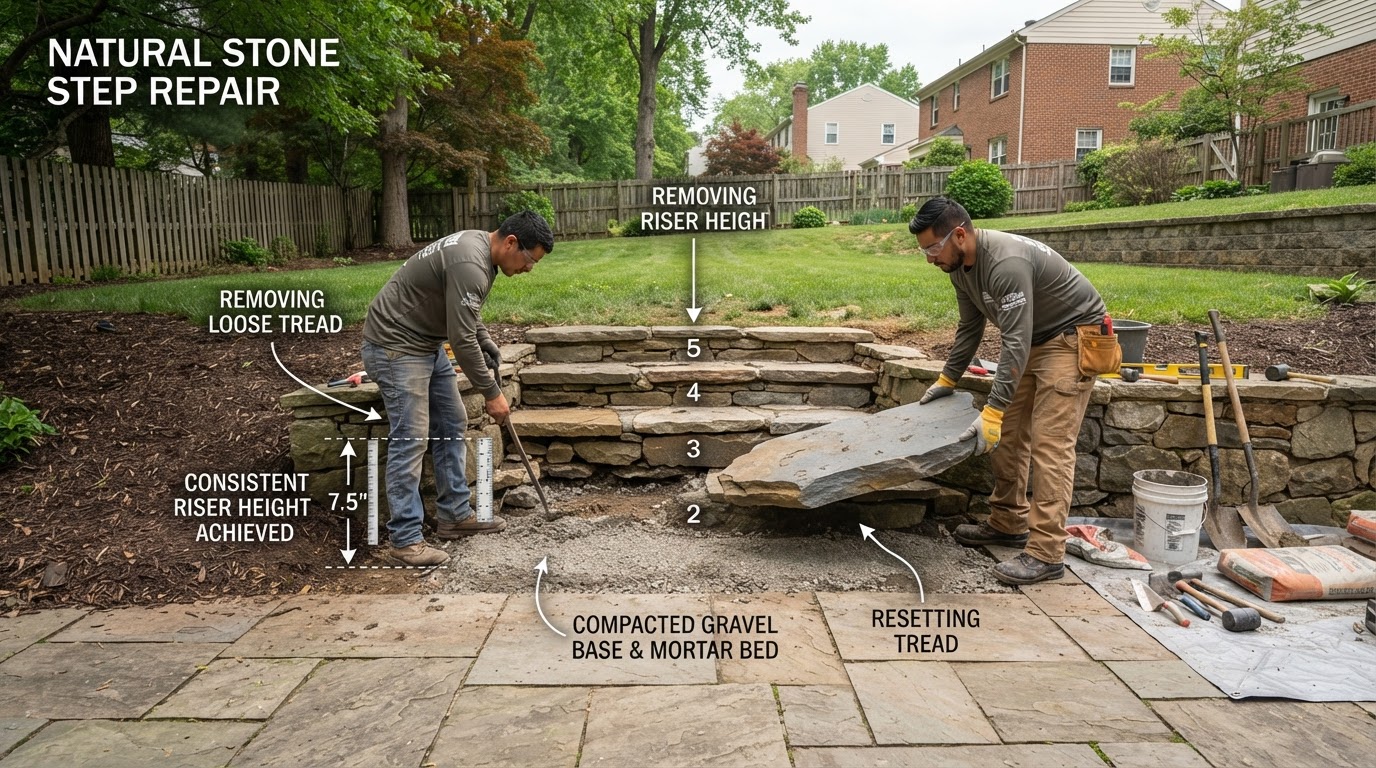
Concept visualization: Outdoor stone step repair and resetting
Provenance: Concept visualizationScope, Applications, and Homeowner Goals
This service addresses outdoor stone and paver steps — patio stairs, stoop entries, garden steps, and walkway transitions — where treads have loosened, settled, or shifted, riser heights have become uneven, or the footing beneath has degraded. It includes lifting the affected treads, rebuilding the base or footing, and resetting the steps to a consistent riser and stable bearing.
This page is distinct from outdoor steps and stoops installation, which builds a new staircase from scratch, and from flagstone patio repair, which addresses flat stone surfaces rather than the vertical step geometry. Step repair is a stair-specific reset that restores safe tread and riser geometry. Where a step's settling traces to a retaining wall or slope failure beneath it, that structural cause is addressed as part of the repair.
Choosing between a single tread reset and a full flight footing restoration depends on how many steps have moved and whether the risers are still uniform. Resetting one loose tread on a shifted flight leaves the staircase uneven; the footing is what the repair actually addresses.
Loose tread resetting
A rocking or lifted tread is lifted, the bearing beneath is rebuilt, and the stone is reset flush and stable underfoot.
Riser height restoration
Steps whose risers have become uneven are reset to a consistent height so the flight reads as one uniform, safe staircase.
Footing and base repair
A degraded or shifted footing beneath the steps is rebuilt so the reset treads bear on a stable base rather than re-settling.
Mortar joint repointing
Cracked or eroded mortar between step stones is raked and repointed so the joints shed water and hold the treads in place.
Materials, Methods, and Design Choices
The comparison below distinguishes a single-tread repair from a full footing restoration — and why resetting a loose tread without addressing the footing re-settles.
| Consideration | Single tread reset | Full footing restoration | Mortar repoint only |
|---|---|---|---|
| What it fixes | One loose or rocking tread | The base beneath the flight | Joints only, not the bearing |
| Riser alignment | Restores one step | Restores the whole flight | Does not address risers |
| When it fits | Isolated loose tread | Uneven risers throughout | Treads firm, joints cracked |
| Durability | Lasts if footing is sound | Lasts — base is rebuilt | Temporary if base has moved |
| What it cannot do | Does not fix neighboring steps | Higher scope and cost | Does not reset the treads |
Rebuilt step footing
A stable crushed-stone or concrete footing beneath the steps is what keeps the reset treads from re-settling. A loose tread reset over a failed footing rocks again within a season.
Consistent riser geometry
Each step is reset to a uniform riser height so the flight reads as one safe staircase. Uneven risers are what make an otherwise sound set of steps a trip hazard.
Matched mortar repointing
Mortar between step stones is raked and repointed to match the existing joints so water sheds and the treads are held laterally as well as bearing vertically.
Site Assessment and Project Planning
Before defining the repair, several factors shape the approach: how many treads have loosened, whether the risers are still uniform, the condition of the footing beneath the flight, and whether a retaining wall or slope is driving the movement. Resetting a loose tread on a flight whose footing has shifted leaves the staircase uneven.
Tread stability
Which treads rock, lift, or settle determines whether a single reset or a full footing restoration fits the flight.
Riser uniformity
The riser heights are measured across the flight; uneven risers point to a systemic footing problem rather than one loose tread.
Footing condition
The base or concrete footing beneath the steps is evaluated for degradation or shifting that would cause reset treads to re-settle.
Structural cause
Where step movement traces to a retaining wall, slope, or drainage failure beneath, that structural cause is identified so the step repair is not undone.
Mortar joint state
Cracked or eroded mortar between step stones is noted for repointing so the joints hold the treads and shed water.
Code and safety
Riser height, tread depth, and handrail needs are checked against the geometry a safe, code-aligned flight requires.
Germantown Context and Related Services
Across Germantown and Montgomery County, MD, outdoor steps most often fail where freeze-thaw has loosened the mortar and the footing beneath has settled from poor drainage. A single loose tread on a sound flight is a targeted reset, but uneven risers across the flight point to a footing problem — and resetting the treads without rebuilding the base is the most common reason the steps re-settle within a year.
Related completed pages: outdoor steps and stoops installation covers the new-build standard this repair restores, retaining wall repair addresses the wall failures that often shift the steps above them, and flagstone patio repair handles the flat stone surfaces this step repair complements.
Outdoor Stone Step Repair Questions
Loose treads and uneven risers are footing and bearing problems. Call to describe which steps rock and whether the risers are still even, or request an estimate to evaluate whether a tread reset or a footing restoration fits your flight.
Why is my stone step rocking when I stand on it?↓
The tread has loosened from its bearing — usually because the mortar or bedding beneath it has eroded, or the footing underneath has settled. The repair lifts the tread, rebuilds the bearing, and resets it flush and stable so it no longer rocks.
Why are my step heights uneven across the flight?↓
The footing beneath the steps has settled unevenly, throwing the riser heights out of uniform. Resetting the treads without rebuilding the base leaves the flight uneven. A full footing restoration restores a consistent riser across the staircase.
Can you just repoint the mortar without lifting the steps?↓
Only if the treads are still firmly bedded. If a tread rocks or the footing has shifted, repointing mortar over it locks the movement in. Loose treads are reset and the footing rebuilt before the joints are repointed.
What if a retaining wall under the steps is also moving?↓
Then the step movement is a symptom of the wall or slope failure beneath it, and that structural cause has to be addressed alongside the step reset. Repairing the steps without fixing what is moving them underneath is undone within a season.
Do uneven risers really matter if the steps look fine?↓
Yes. Uneven riser heights are what make an otherwise sound flight a trip hazard — the foot expects a consistent step and misjudges the next one. Restoring uniform risers is as much a safety repair as resetting a loose tread.
Discuss Your Project
Call our team based in Germantown, MD to talk through scope, site considerations, and next steps — or request an estimate and we will follow up.