
Sunken Paver Repair & Releveling Germantown
Uneven, sagging, or settled pavers are almost always a base problem, not a paver problem. When the crushed-stone base beneath a patio, walkway, or driveway settles, compacts unevenly, or washes out at the edges, the pavers above follow it down. Germantown Hardscape & Pavers relevels settled pavers in Germantown, MD by lifting the affected section, rebuilding the base that failed, and re-laying the existing pavers flush rather than masking the dip with a surface patch.
The main decision is whether the settling is isolated to a small section or part of a broader base failure. A single dip repaired early stops a small problem from becoming a full patio rebuild; a widespread settlement pattern points to a drainage or base-cause issue that should be diagnosed before the surface is reset.
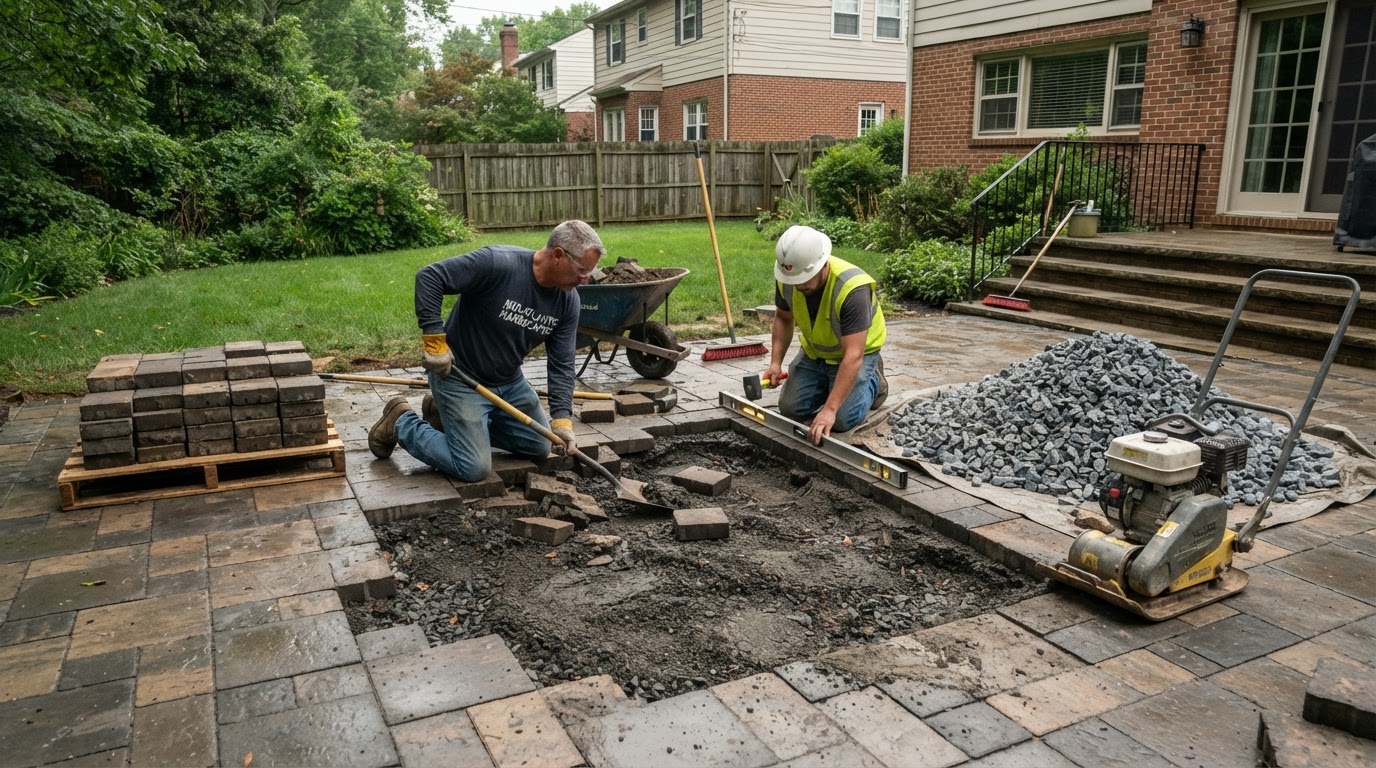
Concept visualization: Sunken paver repair and releveling with rebuilt base
Provenance: Concept visualizationScope, Applications, and Homeowner Goals
This service addresses settled, sunken, or uneven paver surfaces — patios, walkways, driveways, and steps — where the pavers themselves are reusable but the base beneath them has moved. It includes lifting the affected pavers, evaluating the base and subgrade, re-compacting or replacing the failed base material, and re-laying the existing pavers to a flush, stable finish.
This page is distinct from new paver patio installation, which builds a surface from scratch, and from polymeric sand replacement, which addresses joint stability without lifting the pavers. Sunken paver repair addresses the structural base that determines whether the surface stays level. When settling coincides with edge spreading, paver edge restraint repair may be needed alongside releveling.
Choosing between a targeted relevel of one dip and a broader section rebuild depends on how widely the base has failed. Re-laying the same pavers over the same failed base only recreates the same dip; the base cause is what the repair actually addresses.
Isolated dip releveling
Lift a single settled section, rebuild the compacted base beneath it, and re-lay the existing pavers flush with the surrounding surface.
Edge settlement correction
Address pavers that have dropped at the patio or walkway edge where the base was insufficiently compacted or has migrated outward.
Base cause diagnosis
Evaluate whether settling stems from inadequate compaction, base washout, poor drainage, or subgrade movement before re-laying the surface.
Paver salvage and re-lay
Reusable existing pavers are lifted, cleaned, and re-laid on the rebuilt base rather than discarded and replaced.
Materials, Methods, and Design Choices
The comparison below distinguishes the three approaches to an uneven paver surface — and why simply adding sand or resetting pavers without addressing the base does not hold up.
| Consideration | Targeted relevel | Section rebuild | Surface patch (not recommended) |
|---|---|---|---|
| What it addresses | The base beneath one dip | The base across a wider failed area | Only the visible surface |
| Pavers reused | Existing pavers re-laid | Existing pavers re-laid | Left in place, not lifted |
| Durability | Lasts when base cause is fixed | Lasts when base cause is fixed | Temporary; dip returns |
| When it fits | One settled section, sound neighbors | Widespread settlement | Never a real repair |
| What it cannot do | Does not fix neighboring base | Does not change the layout | Does not address the base cause |
Crushed-stone base
Re-compacted angular crushed stone rebuilds the load-bearing layer that failed. The same material specification used in new installation is used in a proper relevel.
Bedding sand layer
A fresh, level bedding layer is screeded over the rebuilt base before pavers are re-laid, so the finished surface is flush rather than shimmed.
Edge restraint
Where settling coincided with edge spreading, a repaired or new edge restraint keeps the re-laid perimeter from migrating outward again.
Site Assessment and Project Planning
Before defining the relevel, several factors shape the approach: the extent of the settling, whether the existing pavers are reusable, the condition of the base and subgrade, and whether drainage or an edge restraint contributed to the failure. Re-laying pavers over an undiagnosed base cause recreates the same dip within a season.
Extent of settlement
An isolated dip versus a widespread pattern determines whether a targeted relevel or a section rebuild fits the actual base condition.
Base cause
Inadequate compaction, base washout, poor drainage, or subgrade movement each require a different corrective step before the surface is reset.
Paver condition
Existing pavers are evaluated for reuse; cracked or broken units are noted for replacement so the re-laid surface is complete.
Drainage contribution
Where runoff or a low point fed the base failure, the drainage issue is identified so the relevel holds rather than settling again.
Edge restraint
A failing or absent edge restraint lets the base migrate outward; it is checked and repaired as part of a lasting relevel.
Access and staging
Pavers are lifted and staged in order so the existing pattern and color are preserved when the surface is re-laid.
Germantown Context and Related Services
Across Germantown and Montgomery County, MD, paver settling is most often a base-and-drainage problem rather than a material defect. Spring rains and winter freeze-thaw cycles expose any base that was under-compacted or poorly drained, and the surface above it drops. Releveling the pavers without diagnosing the base cause is the most common reason a repaired dip returns the following year.
Related completed pages: paver patio installation covers the full new-build process this repair draws on, paver walkway installation addresses settled walkway surfaces, and paver edge restraint repair handles the perimeter spreading that often accompanies settlement.
Related Completed Services
Sunken Paver Repair & Releveling Questions
Uneven pavers are usually a base problem, not a paver problem. Call to describe the dip, how long it has been settling, and any drainage near the area, or request an estimate to evaluate whether a targeted relevel or a section rebuild fits your property.
Why did my pavers sink if the pavers themselves are fine?↓
Settling is almost always a base problem. If the crushed-stone base beneath the pavers was under-compacted, washed out by drainage, or displaced at the edge, the surface above it drops. The pavers are reusable; the base that failed is what a proper relevel rebuilds.
Can you just add sand to level the dip without lifting the pavers?↓
Adding sand or rescreeding over a dip without lifting the pavers is a surface patch, not a repair. It hides the dip temporarily but does not address the failed base, so the settling returns. A real relevel lifts the pavers, rebuilds the base, and re-lays them flush.
Will my existing pavers be reused?↓
In most cases yes. Existing pavers are lifted, staged in order, and re-laid on the rebuilt base so the original pattern and color are preserved. Cracked or broken units are noted for replacement so the finished surface is complete.
How do you know whether one dip needs a relevel or a wider rebuild?↓
The extent of the settling tells us. An isolated dip with sound neighboring pavers usually suits a targeted relevel. A widespread settlement pattern points to a broader base failure that should be diagnosed and rebuilt across the affected area rather than spot-repaired.
What keeps the relevel from settling again?↓
Diagnosing and fixing the base cause is what makes a relevel last. If drainage fed the base failure or an edge restraint let the base migrate outward, those issues are corrected as part of the same repair rather than re-laying pavers over the same conditions.
Discuss Your Project
Call our team based in Germantown, MD to talk through scope, site considerations, and next steps — or request an estimate and we will follow up.