
Polymeric Sand Replacement Germantown
The sand in paver joints does three jobs at once: it locks the pavers in place, supports the edge against lateral movement, and resists weed growth and insect activity. When that joint sand washes out, freezes loose, or simply degrades over years of weather, the surface stays structurally sound but the joints open up — and weeds, moss, and settling follow. Germantown Hardscape & Pavers replaces eroded joint sand in Germantown, MD by cleaning out the old material, reinstalling high-grade polymeric sand, and activating it properly so the joints lock without haze.
The main decision is whether the joints simply need fresh sand or whether the underlying base or edge restraint contributed to the erosion. Joint sand that keeps washing out of the same edge or the same low spot is a symptom of a drainage or restraint problem, not just a sand problem.
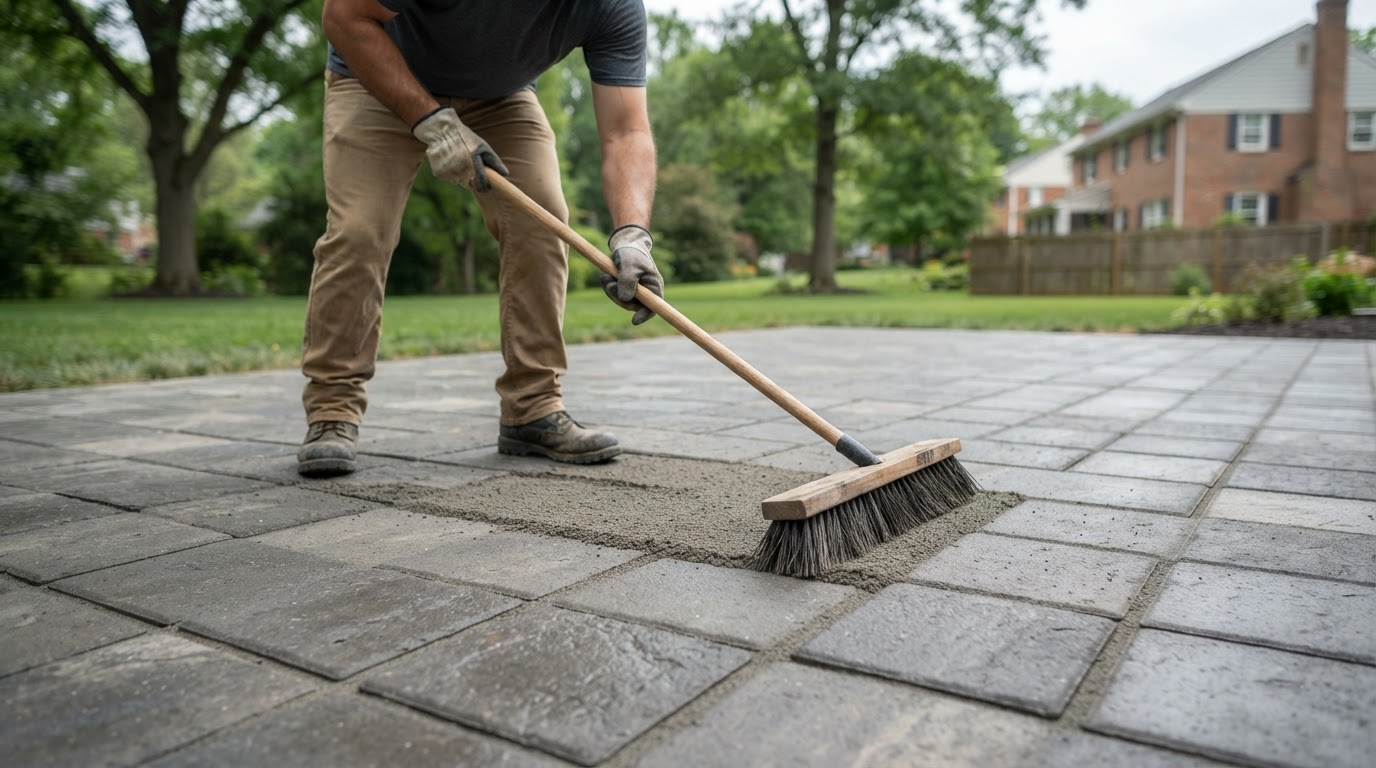
Concept visualization: Polymeric sand replacement locking paver joints
Provenance: Concept visualizationScope, Applications, and Homeowner Goals
This service addresses paver joints that have lost their sand — through washout, freeze-thaw loosening, weed root displacement, or age — on otherwise stable patios, walkways, driveways, and pool decks. It includes cleaning out the old, degraded joint material, re-installing polymeric joint sand, activating it, and removing any residue haze from the paver surface.
This page is distinct from sunken paver repair, which lifts pavers to rebuild a failed base, and from paver cleaning and sealing, which addresses the paver surface and protective sealer rather than the joint sand. Polymeric sand replacement is a joint maintenance step that can complement both. Where joint sand loss is driven by edge spreading, paver edge restraint repair may be needed alongside the sand replacement.
Choosing between a standard joint sand refresher and a full polymeric replacement depends on how much of the old material is degraded and whether the pavers can be cleaned of the residue. Polymeric sand is not a one-size choice: high-traffic or vehicle-loaded joints need a different product than a pedestrian patio.
Joint cleaning and removal
Loose, degraded, and weed-root-displaced joint material is cleaned out to expose clean joint walls before new sand is installed.
Polymeric sand installation
High-grade polymeric joint sand is swept into the joints and compacted in so the joints fill fully and the pavers interlock.
Activation and haze removal
The polymeric binder is activated with the correct water volume, and surface residue is removed before it sets so no haze remains.
Edge-joint cause check
Where sand keeps escaping the same edge or low spot, the drainage or edge restraint contributing to the loss is identified rather than ignored.
Materials, Methods, and Design Choices
The comparison below clarifies what polymeric sand replacement does and does not fix — and why a joint refill without addressing an ongoing cause does not hold.
| Consideration | Polymeric replacement | Plain sand refill | Joint sealing only |
|---|---|---|---|
| What it locks | Paver interlock via activated binder | Fills the joint only | Seals the surface, not the joint |
| Weed resistance | High — binder blocks germination | Low — weeds re-establish quickly | Moderate and temporary |
| Washout resistance | Holds unless an edge cause persists | Low — rinses out again | Helps but does not fill the joint |
| When it fits | Stable base, eroded joints | Temporary fill, same-season only | After sand is already replaced |
| What it cannot do | Does not fix a failed base or edge | Does not lock the pavers | Does not replace lost sand |
Polymeric joint sand
A joint sand with an activated polymer binder that hardens in the joint to lock paver interlock while staying flexible enough to resist freeze-thaw cracking.
Traffic-matched product
Pedestrian patio joints and vehicle-loaded driveway joints need different sand products; the grade is matched to the loading the surface actually sees.
Surface prep and haze control
Pavers are cleaned and dried before installation, and residue is removed before activation so the finished surface is free of the white haze that rushed installations leave behind.
Site Assessment and Project Planning
Before defining the replacement, several factors shape the approach: how much joint material is degraded, whether the paver surface can be cleaned of residue, the loading the joints see, and whether an edge or drainage cause is driving the loss. Refilling joints that keep losing sand to the same edge recreates the same empty joints within a season.
Joint degradation extent
The proportion of joints that have lost their sand determines whether a full polymeric replacement or a targeted refill fits the surface.
Paver surface condition
Pavers are evaluated for cleaning and residue removal so the polymeric sand activates without leaving a surface haze.
Loading and product
Pedestrian versus vehicle loading determines which polymeric product is specified for the joints that will hold up.
Recurring loss cause
Where the same edge or low spot keeps losing sand, the drainage or edge restraint driving the loss is identified so the replacement holds.
Weed and moss state
Established weed roots and moss are removed so the new sand fills clean joints rather than sitting on top of organic material.
Sealer compatibility
If the pavers are sealed, the polymeric sand and activation are planned to be compatible with the existing or forthcoming sealer.
Germantown Context and Related Services
In Germantown and across Montgomery County, MD, paver joints lose sand fastest where freeze-thaw, spring downpours, and poor drainage converge. A joint that empties every winter is usually telling you something about the drainage or edge restraint near it, not just that the sand is old. Replacing the sand without reading that signal is the most common reason the same joints re-open the following year.
Related completed pages: paver cleaning and sealing addresses the paver surface and protective sealer this service complements, paver edge restraint repair handles the perimeter spreading that pushes sand out, and sunken paver repair lifts pavers when the base — not just the joints — has failed.
Polymeric Sand Replacement Questions
Open paver joints invite weeds, washout, and settling. Call to describe which joints keep losing sand and any drainage near the area, or request an estimate to evaluate whether a polymeric sand replacement fits your surface.
What does polymeric sand actually do that plain joint sand doesn't?↓
Polymeric sand contains an activated binder that hardens in the joint, locking the pavers' interlock, resisting washout, and blocking weed germination. Plain sand fills the joint but rinses out, settles, and lets weeds re-establish within a season.
Why do my joints keep losing sand in the same spot?↓
Recurrent loss in the same edge or low spot is usually a symptom — of a drainage path washing the joint, or an edge restraint that is letting the base and sand migrate outward. The cause should be identified so the replacement holds rather than emptying again.
Will the polymeric sand leave a white haze on my pavers?↓
Haze comes from residue left on the surface before activation. Proper surface prep — cleaning and drying the pavers, sweeping the sand in, and removing residue before wetting — prevents it. A rushed installation is what leaves the haze.
Can polymeric sand be used on a paver driveway?↓
Yes, but the product must be matched to vehicle loading. Driveway joints and pedestrian patio joints are not the same specification; using a pedestrian-grade sand under vehicle traffic leads to premature breakdown.
Should polymeric sand replacement be done with sealing?↓
They complement each other well. Replacing the joint sand first, then sealing the paver surface, protects both the interlock and the paver. The sealer and the sand activation are planned to be compatible so neither is compromised.
Discuss Your Project
Call our team based in Germantown, MD to talk through scope, site considerations, and next steps — or request an estimate and we will follow up.