
Paver Edge Restraint Repair Germantown
The edge restraint is what keeps a paver field from spreading outward over time. When the spikes that hold a plastic or metal edge fail, the concrete curb breaks, or the restraint was never adequate for the loading, the outer pavers migrate into the lawn — taking the joint sand and base material with them. Germantown Hardscape & Pavers repairs failing edge restraints in Germantown, MD by exposing the perimeter, correcting the base it rests on, and reinstalling a restraint rated for the traffic the edge actually sees.
The main decision is whether the restraint failed because the spikes corroded or heaved, the restraint was under-rated for the surface, or the base beneath the restraint settled. Each cause points to a different repair; re-spiking the same failing restraint only recreates the same spread.
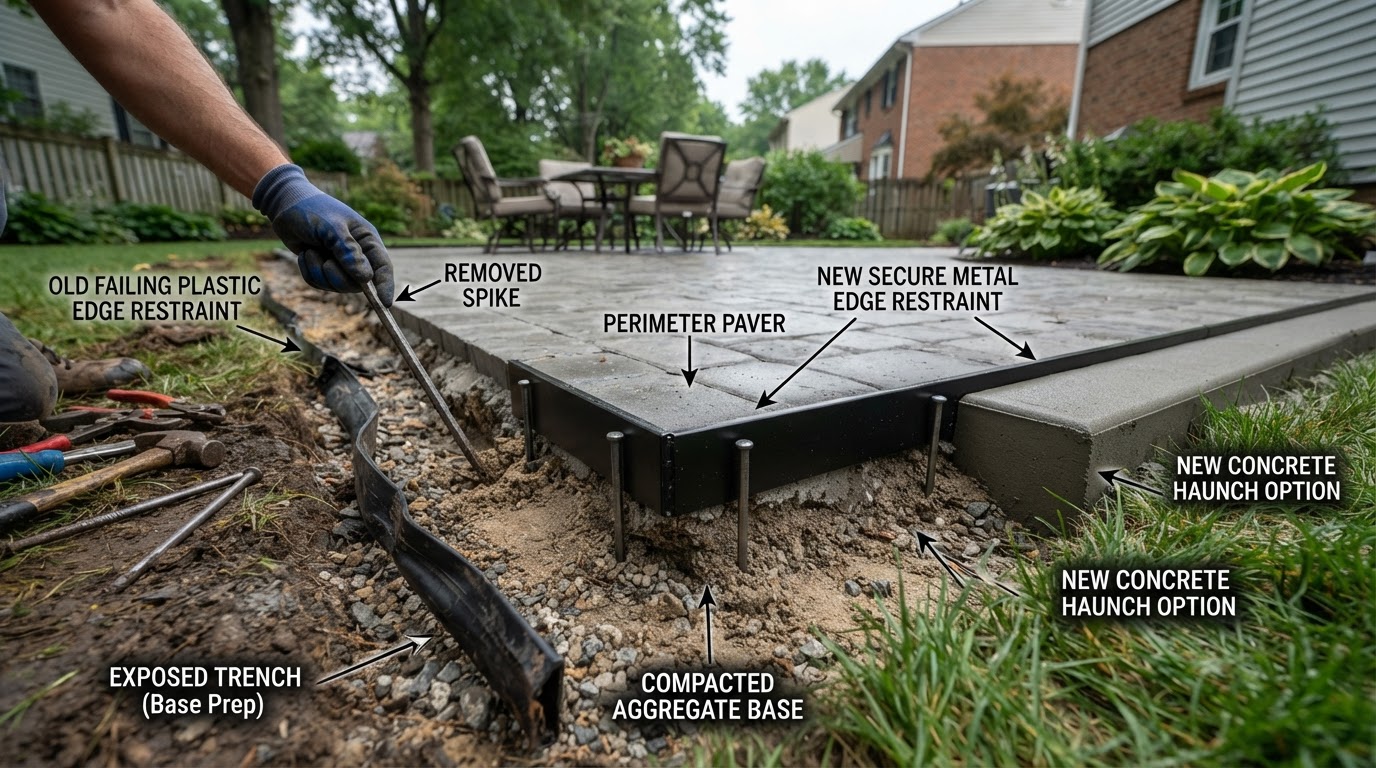
Concept visualization: Paver edge restraint repair stabilizing the patio perimeter
Provenance: Concept visualizationScope, Applications, and Homeowner Goals
This service addresses paver perimeters — patio, walkway, driveway, and pool deck edges — where the edge restraint has failed, loosened, or was never sufficient. It includes exposing the edge, evaluating the base the restraint rests on, replacing the failed restraint with one rated for the loading, and re-establishing the joint sand the spread has displaced.
This page is distinct from sunken paver repair, which addresses base settlement beneath the field, and from polymeric sand replacement, which stabilizes joints without addressing the perimeter. Edge restraint repair is the perimeter fix that lets the other two hold. Where the entire field has spread and settled, a section rebuild may be needed alongside the restraint repair.
Choosing between a like-for-like restraint replacement and an upgraded restraint depends on what failed and the loading the edge sees. A pedestrian patio edge and a driveway edge are not the same specification; the repair matches the restraint to the surface that loads it.
Failing restraint replacement
Loose, corroded, or heaved edge restraints are removed and replaced with a restraint rated for the pedestrian or vehicle loading the edge sees.
Edge base correction
The base the restraint rests on is re-compacted or rebuilt where it settled, so the new restraint is supported rather than bridging a void.
Perimeter paver reset
Migrated outer pavers are pulled back into position, re-laid flush, and locked against the repaired restraint.
Joint sand restoration
Joint sand lost to edge spreading is swept back in or replaced so the re-settled perimeter interlocks rather than remaining loose.
Materials, Methods, and Design Choices
The comparison below distinguishes the common edge restraint options and why the wrong restraint for the loading is what lets a perimeter spread again.
| Consideration | Upgraded metal/plastic restraint | Concrete curb | Re-spiking only (not recommended) |
|---|---|---|---|
| Holds against | Pedestrian or vehicle loading | Vehicle and high-traffic loading | Only what already failed |
| Base dependence | Rests on a re-compacted base | Cast on a stable base | Rests on the same settled base |
| Durability | Lasts when base is corrected | Highest perimeter strength | Temporary; spread resumes |
| When it fits | Most patio and walkway edges | Driveways and loaded edges | Never a real repair |
| What it cannot do | Does not fix field settlement | Higher cost for light edges | Does not address the base or loading |
Restraint matched to loading
A pedestrian-rated plastic or metal restraint suits a patio; a driveway edge needs a heavier restraint or concrete curb. The repair matches the restraint to what the edge actually carries.
Re-compacted edge base
The restraint rests on the same compacted crushed-stone base as the field. A restraint installed over a settled base bridges a void and fails again, so the base is corrected first.
Restored joint sand
Spreading displaces the joint sand at the perimeter. After the pavers are reset, the joints are refilled so the edge interlocks rather than sitting loose against the new restraint.
Site Assessment and Project Planning
Before defining the repair, several factors shape the approach: what failed on the existing restraint, the loading the edge sees, the condition of the base the restraint rests on, and how far the field has spread. Re-spiking a restraint over a settled base recreates the same spread the following season.
Failure cause
Corroded or heaved spikes, an under-rated restraint, or a settled base each point to a different repair before the perimeter is restabilized.
Edge loading
Pedestrian versus vehicle loading determines which restraint specification the repaired edge needs to hold up.
Edge base condition
The base the restraint rests on is evaluated and re-compacted or rebuilt so the new restraint is supported rather than bridging a void.
Spread extent
How far the outer pavers have migrated determines whether a perimeter reset is enough or the field needs a broader section rebuild.
Drainage at the edge
Runoff directed at the edge accelerates both base and restraint failure, so the drainage path near the perimeter is identified.
Lawn interface
The transition from paver edge to lawn is restored so the restraint is buried correctly and the mowing line is clean.
Germantown Context and Related Services
Across Germantown and Montgomery County, MD, paver edges fail most often where a pedestrian restraint was used under vehicle loading, where the base at the edge was under-compacted, or where runoff is directed at the perimeter. Each of these is a diagnosis, not a coincidence — and re-spiking the same restraint under the same conditions is the most common reason an edge spreads again within a year.
Related completed pages: sunken paver repair addresses the base settlement that often accompanies edge spreading, polymeric sand replacement restores the joint sand the spread displaces, and paver driveway installation covers the full perimeter and base standard this repair restores.
Paver Edge Restraint Repair Questions
A spreading paver edge is a restraint and base problem. Call to describe where the outer pavers are separating and any drainage near the edge, or request an estimate to evaluate which restraint repair fits your perimeter.
Why are my outer pavers separating from the lawn?↓
The edge restraint that holds the perimeter has failed or was under-rated for the loading. When the restraint loosens — through corroded spikes, a settled base, or an inadequate product — the outer pavers migrate outward and take the joint sand with them. Replacing the restraint and correcting the base is the repair.
Can you just re-spike the existing restraint?↓
Re-spiking the same restraint over the same settled base or with the same under-rated product only recreates the spread. The repair matches the restraint to the loading and corrects the base the restraint rests on so the perimeter holds.
Does the edge restraint matter on a pedestrian patio?↓
Yes. Even without vehicle loading, a pedestrian paver field spreads outward over time without a perimeter restraint. The restraint keeps the field interlocked and the joint sand in place; its absence is why patio edges gap and grow.
What's the difference between a plastic edge and a concrete curb?↓
A plastic or metal edge restraint suits most pedestrian patio and walkway edges. A concrete curb is reserved for higher loading — typically driveway edges — where a lighter restraint would not hold. The choice is driven by what the edge actually carries.
Will fixing the edge also stop the joint sand from washing out?↓
Largely, yes. Edge spreading is what lets the perimeter joint sand migrate outward. Restabilizing the edge and restoring the joint sand together keeps the perimeter interlocked; without the restraint, refilled sand simply washes out the same edge again.
Discuss Your Project
Call our team based in Germantown, MD to talk through scope, site considerations, and next steps — or request an estimate and we will follow up.