Landscape Renovation Germantown
Landscape renovation is about improving an existing landscape rather than starting from an empty property. It begins with understanding what works, what causes problems, and what the homeowner wants to change. Mature planting, established beds, and existing hardscape may have value worth preserving — and a renovation that retains those elements often produces a better result than a full removal. Germantown Hardscape & Pavers helps property owners in Germantown, MD assess existing landscapes and decide what to keep, selectively renovate, or replace.
The main decision is what to retain versus what to remove or rebuild. Not every mature landscape is a problem, and not every renovation requires starting over. The assessment distinguishes features that are worth keeping from those that cause ongoing issues.
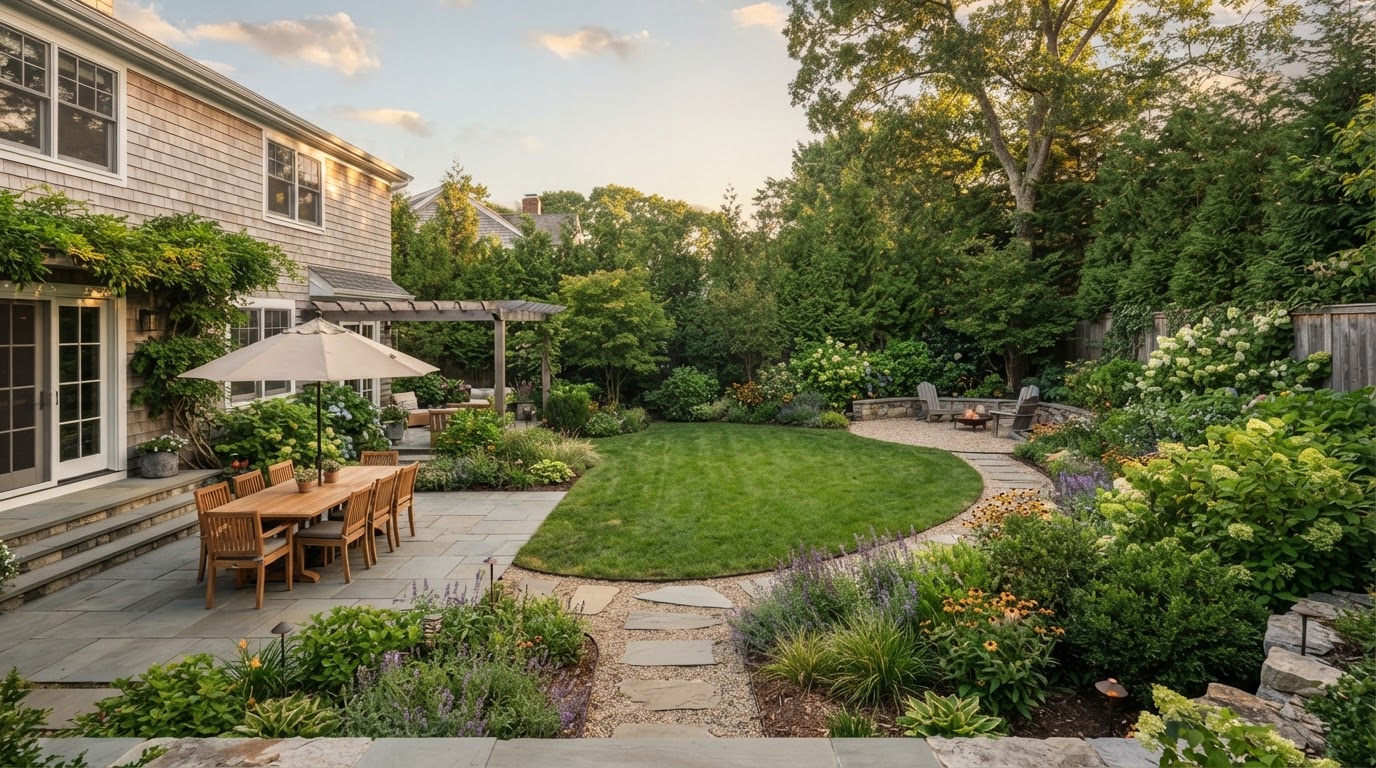
Concept visualization: Landscape renovation blending retained and new planting
Provenance: Concept visualizationScope, Applications, and Homeowner Goals
This service assesses an existing landscape and updates it — refreshing overgrown or outdated planting, redefining beds that no longer fit maintenance preferences, improving lawn areas, addressing drainage concerns, and updating hardscape connections where needed. It includes evaluating plant health and suitability, root conflicts, mature plant size, access for removal and installation, and how to sequence the work so the landscape continues to function during and after renovation.
This page is distinct from new landscape design, which begins with an empty or largely cleared property. Renovation works within an existing landscape's constraints and opportunities — retaining valuable mature elements while correcting problems and updating the overall appearance. It is also distinct from the specialty invasive-plant removal page, which addresses a specific restoration challenge rather than general renovation.
The scope does not assume every renovation requires complete removal. Selective renovation — retaining healthy planting and established structure while updating the surrounding layout — often produces a more mature-looking result more quickly and at less disruption than a full rebuild. The assessment determines what fits the property and the homeowner's goals.
Retain versus remove
Which existing planting, beds, lawn, and hardscape are worth retaining for their health, structure, or established character, and which should be removed because they cause problems or no longer fit the homeowner's goals.
Selective renovation
Refreshing specific elements — pruning or replacing overgrown shrubs, redefining bed edges, improving lawn areas, or updating connections between existing features — while keeping what still works.
Drainage and health issues
Identifying whether drainage concerns, plant health problems, or root conflicts should be addressed as part of the renovation so the updated landscape does not inherit the old problems.
Sequencing and phasing
How the renovation can be sequenced so the landscape continues to function during the work, and whether a phased approach suits the homeowner's budget or timing preferences.
Materials, Methods, and Design Choices
The renovation decision framework applies to each element of the existing landscape — planting, bed layout, lawn, surface materials, and connections to hardscape. For each, the question is whether to retain it as-is, selectively renovate it, or replace it entirely. Age alone does not determine the answer; a healthy mature shrub may be worth retaining while a younger but diseased plant may need replacement.
The framework helps avoid two common mistakes: removing everything because the landscape looks dated, and keeping everything because it is established. The right answer depends on plant health, how the feature fits the updated layout, the homeowner's maintenance preferences, and whether the existing element causes ongoing problems. A retained feature that does not fit the plan creates more work than it saves.
| Element | Retain | Selectively renovate | Replace |
|---|---|---|---|
| Existing planting | Healthy, fits layout | Overgrown but salvageable | Diseased, unsuitable, or causes conflict |
| Bed layout | Shape still works | Refine edges or boundaries | No longer fits the plan |
| Lawn areas | Healthy and well-placed | Patch or overseed | Poor drainage or wrong location |
| Surface materials | Good condition, matches plan | Repair or extend | Failed or incompatible |
Retained planting
Healthy mature trees and shrubs that fit the updated layout are retained for their established shade, screening, and character — often producing a more finished look than newly planted alternatives.
Renovated beds and lawn
Existing beds may be re-edged, replanted, or redefined; existing lawn may be aerated, overseeded, or partially replaced. These refreshes update the landscape without removing its established structure.
New elements where needed
Where existing features are removed or where the updated layout requires additions — new beds, updated edging, corrected drainage, or new planting — those elements are installed to integrate with what remains.
Site Assessment and Project Planning
A renovation assessment evaluates the existing landscape's health, function, and fit with the homeowner's goals. Each element — planting, beds, lawn, hardscape, drainage — is evaluated for whether it should be retained, selectively renovated, or replaced. Plant health and suitability matter: a shrub that is overgrown but healthy may be pruned or transplanted, while one that is diseased or causes root conflicts may need removal. The age of the landscape is not by itself a reason to remove it.
Drainage is evaluated because a renovated landscape inherits the site's water movement. If the existing landscape has drainage problems — standing water, erosion, saturated lawn — those should be addressed as part of the renovation rather than carried into the updated design. Root conflicts between existing trees and proposed work are assessed so retained trees stay healthy. Access for removal and installation is considered because removing large plants or hardscape may require equipment that affects the surrounding landscape.
Plant health and suitability
Which existing plants are healthy and worth retaining, which are overgrown but salvageable through pruning or transplanting, and which are diseased, unsuitable, or causing conflicts that warrant removal.
Bed and layout fit
Whether existing bed shapes, sizes, and locations fit the updated layout or need to be redefined, and how to transition from the old layout to the new without disrupting retained elements.
Drainage and soil
Whether the existing landscape has drainage problems that should be corrected as part of the renovation, and whether soil conditions support the updated planting plan.
Root conflicts
How existing tree roots interact with proposed work — retaining a tree is only valuable if nearby construction does not compromise its root zone. The assessment considers what can be built near existing trees without harming them.
Access and disruption
What access is needed for removal and installation, how equipment will reach the work area, and what protection retained plants and hardscape need during the renovation process.
Maintenance and goals
How the renovated landscape should serve the homeowner's current maintenance capacity and use goals — a renovation that produces a landscape the homeowner cannot maintain creates the same problem the old one had.
Germantown Context and Related Services
Established landscapes in Germantown and across Montgomery County, MD often include mature trees and planting that add value worth preserving. Renovation evaluates each property's existing landscape on its own merits — its plant health, drainage, and fit with the homeowner's goals — rather than assuming every property needs the same approach. Some mature landscapes need selective refresh; others need more substantial updating. The assessment determines which.
Landscape renovation connects to related completed services — overall landscape design for coordination, tree and shrub planting for replacements, sod installation for lawn areas, and yard drainage solutions where water problems need correction. Each may be part of a renovation plan.
Related Completed Services
Landscape Renovation Questions
A renovation starts with understanding what your existing landscape has and what it needs. Call to discuss what you want to keep, change, or correct, or request an estimate to begin assessing how to update your landscape without starting from scratch.
Does landscape renovation require removing everything?↓
No. Most renovations retain some existing elements — healthy mature trees, established shrubs, or hardscape in good condition — while updating the surrounding layout. A full removal is appropriate when the existing landscape is largely failed or causes ongoing problems, but it is not the default. The assessment determines what is worth keeping and what should go.
How do you decide what to retain?↓
Each element is evaluated for health, fit with the updated layout, and whether it causes or solves problems. A healthy shrub that fits the plan is retained; an overgrown but salvageable plant may be pruned or transplanted; a diseased plant or one causing root conflicts is removed. Age alone is not the deciding factor — a mature, healthy feature often adds more value than a new replacement.
Can renovation improve maintenance access and usability?↓
Yes. Renovation is often an opportunity to address maintenance problems — overgrown beds that are hard to weed, lawn areas that are too small or poorly shaped, or planting that has outgrown its space. The updated layout can make the landscape easier to maintain and more usable, which is one of the main reasons homeowners choose renovation over living with the existing layout.
Should drainage issues be addressed during renovation?↓
Yes, if the existing landscape has drainage problems — standing water, erosion, or saturated areas. A renovated landscape inherits the site's water movement, so correcting drainage as part of the renovation prevents the updated design from developing the same problems. Ignoring drainage during renovation often means the new landscape fails the same way the old one did.
Can the work be divided into phases?↓
Yes, if the overall plan is laid out first. A phased renovation might start with the most problematic area — removing failed planting or correcting drainage — then update other areas in later phases. The key is planning the full layout up front so each phase connects properly and does not need to be redone later.
What photos and background information help with an initial discussion?↓
Photos of the existing landscape from multiple angles showing the overall layout, specific problem areas, and any features the homeowner wants to retain. Notes on what works, what does not, drainage observations, and maintenance preferences help guide the assessment. The more specific the goals and observations, the more useful the discussion.
Discuss Your Project
Call our team based in Germantown, MD to talk through scope, site considerations, and next steps — or request an estimate and we will follow up.