
Tree & Shrub Planting Germantown
Tree and shrub planting is about more than putting plants in the ground — it is about selecting the right species for the site, placing them where they have room to grow, and planning for their establishment and long-term care. Germantown Hardscape & Pavers helps property owners in Germantown, MD choose and install trees and shrubs that suit their property's sun, soil, and drainage and the role the plants are meant to play in the landscape.
The main decision is what the planting should accomplish. A specimen tree that provides shade, a grouped shrub planting that adds seasonal interest, and a planting intended for screening are different choices with different species, spacing, and establishment needs. Understanding that distinction early shapes the selection and the installation.
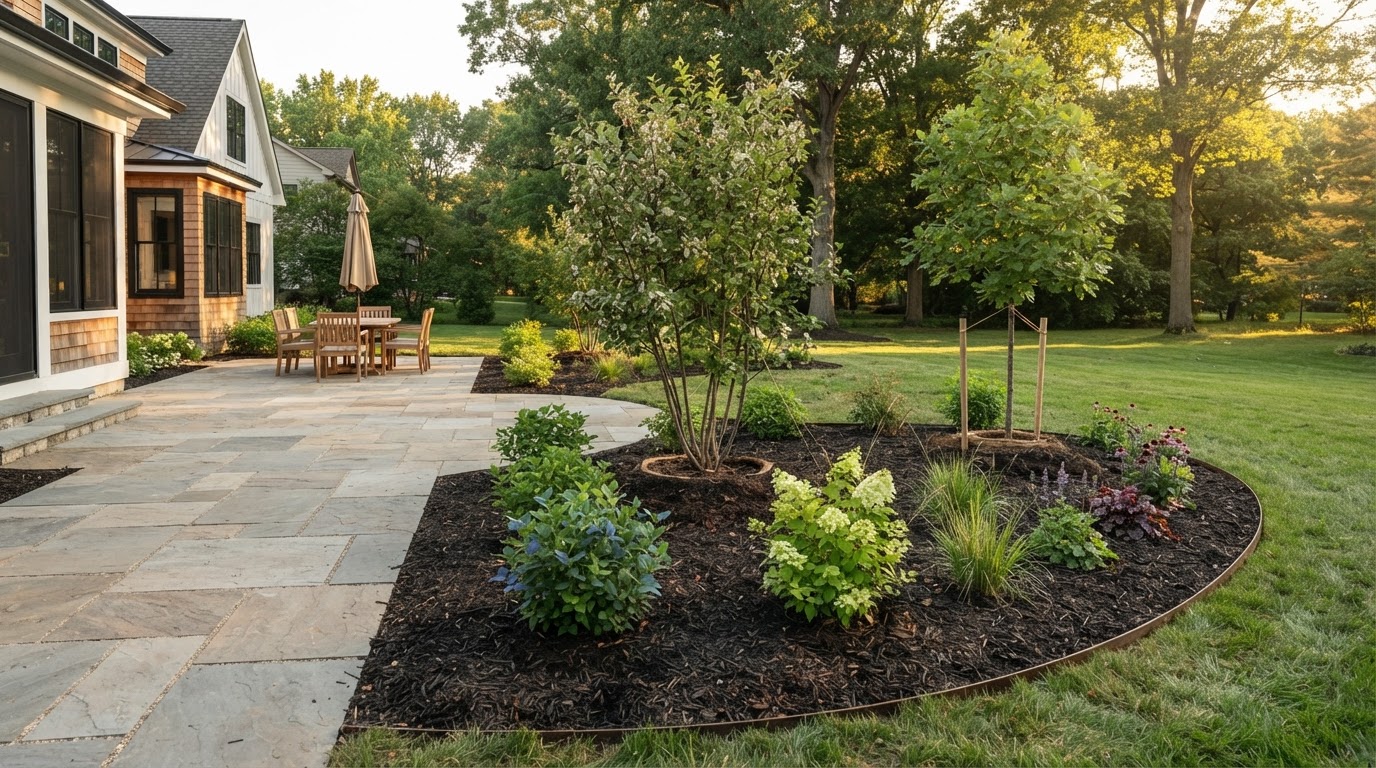
Concept visualization: Tree and shrub planting with proper spacing and landscape integration
Provenance: Concept visualizationScope, Applications, and Homeowner Goals
This service covers the selection and installation of trees and shrubs around site suitability, mature size, placement, and establishment needs. It includes evaluating sun and shade, soil and drainage conditions, mature height and spread, distance from structures and utilities, existing vegetation and root competition, and access for installation and watering. The homeowner's goals — structure, seasonal interest, shade, or screening — guide the selection and layout.
This page is distinct from the coordinated landscape design page because it focuses specifically on plant selection, placement, and establishment rather than the overall property-wide plan. It is also distinct from a future privacy hedge and tree installation page, which will focus on screening applications. Here, the emphasis is on choosing and installing trees and shrubs that will thrive at the specific site.
Not every property needs the same species. Sun exposure, soil type, drainage, and deer pressure all vary, and selection follows the site conditions rather than a universal list. Mature size matters at planting time because a plant that fits today may outgrow its space — and the distance from structures, paving, and utilities should be planned with the mature plant in mind.
Site-driven selection
Plants are selected for the property's sun, shade, soil, and drainage conditions — not chosen from a universal list assumed to suit every yard.
Mature size at planting time
Mature height and spread are considered before planting, so a plant that fits today does not outgrow its space or conflict with structures, paving, or utilities as it grows.
Purpose guides the choice
Whether the planting provides structure, seasonal interest, shade, or screening shapes the species selection and the layout — each purpose calls for different plants and placement.
Placement and spacing
Distance from structures, paving, utilities, and other plants is planned with mature size in mind, so the planting has room to grow without crowding or conflict.
Establishment and long-term care
Watering availability, establishment needs, and ongoing maintenance are part of the project discussion, because a newly planted tree or shrub needs care to thrive — it is not maintenance-free at installation.
Materials, Methods, and Design Choices
The difference between a specimen tree, a grouped shrub planting, and a planting intended for screening is the key selection distinction because each serves a different purpose with different mature size, placement, and maintenance. A specimen tree provides a focal point and shade, growing large enough to need careful placement. A grouped shrub planting adds seasonal interest and structure at a smaller scale. A screening planting uses spacing and mature height to create privacy, covered in more detail on the future privacy hedge page. The comparison below shows how these three purposes differ.
Plant selection should not assume every property needs the same species. Soil type, sun exposure, drainage, and deer pressure all affect what will thrive, and a plant that is deer-resistant in one region may not be in another. If specific plants are named, their suitability and any native status should be verified through authoritative regional horticultural sources. Otherwise, the selection criteria — sun, soil, drainage, mature size, purpose — guide the choices without inventing a universal plant list. Establishment care depends on plant type, weather, soil, root condition, and site exposure, not a rigid schedule.
| Consideration | Specimen tree | Grouped shrub planting | Screening planting |
|---|---|---|---|
| Main purpose | Focal point and shade | Seasonal interest and structure | Privacy and visual screen |
| Mature space needs | Large — height and canopy spread | Medium — grouped spread | Spaced for mature overlap |
| Placement | Distance from structures and utilities | Bed edges and foundation areas | Property lines and sightlines |
| Establishment | Longer — deep root development | Moderate — root ball establishment | Spaced to fill in over time |
| Ongoing maintenance | Pruning, structural care | Pruning, shape management | Pruning, density maintenance |
Specimen trees
Trees selected for the site's sun, soil, and drainage, with mature canopy spread considered so the tree has room to grow without crowding structures, paving, or utilities — providing a focal point and shade.
Ornamental shrubs
Shrubs selected for seasonal interest, structure, or foundation planting, grouped with mature spacing in mind so they fill their intended role without overcrowding the bed or nearby hardscape.
Screening plantings
Trees or shrubs selected and spaced for privacy and visual screening, with mature height and density considered — a more specific application covered in detail on the future privacy hedge page.
Site Assessment and Project Planning
A tree and shrub planting assessment looks at the site conditions that will determine whether the selected plants thrive. Sun and shade patterns, soil type and drainage, the distance to structures, paving, and utilities, existing vegetation and root competition, and access for installation and watering are all evaluated at the property. These conditions vary across a single yard — a sunny front bed and a shaded side yard call for different selections.
Plant health and suitability are checked before installation. A plant that is diseased, root-bound, or unsuited to the site will struggle regardless of how carefully it is installed. Watering availability matters because newly planted trees and shrubs need consistent moisture during establishment — the care depends on plant type, weather, soil, and root condition, not a fixed schedule. Long-term maintenance, including pruning and structural care, is part of the discussion because a planting is not maintenance-free at installation.
Sun and shade exposure
What are the sun and shade patterns at the planting location, and is the selected plant suited to that exposure? A plant that needs sun will not thrive in shade, and vice versa.
Soil and drainage
What is the soil type and drainage at the location, and is it suitable for the selected plant? Heavy clay, sand, or poorly drained soil may require different selections or soil preparation.
Distance from structures and utilities
How far is the planting from the house, paving, underground utilities, and other plants, and will the mature plant fit that space without conflict? Mature size is considered before planting.
Existing vegetation and root competition
What existing trees, shrubs, and roots are nearby, and will the new planting compete with them for water, light, and root space? Root competition affects establishment and long-term health.
Watering and establishment
Is watering available for the establishment period, and what care does the selected plant need? Establishment care depends on plant type, weather, soil, and root condition.
Long-term maintenance
What pruning, structural care, or ongoing maintenance will the planting need as it matures, and can the homeowner provide that care? A planting is not maintenance-free at installation.
Germantown Context and Related Services
Properties in Germantown and across Montgomery County, MD vary in soil type, sun exposure, drainage, deer pressure, and existing vegetation. Tree and shrub planting is selected for the specific property's conditions — not from a universal list assumed to suit every yard. Deer pressure, in particular, varies across neighborhoods and affects which plants will survive without protection.
New planting often integrates with other landscape features. Related completed pages describe the coordinated landscape design it fits within, the garden walls that define planting beds, and the landscape lighting that can highlight specimen trees after dark.
Tree & Shrub Planting Questions
Tree and shrub planting is a selection and placement decision, not just putting plants in the ground. Call to talk through your site conditions and planting goals, or request an estimate to begin selecting plants that will thrive on your property.
How are trees and shrubs selected for a property?↓
By the site's sun and shade exposure, soil type and drainage, the distance to structures and utilities, the purpose the planting should serve, and the plant's mature size. Selection follows the site conditions rather than a universal list, and deer pressure and existing vegetation are also considered.
Why does mature size matter before planting?↓
A plant that fits its space at installation may outgrow it as it matures — crowding structures, lifting paving, or conflicting with utilities. Mature height and spread are considered before planting so the tree or shrub has room to grow without future problems, and the distance from structures and other plants is planned with the mature plant in mind.
Can new planting be added around an existing patio?↓
Yes. New trees and shrubs can be added around an existing patio, but the planting should be evaluated for root competition with the patio base, mature size relative to the hardscape, and the watering and maintenance access the location allows. Existing hardscape and planting are both assessed before installation.
What should be checked near utilities or structures?↓
The distance to underground utilities, the foundation, paving, and overhead lines, and whether the mature plant will fit that space without conflict. A tree planted too close to a utility line or foundation can cause problems as it grows, so placement is planned with mature size in mind.
How does planting for screening differ from an ornamental planting?↓
A screening planting uses spacing and mature height to create privacy, with plants selected and positioned to fill in over time. An ornamental planting adds seasonal interest or structure at a smaller scale. The two have different species, spacing, and establishment needs — screening is covered in more detail on the future privacy hedge page.
What should homeowners plan for after installation?↓
Watering and establishment care during the root development period, which depends on plant type, weather, soil, and root condition — not a fixed schedule. Ongoing maintenance, including pruning and structural care, is part of the discussion, because a newly planted tree or shrub needs care to thrive and is not maintenance-free at installation.
Discuss Your Project
Call our team based in Germantown, MD to talk through scope, site considerations, and next steps — or request an estimate and we will follow up.