
Landscape Lighting Installation Germantown
Landscape lighting extends the usefulness of an outdoor space into the evening — making paths safe to walk, steps visible, and gathering areas comfortable after dark. Germantown Hardscape & Pavers helps property owners in Germantown, MD plan intentional outdoor lighting that supports movement, highlights landscape features, and creates usable evening spaces without excessive glare or over-illumination.
The main decision is what the lighting needs to do. Lighting a walking route, highlighting a landscape feature, and supporting an outdoor gathering area are different purposes with different fixture placement, beam angles, and brightness. Understanding that distinction — and that brighter is not automatically better — shapes the plan from the start.
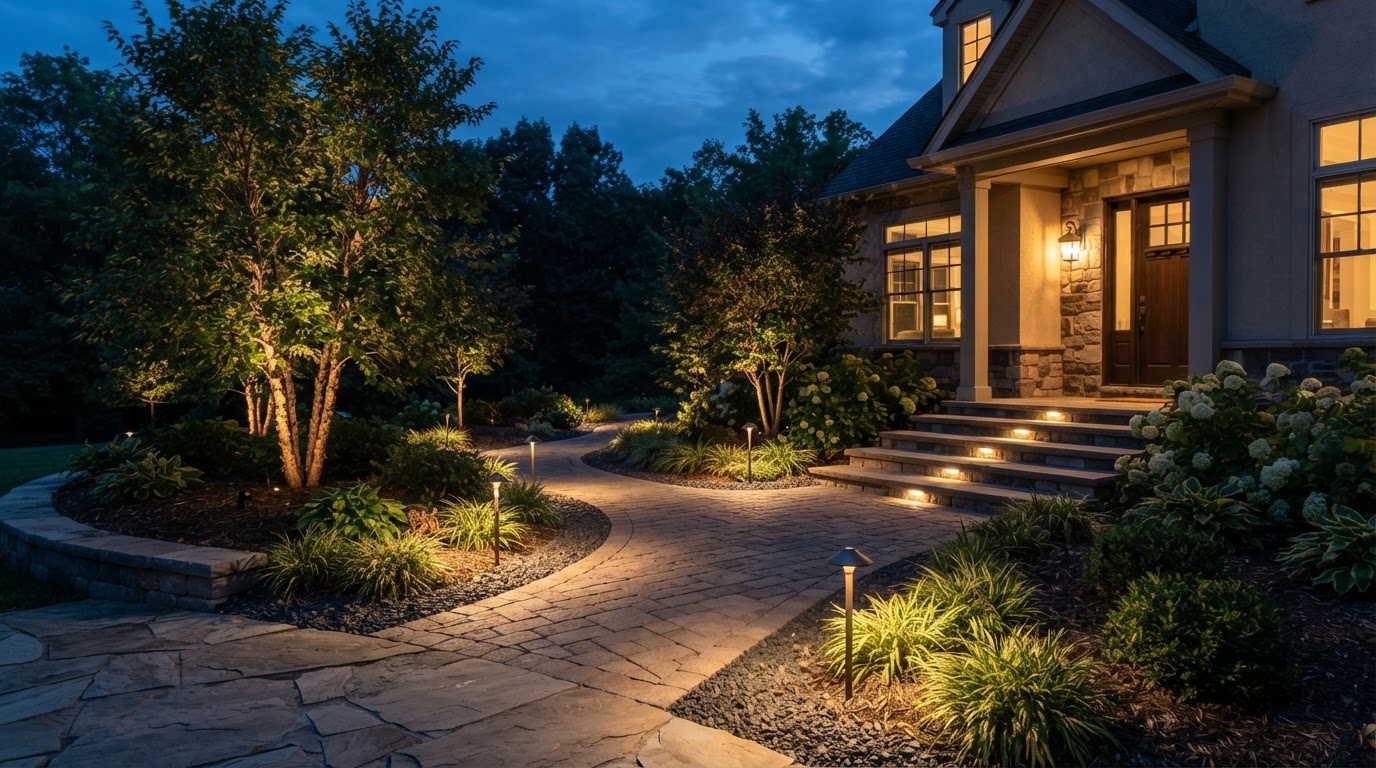
Concept visualization: Landscape lighting at dusk with controlled path, accent, and step illumination
Provenance: Concept visualizationScope, Applications, and Homeowner Goals
This service covers the installation of intentional landscape lighting that supports movement, usability, and visual emphasis. It includes path and entry lighting, step and level-change visibility, selective planting or feature illumination, and patio and gathering-area lighting. Fixture placement, shielding and glare control, light distribution, color appearance, and the coordination of controls or timers are planned as project choices.
The decisions that define a landscape lighting project begin with what the homeowner needs to see and do after dark. Lighting a walking route for safe footing, highlighting a specimen tree or stone wall, and illuminating a patio for evening gatherings each have different fixture types, placement, and brightness. The plan follows the purpose rather than flooding the yard with uniform light.
This page is distinct from an electrical contractor's page because the focus is on the intentional design of outdoor lighting — where to place fixtures, what to illuminate, how to control glare — rather than wiring or electrical service work. Power availability and appropriate electrical involvement are project considerations, but the planning value is in the lighting strategy.
Purpose-driven placement
Fixtures are placed to serve a specific purpose — lighting a path, highlighting a feature, or supporting a gathering area — rather than installed uniformly across the yard.
Path and step visibility
Walking routes, steps, and level changes are illuminated for safe footing after dark, with fixtures positioned to show the ground without creating glare.
Selective feature illumination
Specimen trees, stone walls, and landscape features are highlighted with targeted fixtures and beam angles rather than blanket illumination.
Glare control and visual comfort
Shielding, fixture direction, and light distribution are planned so the lighting is comfortable to be around — not glaring toward windows, seating, or neighboring properties.
Coordination with landscape growth
Fixture placement accounts for how planting will grow and how the landscape may change, so the lighting continues to work as the garden matures.
Materials, Methods, and Design Choices
The difference between path lighting, accent lighting, and patio-area lighting is the key planning distinction because each serves a different purpose with different placement and glare considerations. Path lighting shows the walking surface for safe footing. Accent lighting highlights a specimen tree, stone wall, or landscape feature. Patio-area lighting supports an outdoor gathering space after dark. The comparison below shows how these three purposes differ.
Brighter is not automatically better. Over-illumination creates glare, light trespass toward windows and neighboring properties, and a washed-out appearance that defeats the purpose of selective lighting. Fixture selection, beam angles, shielding, and color appearance all affect how the lighting performs and how comfortable it is to experience. Controls, timers, or other supported options are project choices. Power availability and appropriate electrical involvement are considered, but the planning value is in the lighting strategy.
| Consideration | Path lighting | Accent lighting | Patio-area lighting |
|---|---|---|---|
| Primary purpose | Safe footing on walking routes | Highlight a landscape feature | Support evening gatherings |
| Placement | Low fixtures along the path | Directed at tree, wall, or feature | Around seating and dining areas |
| Glare concerns | Shielded, aimed at the ground | Beam aimed away from viewers | Diffused, comfortable for seating |
| Coordination | Aligns with walkway and steps | Accounts for mature plant growth | Coordinates with patio layout |
Path and step fixtures
Low fixtures placed along walking routes and at level changes to illuminate the ground surface for safe footing, shielded to direct light downward rather than into the eyes.
Accent and feature fixtures
Directed fixtures with appropriate beam angles to highlight specimen trees, stone walls, or landscape features, aimed away from seating and windows to control glare.
Patio and gathering-area fixtures
Fixtures placed around seating and dining areas to support evening use, with diffused or shielded light that is comfortable for gathering rather than harsh or glaring.
Site Assessment and Project Planning
A landscape lighting assessment looks at the outdoor spaces that need illumination, the paths and steps that should be visible after dark, the features worth highlighting, and the gathering areas that need comfortable evening light. Fixture placement considers glare toward windows and neighboring properties, the relationship to planting that will grow, and the power availability at the site. The plan balances what the homeowner needs to see with visual comfort — not simply adding more fixtures.
Coordination with planting growth and future landscape changes matters because a fixture that works today may be hidden by mature growth or may no longer suit a redesigned bed. Equipment access and maintenance are considered, because fixtures need occasional adjustment, cleaning, or lamp replacement. Power availability and appropriate electrical involvement are evaluated for the project, and controls or timers are selected as project choices.
What needs to be visible
Which paths, steps, features, and gathering areas should be illuminated after dark, and what level of light does each need — safe footing, feature highlighting, or comfortable gathering?
Glare and light trespass
How are fixtures shielded and aimed to avoid glare toward windows, seating areas, and neighboring properties, and how is light distribution planned for visual comfort?
Planting growth and future changes
How will the planting around the fixtures grow, and will the lighting continue to work as the landscape matures or changes? Fixture placement accounts for mature plant size.
Power availability
Is power available at the locations where fixtures are needed, and what electrical involvement does the installation require? Power access is a project consideration.
Controls and maintenance
What controls, timers, or other options suit the household's use, and how will fixtures be accessed for cleaning, lamp replacement, or adjustment over time?
Color appearance and consistency
What light color and fixture style will create a consistent appearance across the landscape, and how do the selected fixtures complement the hardscape and planting?
Germantown Context and Related Services
Properties in Germantown and across Montgomery County, MD vary in lot size, proximity to neighboring properties, planting maturity, and the amount of hardscape and landscape to illuminate. A lighting plan is designed around the specific property's paths, features, and gathering areas — not installed identically on every yard.
Landscape lighting often connects with other outdoor features. Related completed pages describe the paver walkways and stone paths it illuminates, the outdoor steps and stoops it makes visible after dark, and the broader landscape design it complements.
Landscape Lighting Installation Questions
Landscape lighting is an intentional design decision, not just a fixture count. Call to talk through what you need to see and do after dark, or request an estimate to begin planning the lighting for your paths, features, and gathering areas.
How should a landscape lighting plan begin?↓
With what the homeowner needs to see and do after dark — which paths, steps, features, and gathering areas need light. The plan follows the purpose: path lighting for safe footing, accent lighting for features, and patio-area lighting for gatherings. Brighter is not automatically better — the goal is intentional, comfortable illumination, not uniform brightness.
Can lighting be added to an existing patio or walkway?↓
Yes. Fixtures can be placed along existing walkways, at steps, around patio seating, and at landscape features. The existing hardscape and planting are evaluated for where fixtures can go and how they can be powered, and the plan is designed around what is already there.
How can glare toward windows or neighboring properties be reduced?↓
Through fixture shielding, beam direction, and light distribution planned for visual comfort. Fixtures are aimed at the ground or at features rather than into the eyes, and light is kept off windows and neighboring properties through shielding and placement rather than simply reducing brightness.
What is the difference between path and accent lighting?↓
Path lighting uses low fixtures along walking routes to illuminate the ground for safe footing. Accent lighting uses directed fixtures to highlight a specimen tree, stone wall, or landscape feature. The two serve different purposes, use different fixture types, and have different placement and glare considerations.
Can lighting be planned with new planting?↓
Yes. When lighting is planned alongside new planting, fixture placement can account for how the plants will grow, so the lighting continues to work as the garden matures. Planning both together avoids fixtures that are later hidden by growth or that no longer suit a redesigned bed.
What maintenance considerations should be discussed?↓
Fixtures may need occasional cleaning, lamp replacement, or adjustment as planting grows. Access for maintenance, the expected service life of components, and how controls or timers are managed are part of the project discussion, so the lighting continues to work over time.
Discuss Your Project
Call our team based in Germantown, MD to talk through scope, site considerations, and next steps — or request an estimate and we will follow up.