
Landscape & Garden Wall Installation Germantown
Landscape and garden walls define outdoor spaces — they frame planting beds, organize front and backyard layouts, and give a yard visual structure. Landscape and garden wall installation in Germantown, MD is about building those defining elements so they integrate with planting, circulation, and the site's grade. Germantown Hardscape & Pavers helps property owners plan walls that shape the landscape while respecting what the wall is actually doing.
The main decision is what the wall needs to do. A wall defining a garden bed and a wall holding back a slope carry different requirements, and a wall labeled a garden wall can still retain soil. Understanding the function prevents building a decorative wall where a structural one is needed.
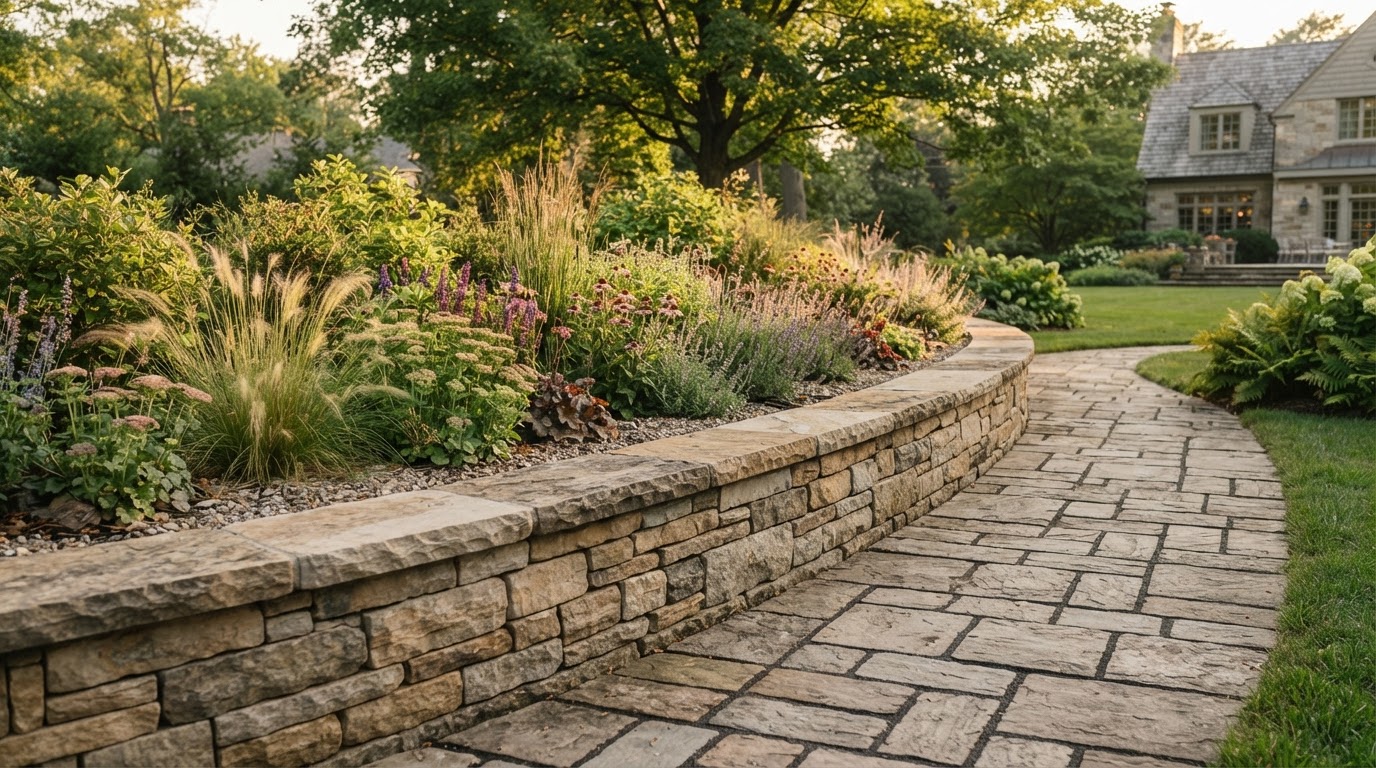
Concept visualization: Landscape garden wall defining a curved planting bed
Provenance: Concept visualizationScope, Applications, and Homeowner Goals
This service covers the installation of landscape and garden walls that define beds, boundaries, and outdoor spaces. It includes garden-bed borders, landscape transitions, visual organization of front and backyard areas, coordination with patios and walkways, material and texture selection, curved and straight layouts, and the relationship to planting, roots, irrigation, and maintenance access. It is distinct from retaining wall installation, which handles soil-retention loads, and from patio seating wall installation, which integrates built-in seating.
The decisions that define a landscape wall project are about space and integration: what the wall defines, how it relates to the planting and circulation around it, what material and layout suit the design, and whether the wall also needs to retain soil. A wall that defines a bed on flat ground is a different project than a wall that holds back a grade change, and the design must recognize that.
Not every garden wall is purely decorative. A wall that edges a raised bed or follows a slope may retain soil even if it was envisioned as a landscape feature, and retaining soil changes the structural requirements. The evaluation considers what the wall is actually doing, not just what it is called.
Garden-bed boundaries
Walls that define and raise planting beds, giving the garden structure and separating mulch and soil from lawn or paving.
Landscape transitions
Walls that organize the transition between different yard areas — lawn to patio, front to side, planted to paved — so the landscape reads as intentional.
Coordination with patios and paths
Walls are integrated with existing or planned patios and walkways so the vertical and horizontal elements read as one design.
Material, texture, and cap selection
Stone or block texture, color, and cap profile are chosen to complement the home and the landscape, with the material suited to the wall's function.
Curved and straight layouts
Walls can follow curved planting beds or run straight to define crisp edges, with the layout following the garden's shape rather than fighting it.
Materials, Methods, and Design Choices
Landscape wall materials are chosen for both appearance and function. A wall defining a garden bed on flat ground can use lighter materials and a simpler base; a wall that retains a grade change needs structural selection, drainage, and a foundation designed for the retained soil. The same material — stone, block, or cast stone — may work for one application and not the other, so the choice follows what the wall does.
The useful comparison is between three wall types that often get confused: a freestanding landscape divider, a garden-bed wall, and a wall that retains a grade change. Each carries different requirements, and the design must match the wall's actual function.
| Consideration | Freestanding divider | Garden-bed wall | Wall retaining a grade change |
|---|---|---|---|
| Intended purpose | Visual division in the landscape | Define and raise a planting bed | Hold back soil at a slope |
| Structural load | Its own weight only | Soil pressure from bed fill | Lateral soil pressure from slope |
| Site questions | Alignment and appearance | Bed depth and drainage | Slope, drainage, and foundation |
| Relationship to planting | Frames the garden | Contains the bed and mulch | Creates level planting from slope |
| When structural review may be needed | Rarely | If the bed is deep or loaded | When it retains soil at height |
Natural stone and block
Materials selected for texture and color that complement the landscape, with the choice following the wall's function — lighter for definition, structural for retention.
Caps and finishes
Cap profiles and surface finishes shape how the wall reads in the garden, with the cap chosen for both appearance and any seating or functional use the wall may serve.
Integration with planting
The wall is planned around existing trees, roots, irrigation, and maintenance access so it enhances the garden rather than creating conflicts with what is planted around it.
Site Assessment and Project Planning
Assessing a site for a landscape or garden wall means looking at the grade, the planting, the existing features the wall will relate to, and whether the wall will retain soil. A wall on flat ground defining a bed is a different project than a wall holding back a slope, and the evaluation determines which one the site actually calls for.
Relationships to existing trees, roots, irrigation lines, and adjacent patios or walkways all influence the layout, material, and construction approach. Drainage and grade are considered even for lower walls, because a garden wall that channels water toward the house or traps it behind the wall creates problems. Applicable property approvals depend on project scope and jurisdiction and should be checked before construction.
Grade and soil retention
Does the wall define a space on flat ground, or does it retain soil at a grade change, and does that change the structural requirements?
Existing trees and roots
Are there trees or roots the wall must work around, and how does the layout avoid damage to both the wall and the planting?
Irrigation and drainage
Where are irrigation lines and drainage paths, and does the wall interact with them safely or redirect water problematically?
Coordination with patios and paths
How does the wall relate to existing or planned patios and walkways, and do the vertical and horizontal elements read as one design?
Maintenance access
Can the planting behind and around the wall still be maintained, and does the wall create any hard-to-reach areas?
Property approvals
What permit or HOA requirements apply to this wall, particularly if it retains soil or exceeds a height that triggers review?
Germantown Context and Related Services
Yards in Germantown and across Montgomery County, MD include a range of layouts — flat lots where a garden wall defines beds, and sloped properties where a wall may retain soil. The evaluation considers the specific grade, planting, and drainage rather than assuming every garden wall is decorative or every yard is flat.
A landscape wall often connects to other features. Related completed pages describe the coordinated hardscape plan it may be part of, the walkways it borders, the retaining wall installation page for soil-retention requirements, and the patio seating wall page for walls that also provide seating.
Landscape & Garden Wall Installation Questions
A landscape or garden wall shapes how a yard reads and functions, so the planning should reflect what the wall is actually doing. Call to discuss the layout, materials, and planting integration, or request an estimate to begin.
What is the difference between a garden wall and a retaining wall?↓
A garden wall defines a planting bed or landscape space and may carry minimal lateral load, while a retaining wall holds back soil and resists lateral pressure from the ground behind it. The difference is structural: a retaining wall needs drainage, a foundation designed for the retained soil, and material that can handle the load. A garden wall can be lighter — but if it retains soil at a grade change, it carries retaining-wall requirements regardless of its name.
Can a garden wall coordinate with a patio or walkway?↓
Yes. A garden wall that borders a patio or follows a walkway can use compatible materials and a coordinated layout so the vertical and horizontal elements read as one design. Planning the wall and the paving together ensures the transitions, drainage, and material relationships work rather than clash.
How are materials selected for a landscape wall?↓
Materials are selected for the wall's function first and its appearance second. A wall defining a bed on flat ground can use lighter stone or block; a wall retaining soil needs structural material, drainage, and a suitable foundation. Texture, color, and cap profile are then chosen to complement the home and landscape, so the wall looks right and performs right.
Can a wall follow a curved planting bed?↓
Yes. Segmental block and many natural stones can follow a curve, letting the wall trace the shape of a garden bed rather than forcing a straight line where a curve reads better. The layout follows the garden's shape, and the material is chosen for its ability to form the desired curve cleanly.
What should be considered around existing trees or roots?↓
Existing trees, roots, and irrigation are evaluated so the wall avoids damage to both the planting and the structure. A wall that cuts a root zone or traps water around a tree can harm both the tree and the wall, so the layout works around significant trees and the base and drainage are planned to protect root health. Maintenance access to the planting behind the wall is also considered.
Can a garden wall also provide seating?↓
Some can, but seating requires intentional design — not every wall is meant to be sat on. A wall with a smooth, comfortable cap at a suitable height can serve as seating, and that use should be planned into the design rather than assumed. The patio seating wall page addresses built-in seating in more detail, because the structural, comfort, and layout requirements differ from a wall that only defines a bed.
Discuss Your Project
Call our team based in Germantown, MD to talk through scope, site considerations, and next steps — or request an estimate and we will follow up.