Native Plant & Conservation Landscaping Germantown
Native plant and conservation landscaping uses regionally adapted species and landscape practices guided by defined conservation goals — supporting habitat, increasing plant diversity, managing selected areas with different maintenance expectations, or integrating planting with runoff management. The goal is to match regional plant suitability with the homeowner's actual landscape and conservation priorities, not to assume every native plant suits every site. Germantown Hardscape & Pavers helps property owners in Germantown, MD evaluate what native and conservation-focused planting can accomplish on their property.
The main decision is what the planting should accomplish. Native does not mean suitable for every part of the yard, and conservation landscaping does not mean a single style. Understanding the homeowner's goals early determines which plants fit the site and how the landscape should be maintained going forward.
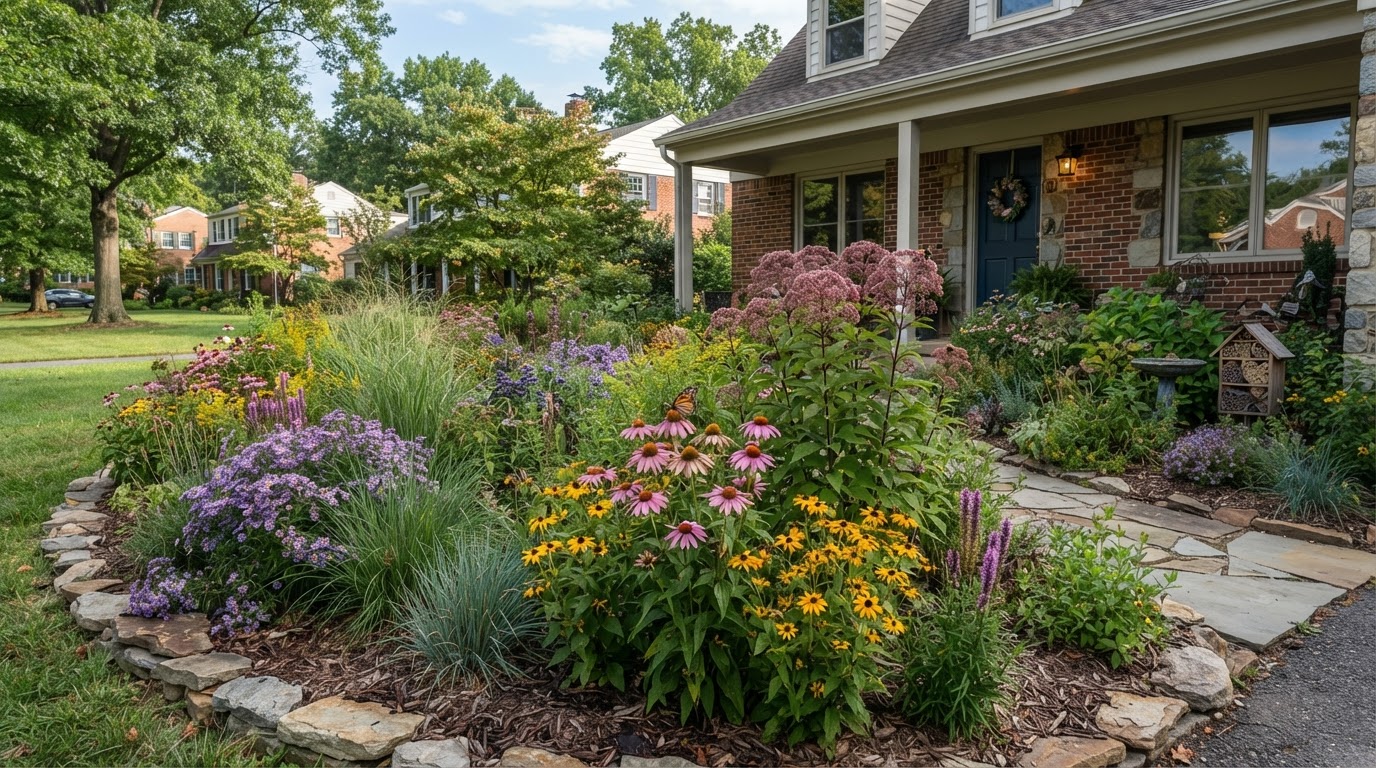
Concept visualization: Native plant conservation landscaping
Provenance: Concept visualizationScope, Applications, and Homeowner Goals
This service addresses planting and landscape practices guided by regional plant suitability and defined conservation goals. It includes evaluating site exposure, soil and moisture, existing plants worth retaining, regional native status, mature size, seasonal structure, plant diversity, maintenance capacity, establishment needs, and compatibility with paths, gathering areas, and property use. Goals may include supporting habitat, increasing diversity, managing selected areas with different maintenance expectations, integrating planting with runoff management, or reducing unsuitable lawn areas where appropriate.
This page is distinct from the broad landscape design and installation page, which addresses overall landscape coordination. Native and conservation landscaping is a planting approach guided by specific goals, not a separate property plan. Tree and shrub planting addresses individual plant installation; this page addresses a conservation-focused planting strategy.
Not all goals are guaranteed results of every project. A planting plan that supports habitat does not guarantee particular wildlife outcomes, and a reduced-maintenance plan does not mean no maintenance. The outcomes depend on plant selection, establishment care, and the homeowner's ongoing commitment.
Defined goals
Clarify what the planting should accomplish — habitat, diversity, reduced maintenance, or runoff integration.
Regional suitability
Select plants based on verified regional native status and suitability for the site conditions.
Existing plants
Evaluate which existing plants are worth retaining and how they fit the conservation plan.
Maintenance planning
Match the planting plan to the homeowner's actual maintenance capacity and expectations.
Materials, Methods, and Design Choices
Conservation landscaping can range from a focused native planting bed to a broader landscape plan. The comparison below clarifies the difference in scope and what each approach involves.
| Consideration | Native-focused planting bed | Broader conservation landscape plan |
|---|---|---|
| Scope | A defined bed or area of native plantings | Coordinated planting across the property with conservation goals |
| Site connections | Integrates with surrounding beds | Connects planting, lawn, paths, and runoff features |
| Ongoing care | Maintenance of the planting bed | Maintenance plan for the entire landscape |
| Goals addressed | Focused goal such as habitat or diversity | Multiple conservation goals across the property |
Regional native status
Plant selections should be verified for regional native status — not every plant labeled 'native' suits every local site.
Mature size and spacing
Plants should be spaced for mature growth, not nursery size, to avoid overcrowding and future maintenance problems.
Establishment care
Native plants still need establishment care — watering, weeding, and monitoring during the first seasons.
Site Assessment and Project Planning
Before defining the work, several factors shape the approach: site exposure, soil and moisture conditions, existing plants worth retaining, the homeowner's defined conservation goals, mature plant size, seasonal structure, and maintenance capacity. Native does not mean no maintenance — it means maintenance matched to the plan.
Site exposure
Sun, shade, wind, and moisture conditions determine which native plants will thrive at the site.
Regional native status
Plants should be verified for regional native status; a national label does not prove regional suitability.
Existing plants
Evaluate which existing plants are worth retaining and how they fit the conservation plan.
Mature size
Space plants for mature growth to avoid overcrowding and the maintenance problems that follow.
Maintenance capacity
The planting plan should match the homeowner's actual maintenance capacity and expectations.
Establishment needs
Plan for watering, weeding, and monitoring during the establishment period.
Germantown Context and Related Services
Properties across Germantown and Montgomery County, MD offer a range of exposures, soils, and existing plant communities. Whether native and conservation landscaping fits a given property depends on the site conditions and the homeowner's goals — not on an assumption that every native plant suits every local yard.
Related completed pages: landscape design and installation provides the broader coordination framework, and tree and shrub planting addresses individual plant installation. A rain garden may complement conservation landscaping when both support runoff management and habitat goals.
Related Completed Services
Native Plant & Conservation Landscaping Questions
Native and conservation landscaping is a goal-guided planting strategy, not a single style. Call to talk through your site conditions and conservation priorities, or request an estimate to begin evaluating what native planting can accomplish on your property.
Does native mean suitable for every part of the yard?↓
No. Native plants are regionally adapted, but they still have specific sun, shade, soil, and moisture requirements. A plant native to Maryland may not suit a dry, shaded area or a wet low spot on the same property. Suitability must be evaluated for each part of the yard.
Can native plants be integrated with an existing landscape?↓
Yes. Native plantings can be added to existing beds or integrated into a broader landscape plan. Existing plants worth retaining can be evaluated for how they fit the conservation goals, and new plantings can complement the established landscape.
How does maintenance change with the planting plan?↓
Native and conservation plantings still need maintenance — establishment care, weeding, and monitoring — but the maintenance profile changes. A plan focused on reducing maintenance should match the planting to the homeowner's actual maintenance capacity, not assume native means no care.
Can conservation goals fit a formal-looking landscape?↓
Yes, with appropriate plant selection and layout. Conservation landscaping does not require a wild or informal appearance. A native planting bed can be designed with clean edges and intentional structure while still supporting habitat and diversity goals.
What should be decided before selecting plants?↓
The homeowner's conservation goals, the site exposure and soil, the existing plants worth retaining, the mature size of candidate plants, and the maintenance the homeowner is prepared to provide. These decisions shape a planting plan that fits the property and the goals.
Discuss Your Project
Call our team based in Germantown, MD to talk through scope, site considerations, and next steps — or request an estimate and we will follow up.