
Outdoor Fire Pit Installation Germantown
A built-in fire pit creates a natural gathering point within a patio — a place to sit, talk, and extend outdoor use into cooler evenings. Germantown Hardscape & Pavers helps property owners in Germantown, MD plan a fire pit that fits the patio layout, the seating arrangement, and the practical constraints of fuel, materials, clearances, and local requirements.
The main decision is fuel choice and placement. A wood-burning fire pit and a gas-fueled fire pit are different projects with different placement constraints, maintenance needs, and utility considerations. Understanding that distinction — and how the fire pit relates to structures, planting, and property boundaries — shapes the project from the start.
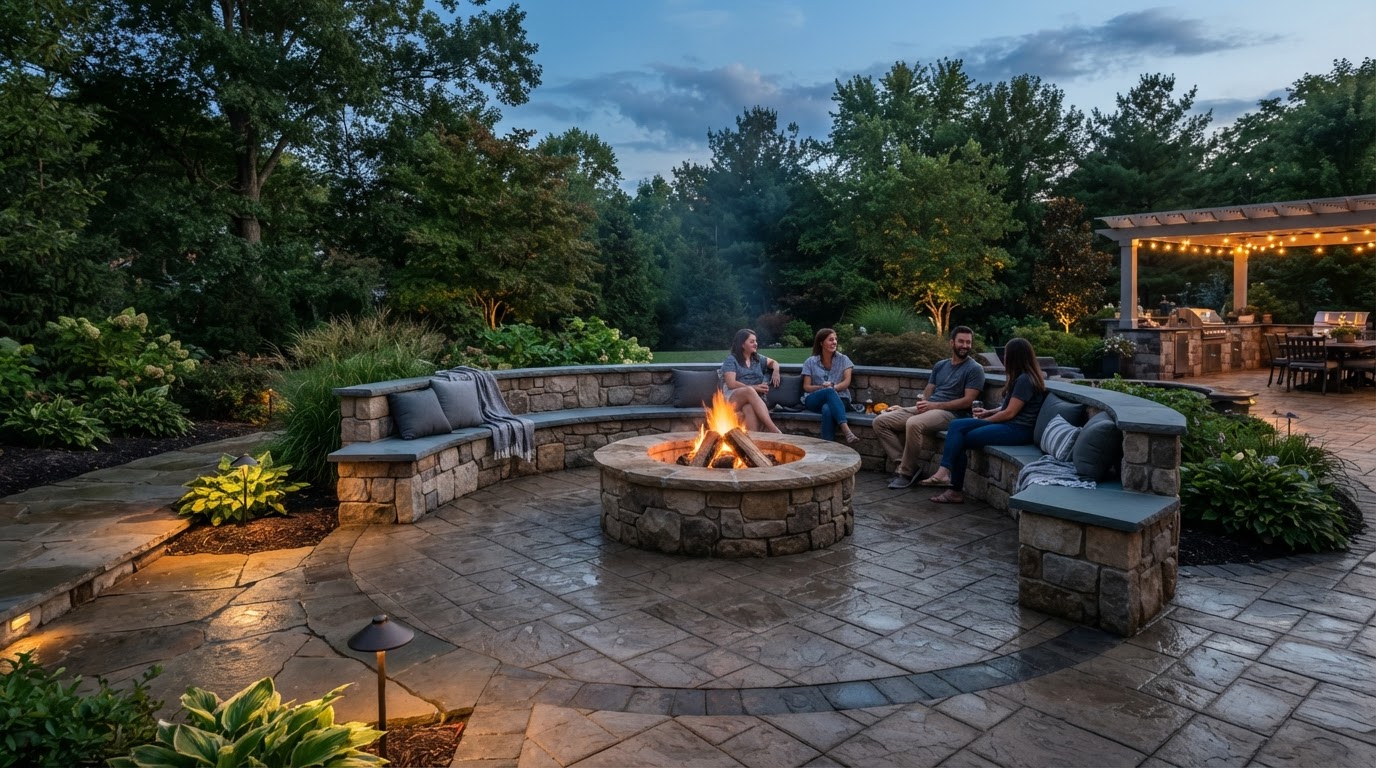
Concept visualization: Built-in stone fire pit with seating wall and surrounding gathering area
Provenance: Concept visualizationScope, Applications, and Homeowner Goals
This service covers the installation of built-in outdoor fire pits integrated with an outdoor gathering area. It includes the fire pit's placement within the patio layout, the seating arrangement and circulation around it, the relationship to nearby structures and planting, the selection of heat-compatible materials, and the fuel choice that defines the project's utility and maintenance needs.
A fire pit is distinct from an outdoor fireplace because it organizes a gathering area around an open fire feature rather than a directional, chimney-vented structure. The two have different placement logic, different construction requirements, and different relationships to the surrounding patio. Fuel choice — wood-burning versus gas-fueled — is a major planning decision that affects where the fire pit can sit, how it operates, and what utility connections it may need.
Product suitability matters. Not every decorative block or natural stone is suitable for direct fire exposure, and the fire pit's construction should use materials rated for that purpose. Manufacturer requirements, local fire restrictions, and applicable project approvals all factor into the planning.
Placement within the patio
The fire pit is positioned so seating, circulation, and the relationship to structures and property lines are all appropriate — not just placed wherever there is open space.
Fuel choice as a planning decision
Wood-burning and gas-fueled options have different placement constraints, maintenance needs, and utility considerations. Fuel choice is settled early because it shapes the rest of the project.
Heat-compatible materials
The fire pit's construction uses materials suited for direct fire exposure, selected based on the product and the manufacturer's requirements rather than appearance alone.
Clearances and surroundings
Relationships to overhead features, nearby combustible materials, planting, and property boundaries are evaluated so the fire pit sits safely within its setting.
Local restrictions and approvals
Applicable local fire restrictions, burn ordinances, and project approvals are checked based on the property and the fuel type, not assumed to be the same everywhere.
Materials, Methods, and Design Choices
The choice between a wood-burning and a gas-fueled fire pit is the most important planning decision because it changes where the fire pit can go, how it operates, and what it connects to. A wood-burning fire pit needs open space, a safe distance from structures and overhanging branches, and attention to local burn restrictions. A gas-fueled fire pit needs a gas supply run to the location, may offer easier ignition and cleanup, and has different clearance and placement logic. The comparison below shows how these two approaches differ.
Materials should be selected for heat compatibility, not just appearance. Ordinary decorative blocks or arbitrary natural stone may not be suitable for direct fire exposure. The fire pit's inner construction and surrounding surfaces should use materials the manufacturer rates for that purpose. Surface and support considerations, drainage, and exposure to weather all affect how the fire pit performs and how it is maintained.
| Consideration | Wood-burning fire pit | Gas-fueled fire pit |
|---|---|---|
| Fuel and utility | Firewood, no utility connection | Gas line to the fire pit location |
| Operation | Lighting and tending an open fire | Controlled ignition, adjustable flame |
| Maintenance | Ash removal, wood storage | Cleaner operation, less residue |
| Placement constraints | Open space, distance from structures and branches | Gas access, clearance to combustibles |
| Local restrictions | Burn ordinances may limit use | Restrictions vary by jurisdiction |
Fire-rated construction materials
Inner firebox components and surrounding materials selected for direct fire exposure based on manufacturer requirements, rather than decorative blocks assumed to be suitable.
Surrounding surface materials
Paver or stone surfaces around the fire pit chosen for heat tolerance, stable support, and drainage — coordinating with the existing patio or planned paving.
Fuel system components
For gas-fueled pits, the gas connection and burner system are planned with appropriately qualified involvement, following the product specifications rather than improvised installation.
Site Assessment and Project Planning
A fire pit assessment looks at where the feature can sit safely within the patio and yard. The distance to structures, overhanging branches, and nearby combustible materials; the relationship to property boundaries and neighboring yards; the surface and support beneath the fire pit; and the drainage and exposure conditions all determine the right placement. For a gas-fueled fire pit, gas availability and the route for a gas connection are also evaluated.
Fuel choice, product suitability, and local restrictions interact with the site assessment. A wood-burning fire pit may be limited by local burn ordinances or by proximity to overhanging trees. A gas-fueled fire pit depends on gas access and may require qualified trade involvement for the connection. Manufacturer requirements guide clearances and material selection. Applicable approvals depend on the property, the fuel type, and the project scope, and should be checked before construction.
Distance to structures and combustibles
How far is the planned fire pit from the house, fences, overhanging branches, and nearby combustible materials, and is that distance appropriate for the fuel type and the manufacturer's requirements?
Fuel availability and access
For a gas-fueled fire pit, is a gas supply available near the location, and what qualified involvement does the connection require? For wood-burning, is there safe access for firewood and ash management?
Surface and support
What surface and base will support the fire pit, and does the existing patio need modification to provide a stable, heat-compatible foundation?
Seating and circulation
How does the seating arrangement around the fire pit maintain comfortable separation from the fire while keeping the gathering area connected to the patio?
Local restrictions
What burn ordinances, fire restrictions, or local approvals apply to a fire pit at this property, and how do they differ between wood-burning and gas-fueled options?
Product suitability
Are the planned construction materials rated for direct fire exposure, and do they meet the manufacturer's requirements for the selected fire pit system?
Germantown Context and Related Services
Properties in Germantown and across Montgomery County, MD differ in lot size, proximity to neighboring structures, overhanging trees, and local fire restrictions. A fire pit is planned around the specific property's available space, the distances that matter for the fuel type, and any local burn ordinances that apply — not placed identically on every yard.
A fire pit often integrates with other patio features. Related completed pages describe the paver patio it sits within, the flagstone surfaces that may surround it, and the seating wall that can define the gathering area around it.
Outdoor Fire Pit Installation Questions
A fire pit is a placement and fuel decision as much as a construction project. Call to talk through where a fire pit can sit safely in your yard, or request an estimate to begin planning the gathering area around it.
What should determine the location of a fire pit?↓
The distance to structures, overhanging branches, and nearby combustible materials; the relationship to property boundaries; the surface and support beneath the fire pit; the seating arrangement and circulation; and any local fire restrictions. The fuel type also affects where the fire pit can safely sit.
How does fuel choice affect the project?↓
A wood-burning fire pit needs open space, distance from structures and overhanging branches, and attention to local burn restrictions. A gas-fueled fire pit needs a gas supply at the location and may offer easier ignition and cleanup. The choice changes placement, maintenance, utility needs, and what local restrictions apply.
Can a fire pit be added to an existing patio?↓
It depends on whether the existing patio surface and base can support the fire pit, whether the placement allows safe distances from structures and combustibles, and whether the surrounding materials are heat-compatible. The existing patio is evaluated before deciding whether it can accommodate the fire pit or whether modification is needed.
Can a seating wall be planned around a fire pit?↓
Yes. A seating wall can define the gathering area around a fire pit, but the seating distance from the fire should be comfortable and safe, and the wall's materials should be compatible with the heat exposure. Clearances and product-specific requirements should be checked rather than assuming a standard distance.
What should be checked before choosing materials?↓
Whether the construction materials are rated for direct fire exposure, whether they meet the manufacturer's requirements for the selected fire pit system, and whether the surrounding surface and base provide stable, heat-compatible support. Ordinary decorative blocks or arbitrary stone may not be suitable for fire exposure.
Are local restrictions or approvals part of project planning?↓
Yes. Burn ordinances, fire restrictions, and local approvals may apply to a fire pit at a given property, and they can differ between wood-burning and gas-fueled options. These are checked based on the property and fuel type before construction begins, not assumed to be the same everywhere.
Discuss Your Project
Call our team based in Germantown, MD to talk through scope, site considerations, and next steps — or request an estimate and we will follow up.