
Privacy Hedge & Tree Installation Germantown
Privacy hedge and tree installation is about creating planted screening that addresses a specific view or sightline the homeowner wants to block. It begins with where screening is needed, the viewing height and direction, the space available for planting, and how the screen will look through the seasons. Germantown Hardscape & Pavers helps property owners in Germantown, MD design planted privacy screens that fit their site's conditions, available space, and long-term maintenance capacity.
The main decision is the type of screening — a single-species evergreen hedge, a mixed tree-and-shrub screen, or a combination — and how it fits the available space at maturity. Privacy from planting is not instant, and the screen's effectiveness depends on mature growth, not the size at installation.
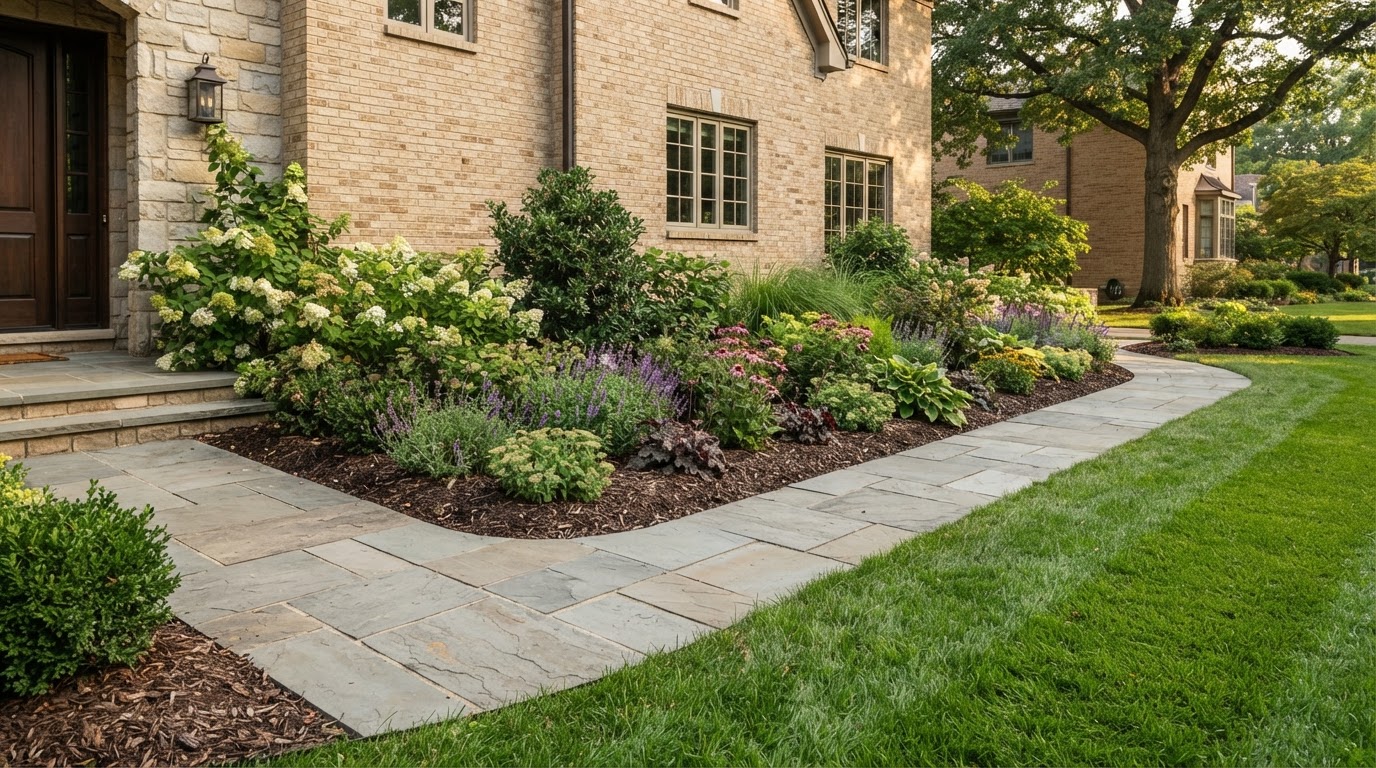
Concept visualization: Privacy hedge and mixed screen planting with mature spacing
Provenance: Concept visualizationScope, Applications, and Homeowner Goals
This service designs and installs planted screening for privacy. It includes evaluating where screening is needed, the viewing height and direction to be addressed, available planting width, mature height and spread, seasonal screening behavior, sun and soil and drainage conditions, existing structures and utilities, property boundaries, maintenance access, and growth and establishment expectations. The design balances the screening goal against the space it will occupy and the care it will need.
This page is distinct from general tree and shrub planting, which addresses a broader range of planting goals. Privacy screening is a specific application — the plants are selected and placed specifically to block a sightline, which introduces constraints on mature size, spacing, and growth habit that general planting does not face.
The scope does not promise instant complete privacy. Planted screening takes time to establish and reach effective height and density. The design plans for that growth timeline and the maintenance it will require, rather than implying a hedge that provides full screening the day it is installed or never needs care.
Sightline and viewing direction
What the homeowner wants to screen — a neighbor's window, a road, a fence line — and the height and direction that screening needs to address. The screen is designed for the specific sightline, not as a generic wall.
Available space and mature size
How much width and depth the planting area provides, and how the selected plants' mature spread fits that space without crowding structures, utilities, or the usable yard.
Seasonal screening behavior
Whether the screen needs to be effective year-round — requiring evergreen planting — or whether seasonal screening from deciduous plants is acceptable, and how each option affects the screen's appearance and effectiveness.
Maintenance and establishment
How the screen will be maintained as it grows — pruning, shaping, watering during establishment — and how long the planting will take to reach effective screening height and density.
Materials, Methods, and Design Choices
The two main screening approaches are a single-species evergreen hedge and a mixed tree-and-shrub screen. A single-species hedge uses one plant type — typically an evergreen — planted in a row to create a uniform, dense screen. It provides consistent year-round screening and a formal appearance, but offers less visual diversity and can be affected uniformly if a pest or disease strikes that species. A mixed screen uses several plant types — a combination of evergreen and deciduous trees and shrubs — to create a layered, naturalistic screen with more visual variety and resilience.
The choice depends on available space, the desired appearance, and the homeowner's maintenance preferences. A single-species hedge requires uniform pruning and produces a formal look. A mixed screen takes more layout planning but offers seasonal variation and is less vulnerable to losing an entire section if one plant type struggles. Neither is universally better; each suits different properties and preferences. The comparison below shows how they differ.
| Consideration | Single-species hedge | Mixed tree-and-shrub screen |
|---|---|---|
| Visual character | Uniform, formal | Layered, naturalistic |
| Seasonal screening | Year-round if evergreen | Varies by plant selection |
| Available space | Needs consistent width | Can adapt to varying depth |
| Maintenance | Uniform pruning | Varied pruning by species |
| Resilience | One pest affects all | Diversity limits loss impact |
Evergreen hedges
Single-species evergreen plantings that provide year-round screening with a uniform appearance, suited to properties where consistent privacy and a formal look are the priority and the available width supports a hedge.
Mixed screens
Combinations of evergreen and deciduous trees and shrubs that create layered, naturalistic screening with seasonal variation and greater resilience, suited to properties with space for a deeper planting area.
Deciduous screening
Plantings that provide screening during the leaf-on season but lose density in winter, suited to situations where year-round privacy is not required and seasonal openness is acceptable.
Site Assessment and Project Planning
A privacy planting assessment evaluates the site's conditions and the specific screening need. The sightline — what view needs blocking and from what height — determines the mature height the screen must reach. Available planting width determines which plant types are feasible; a narrow space may not support a mixed screen that needs depth for layering. Sun exposure and soil conditions affect which plants will thrive, and drainage matters because a saturated planting area will not support healthy screening plants. Existing structures, utilities, and property boundaries constrain where planting can go.
Mature width matters as much as mature height. A plant that reaches the needed height but spreads too wide may encroach on the usable yard, structures, or neighboring property. The assessment plans for the mature spread, not the installation size, so the screen fits the space at full growth. Maintenance access is also evaluated — a screen that cannot be reached for pruning becomes overgrown and may lose its shape. Growth timeline and establishment needs are discussed so the homeowner understands how long the screen will take to reach effective screening and what care it will need during that period.
Sightline and height
What view needs blocking, the height that screening must reach, and the direction the screening faces. A screen for a ground-level patio has different requirements than one for a second-story window.
Available width and depth
How much space the planting area provides for the screen's mature spread. A narrow strip limits plant choices; a deeper area allows mixed plantings with layers of trees and shrubs.
Sun, soil, and drainage
The site's exposure, soil type, and drainage, which determine which plants will establish and thrive. Screening plants in poor conditions struggle; the assessment matches plants to the actual conditions.
Boundaries and utilities
Property lines, easements, and underground utilities that constrain where planting can occur. Screening should be planted within verified boundaries, and utility locations should be checked before digging.
Growth timeline
How long the selected plants will take to reach effective screening height and density, and what the screen will look like during establishment. Privacy from planting develops over time, not instantly.
Maintenance access
How the screen will be pruned and shaped as it grows, and whether the planting allows access for that maintenance. A screen that cannot be maintained will overgrow and lose its screening function.
Germantown Context and Related Services
Properties in Germantown and across Montgomery County, MD vary in lot size, setback, existing tree canopy, and the proximity of neighboring homes — all of which shape what kind of screening is practical. A narrow lot between houses may need a different approach than a larger property with room for a mixed screen. The design evaluates the specific site's space, exposure, and sightlines rather than assuming one screening approach works everywhere.
Privacy screening connects to related completed services — tree and shrub planting for the plants themselves, backyard landscape design for how the screen fits the yard's layout, and overall landscape design for property-wide coordination.
Related Completed Services
Privacy Hedge & Tree Installation Questions
Effective screening starts with understanding the sightline and the space. Call to discuss what you want to screen and the conditions of your site, or request an estimate to begin planning a privacy planting that fits your property at maturity.
How do you choose where a privacy planting should go?↓
By identifying the specific sightline that needs screening — what view to block, from what height, and in what direction — and then evaluating whether the available space can support the mature size of plants that will address it. The screen is placed to address the actual sightline, planted within property boundaries, and sized for mature growth rather than installation size. The location is a function of the screening need and the site's constraints.
What is the difference between a hedge and a mixed planting screen?↓
A hedge is a single plant type, typically evergreen, planted in a row for a uniform, dense screen. A mixed screen combines several trees and shrubs for a layered, naturalistic look with more visual variety and resilience. Hedges suit formal styles and consistent width; mixed screens suit deeper spaces and offer seasonal variation. Neither is universally better — each suits different properties and preferences.
Can screening work in a narrow space?↓
Yes, but with constraints. Narrow spaces limit the plant types that will fit at maturity and may require a single-species columnar evergreen rather than a mixed screen. The screening may be less dense or slower to establish than in a wider area. The assessment evaluates what the available width can support and selects plants accordingly rather than forcing a screen that will outgrow the space.
Does evergreen planting guarantee complete year-round privacy?↓
Evergreen plants retain foliage year-round, which is why they are chosen for winter screening. But a newly planted evergreen screen does not provide full privacy immediately — it takes time to reach effective height and density. And no planting creates a completely opaque, maintenance-free barrier. The screen's effectiveness depends on the plant's mature size, spacing, and the care it receives. Privacy from planting is a growing screen, not an instant wall.
Why does mature width matter as much as height?↓
Because a plant that reaches the needed height but spreads too wide will encroach on the usable yard, structures, or neighboring property. A screen designed only for height without considering mature spread will outgrow its space and need to be removed or heavily pruned. Planning for mature width ensures the screen fits the space at full growth and continues to provide screening without becoming a problem.
What maintenance and establishment questions should be discussed?↓
How long the plants will take to reach screening height, what watering they need during establishment, how they will be pruned and shaped as they grow, and whether the homeowner can access the screen for maintenance. A screen that cannot be maintained will overgrow and lose its shape. Discussing maintenance up front ensures the screen the homeowner gets is one they can live with long-term.
Discuss Your Project
Call our team based in Germantown, MD to talk through scope, site considerations, and next steps — or request an estimate and we will follow up.