
Rain Garden Design & Installation Germantown
A rain garden is a planted landscape feature designed to receive runoff from a defined source and manage it through a site-specific approach — holding water briefly while it infiltrates, then draining within a reasonable period. It is not a permanently wet pond, an ordinary garden bed, or a universal fix for standing water. Germantown Hardscape & Pavers helps property owners in Germantown, MD evaluate whether a rain garden suits the runoff source, the soil, and the site before any installation is planned.
The main decision is whether the property can support a rain garden that actually functions. An ornamental low spot with no evaluated inlet or overflow is not a rain garden. Understanding the difference early determines whether a planted infiltration feature fits the property or whether a different approach is needed.
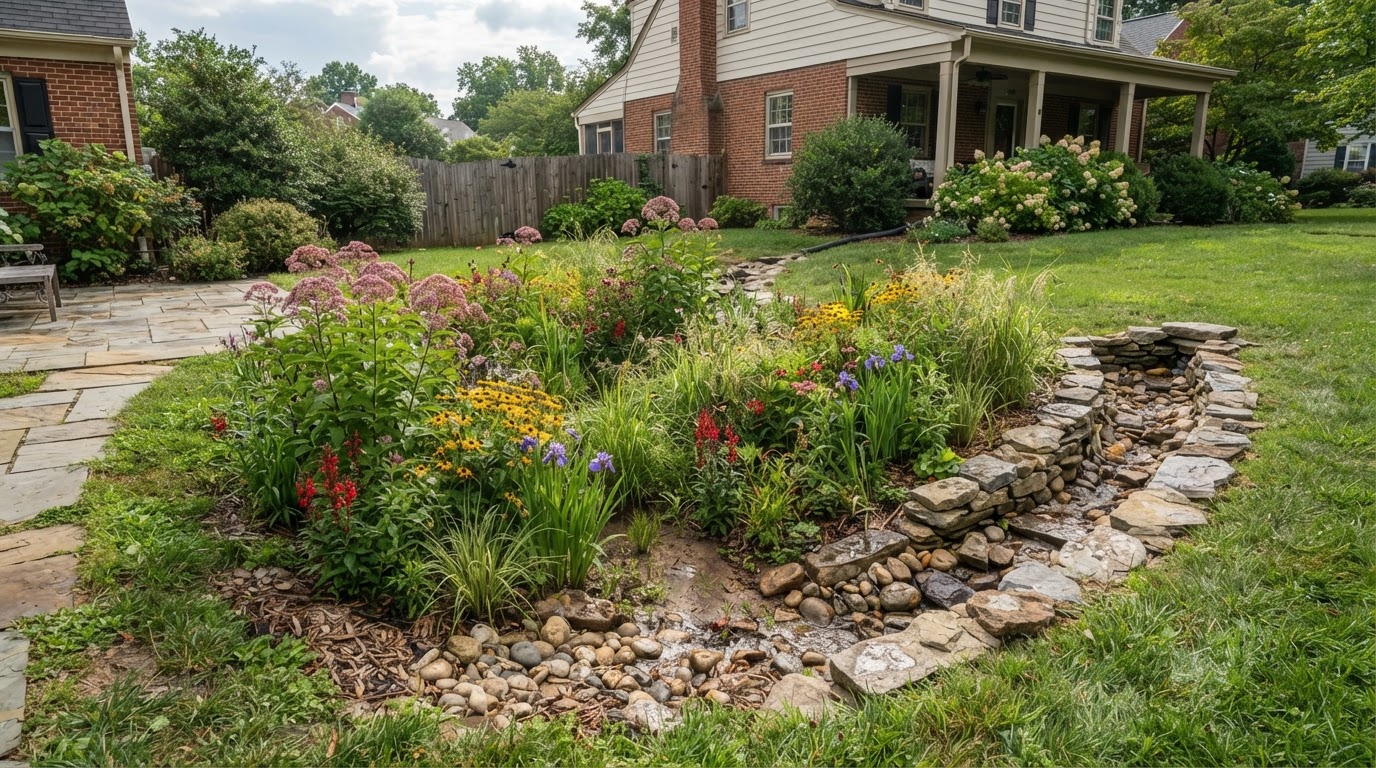
Concept visualization: Rain garden basin capturing runoff with native plantings
Provenance: Concept visualizationScope, Applications, and Homeowner Goals
This service addresses the design and installation of a planted feature that receives runoff and manages it on site. It includes evaluating the runoff source, site placement, soil and infiltration conditions, relationship to structures and boundaries, inlet and overflow considerations, plant selection for the actual moisture pattern, establishment, sediment and maintenance, and appropriate project review.
This page is distinct from the broad yard drainage solutions page, which evaluates overall water problems and selects an approach. A rain garden is one potential runoff-management feature within a broader plan. Garden bed design and installation addresses planting beds generally; a rain garden is a specialized bed designed to receive and manage runoff.
A rain garden is not suitable for every drainage problem. Sites with slow-draining soil, high groundwater, or unsuitable runoff sources may need a different approach. The decision depends on site-specific evaluation, not on an assumption that any low area can become a functioning rain garden.
Runoff source
Evaluate where the water comes from and whether it is suitable for a planted infiltration feature.
Site placement
Choose a location with appropriate soil, space, and setbacks from structures and boundaries.
Inlet and overflow
Plan how water enters the garden and what happens when capacity is exceeded.
Plant selection
Select plants suited to the actual moisture pattern — periods of saturation followed by drying.
Materials, Methods, and Design Choices
A rain garden differs from an ordinary planting bed in its relationship to water. The comparison below clarifies what makes a rain garden a designed runoff-management feature rather than a decorative low spot.
| Consideration | Conventional planting bed | Rain garden for runoff |
|---|---|---|
| Water source | Irrigation or rainfall on the bed itself | Designed to receive runoff from a defined source |
| Inlet | No evaluated inlet | Planned entry point for incoming water |
| Overflow | No overflow consideration | Planned path for water when capacity is exceeded |
| Plant selection | Selected for general landscape conditions | Selected for the moisture pattern of saturation and drying |
| Soil evaluation | Amended for planting | Evaluated for infiltration capacity |
Moisture pattern plants
Plants must tolerate periods of saturation followed by drying — not all landscape plants survive that cycle.
Inlet and overflow
A rain garden needs a planned entry point for runoff and an overflow path for excess water.
Sediment management
Runoff carries sediment; pre-treatment or settling may be needed to protect the planting and infiltration.
Site Assessment and Project Planning
Before defining the work, several factors must be evaluated: the runoff source, soil infiltration, the relationship to structures and boundaries, the inlet and overflow design, plant suitability for the moisture pattern, and applicable review requirements. A rain garden is a designed feature, not a dug hole with plants.
Runoff source
The water source must be suitable for a planted infiltration feature; polluted or contaminated runoff may not be appropriate.
Soil and infiltration
The soil must drain well enough to manage the runoff within a reasonable period after a storm.
Setbacks
Placement must consider relationships to foundations, property boundaries, and other site features.
Inlet and overflow
How water enters and what happens when capacity is exceeded must be planned, not left to chance.
Plant selection
Plants must suit the actual moisture pattern — not every landscape plant tolerates periodic saturation.
Review requirements
Applicable stormwater, building, or local program requirements should be checked before installation.
Germantown Context and Related Services
Properties across Germantown and Montgomery County, MD produce runoff from roofs, driveways, and lawn areas that may be suitable for a rain garden in the right conditions. Whether a rain garden fits a given property depends on the soil, the runoff source, and the site — not on a universal assumption that any low area can serve that role.
Related completed pages: yard drainage solutions provides the broader assessment framework, and garden bed design and installation addresses planting beds generally. Native plant and conservation landscaping may complement a rain garden when plant selection supports both runoff management and habitat goals.
Related Completed Services
Rain Garden Design & Installation Questions
A rain garden is a designed runoff-management feature, not a decorative low spot. Call to talk through your runoff source and soil conditions, or request an estimate to begin evaluating whether a rain garden fits your property.
How does a rain garden differ from an ordinary planting bed?↓
A rain garden is designed to receive runoff from a defined source and manage it through infiltration. It has a planned inlet, an overflow path, soil evaluated for drainage, and plants selected for the moisture pattern of saturation and drying. An ordinary planting bed does not have those features and is not designed to manage runoff.
What should be checked before choosing its location?↓
Soil infiltration capacity, the runoff source, setbacks from foundations and boundaries, available space, and applicable review requirements. A location must drain well enough to manage the runoff within a reasonable period and be set back appropriately from structures.
How are plants selected for changing moisture conditions?↓
Plants in a rain garden experience periods of saturation followed by drying. Not every landscape plant tolerates that cycle. Selection should match the actual moisture pattern at the site, considering both the wet and dry phases the plants will experience.
Does a rain garden suit every drainage problem?↓
No. Sites with slow-draining soil, high groundwater, unsuitable runoff, or limited space may need a different approach. A rain garden is one option within a broader drainage plan, not a universal solution for standing water.
What maintenance is needed after installation?↓
A rain garden needs establishment care for the plants, sediment management to protect infiltration, and periodic checks of the inlet and overflow. Weeds, debris, and plant health all need attention, especially in the first seasons as the planting establishes.
Discuss Your Project
Call our team based in Germantown, MD to talk through scope, site considerations, and next steps — or request an estimate and we will follow up.