
Dry Creek Bed Installation Germantown
A dry creek bed is a stone-lined landscape feature that can serve a decorative role, a drainage role, or a combination of both. When it is primarily decorative, it evokes a natural stream in the landscape without carrying water. When it is designed to convey runoff, it follows an actual flow path with appropriate grade, stone sizing, and downstream planning. Germantown Hardscape & Pavers helps property owners in Germantown, MD clarify which role the feature should serve and evaluate the site accordingly.
The main decision is whether the creek bed is decorative, functional, or both. A stone-lined feature does not automatically manage water effectively — adding stone to a low area without evaluating the grade, flow path, and destination is not a drainage solution. Understanding that distinction early determines what the feature should accomplish and how the site should be assessed.
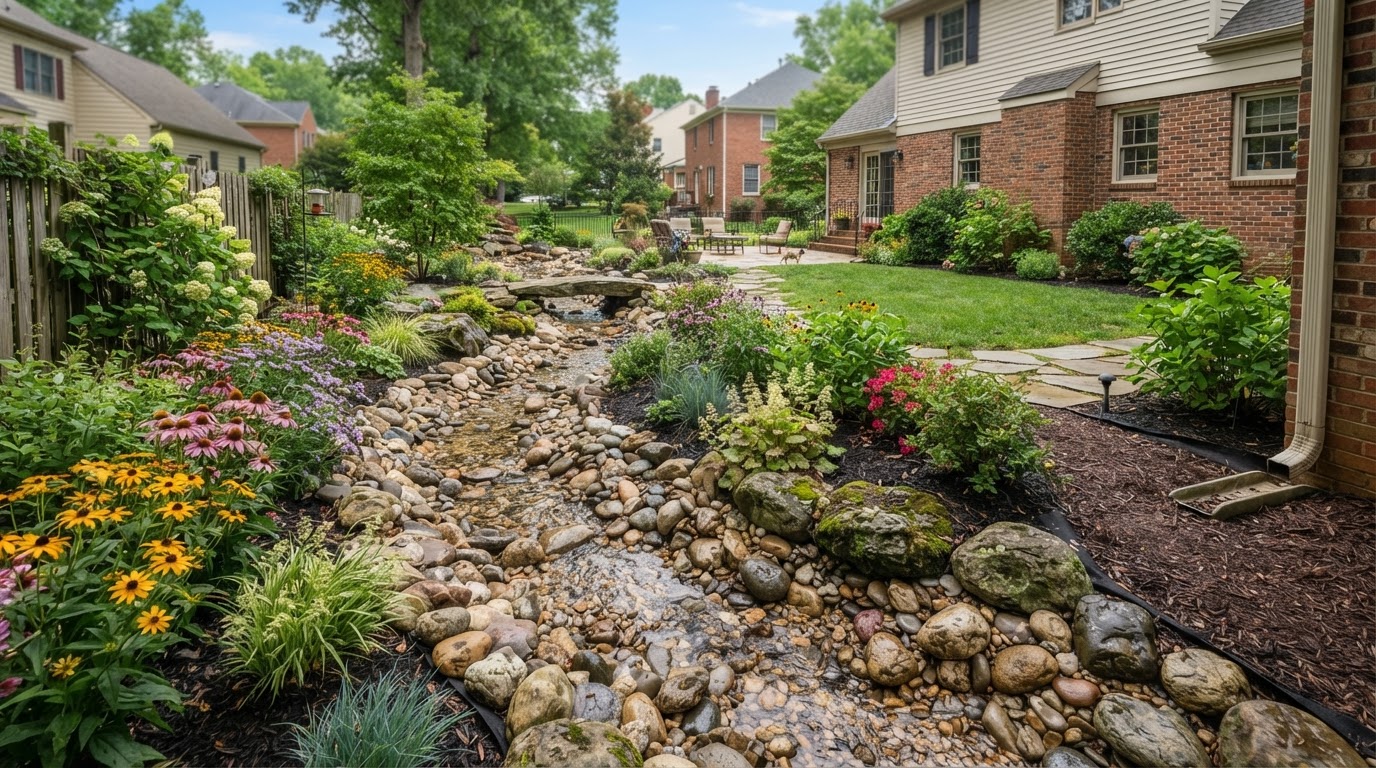
Concept visualization: Dry creek bed drainage feature with river stone
Provenance: Concept visualizationScope, Applications, and Homeowner Goals
This service addresses the design and installation of a stone-lined landscape feature with a defined purpose. It includes evaluating the homeowner's goal, existing flow paths, grade and alignment, stone selection, landscape integration, upstream and downstream conditions, sediment and debris, crossing points, planting, and maintenance. When the feature is intended to convey runoff, additional site evaluation is required to ensure the grade, stone, and destination support that role.
This page is distinct from the broad yard drainage solutions page, which evaluates overall water problems and selects an approach. A dry creek bed is one potential landscape feature within a broader plan — not a universal drainage solution. Decorative landscape rock installation addresses stone as a surface material; a dry creek bed addresses a linear stone feature with a defined role.
A feature can be both decorative and functional, but the drainage role requires real evaluation: the grade must carry water where intended, the stone must stay in place under flow, and the water must reach a suitable destination. A natural-looking feature still needs maintenance and planning when it carries runoff.
Defined purpose
Clarify whether the creek bed is decorative, functional, or both, and evaluate the site accordingly.
Grade and alignment
When conveying runoff, the grade and alignment must direct water along the intended path.
Stone selection
Choose stone size and type suited to the expected flow, the landscape character, and stability under water.
Downstream conditions
Plan where collected or conveyed water goes after it leaves the feature.
Materials, Methods, and Design Choices
The role of a dry creek bed determines what the site needs. The comparison below helps clarify the difference between a primarily decorative feature and one designed to carry intermittent runoff.
| Consideration | Decorative stone feature | Functional drainage feature |
|---|---|---|
| Primary role | Visual landscape interest evoking a natural stream | Conveying intermittent runoff along a defined path |
| Grade evaluation | Follows landscape aesthetics | Must direct water along the intended flow path |
| Stone stability | Selected for appearance | Must stay in place under flow without washing out |
| Downstream planning | May not carry water | Must connect to a suitable destination |
| Maintenance | Debris and weed management | Sediment, debris, and erosion checks at transitions |
Stone sizing
Stone size should match the expected flow — larger stone resists displacement, smaller stone fills gaps for a natural look.
Erosion at transitions
Where the creek bed meets other surfaces or discharges, erosion protection may be needed.
Crossing points
If the feature crosses a path or traffic area, stable crossing stones or a bridge must be planned.
Site Assessment and Project Planning
Before defining the work, several factors shape the approach: the homeowner's goal, existing flow paths, the grade and alignment, stone selection, upstream and downstream conditions, and the integration with surrounding landscape and planting. A decorative feature needs less evaluation than one designed to carry runoff, but both need honest planning.
Defined role
Clarify whether the feature is decorative, functional, or both — the evaluation differs accordingly.
Flow path
When conveying runoff, the existing flow path and grade must be evaluated to ensure water follows the intended route.
Stone stability
Stone must resist displacement under flow and suit the landscape character.
Destination
Collected or conveyed water must reach a suitable destination — it cannot be directed just anywhere.
Erosion at transitions
Where the creek bed meets other surfaces, erosion protection may be needed at the transitions.
Maintenance
Even a natural-looking feature needs debris, sediment, and weed management over time.
Germantown Context and Related Services
Properties across Germantown and Montgomery County, MD vary in slope, soil, and drainage patterns. A dry creek bed can be a useful landscape feature in many settings, but its drainage role depends on the actual grade and flow conditions at the property — not on an assumption that stone alone solves drainage.
Related completed pages: yard drainage solutions provides the broader assessment framework, and landscape erosion control addresses soil movement that a creek bed may help manage. Decorative landscape rock installation addresses stone as a surface material more broadly.
Dry Creek Bed Installation Questions
A dry creek bed can be decorative, functional, or both — the role determines the evaluation. Call to talk through your goals and site conditions, or request an estimate to begin planning a feature that fits your property.
Can a dry creek bed be decorative as well as functional?↓
Yes, but the drainage role requires real evaluation. A feature can evoke a natural stream while also conveying runoff — but the grade must direct water along the intended path, the stone must stay in place under flow, and the water must reach a suitable destination. Adding stone without that evaluation does not create a drainage solution.
How is its route selected?↓
When the feature carries runoff, the route follows the existing flow path and grade. A decorative-only feature can follow landscape aesthetics more freely. The route determines whether water goes where intended or creates new problems at the edges.
Does adding stone automatically fix erosion?↓
No. Stone can help stabilize a surface, but erosion at transitions, edges, and the downstream end still needs attention. The stone must be sized for the expected flow and the grade must carry water without scouring around the stones.
Where should collected or conveyed water go?↓
Collected or conveyed water must reach a suitable destination — a safe surface discharge, an infiltration feature, or an approved connection. A dry creek bed does not eliminate the need for a destination; it conveys water to one.
What maintenance should be expected?↓
Debris, sediment, and weed management are part of owning a dry creek bed, even a natural-looking one. At transitions where the feature meets other surfaces, erosion checks may be needed periodically. A feature designed to carry runoff may need sediment cleaning to maintain flow.
Discuss Your Project
Call our team based in Germantown, MD to talk through scope, site considerations, and next steps — or request an estimate and we will follow up.