
Landscape Erosion Control Germantown
Landscape erosion control addresses soil movement on slopes, planted areas, and disturbed ground — the visible loss of soil, sediment movement, and concentrated runoff that gradually wears away a landscape. It is distinct from simple unevenness, routine lawn wear, or settlement, and the conditions that cause it must be evaluated before selecting a stabilization approach. Germantown Hardscape & Pavers helps property owners in Germantown, MD assess soil movement and the conditions contributing to it.
The main decision is what kind of soil movement is occurring and what is causing it — concentrated runoff, inadequate vegetation, slope conditions, or water moving across disturbed ground. The cause determines whether planting, surface protection, water management, or a combination of approaches is appropriate.
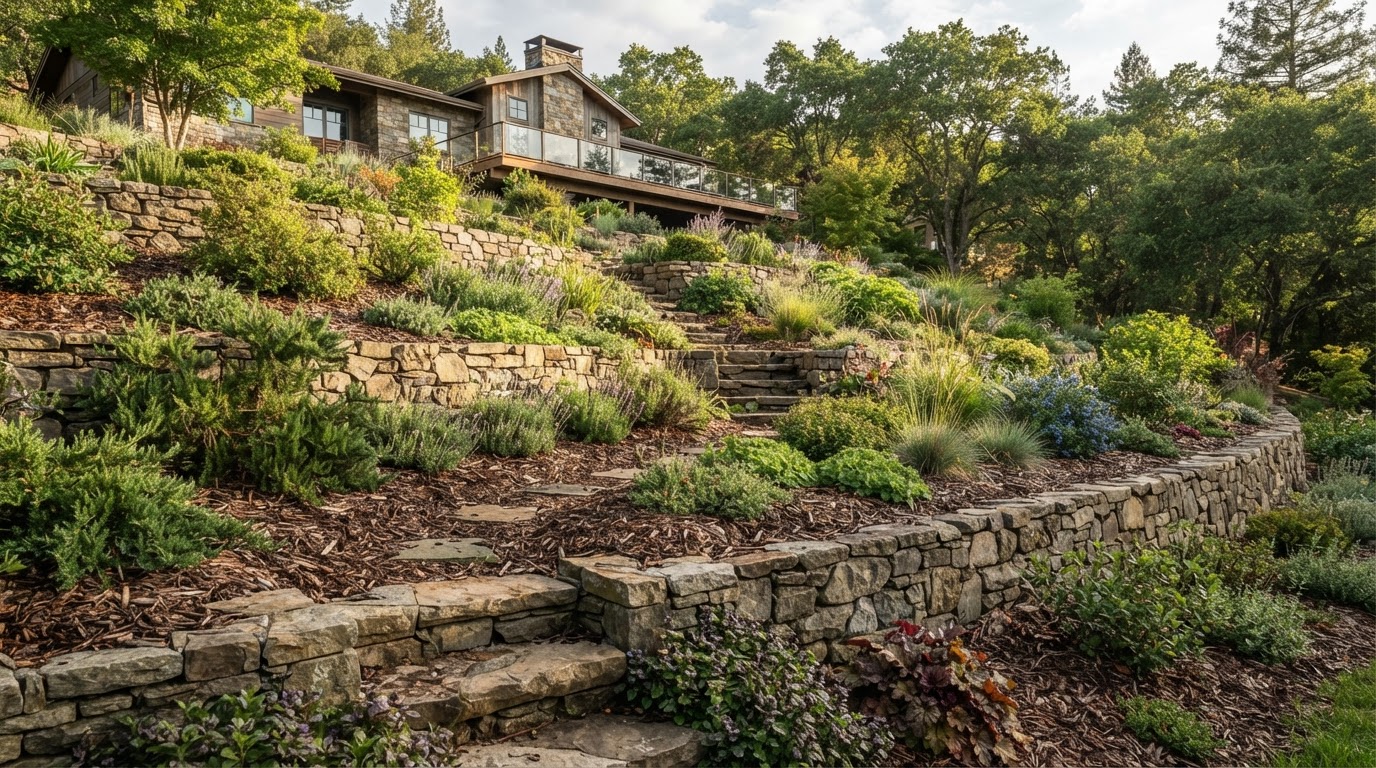
Concept visualization: Stabilized slope with plantings and stone terracing for erosion control
Provenance: Concept visualizationScope, Applications, and Homeowner Goals
This service addresses landscape soil movement through site-specific stabilization and water-management considerations. It includes evaluating exposed soil, sediment movement, concentrated runoff, sloped planting or lawn areas, water moving across newly disturbed ground, and inadequate vegetation or unsuitable surface protection. The assessment considers connections between drainage and soil stabilization, the establishment and maintenance of protective planting, access and restoration, and when a problem extends beyond ordinary landscape work.
This page is distinct from yard grading and leveling, which reshapes elevations, and from yard drainage solutions, which manages water. Erosion control focuses specifically on preventing or correcting soil movement — keeping soil in place on slopes, protecting disturbed ground, and managing the water flow that causes movement. The three are related and often combined, but each addresses a different part of the problem.
Erosion is distinguished from simple unevenness, routine lawn wear, and settlement — these are different conditions that may look similar but have different causes and solutions. Erosion is the movement of soil by water or gravity, and the conditions that cause it — slope, runoff, inadequate cover — must be evaluated before selecting an approach. Not every slope needs engineered stabilization, but not every slope can be stabilized with mulch and planting alone.
Soil movement assessment
Soil movement is evaluated for its cause — concentrated runoff, inadequate vegetation, slope conditions, or disturbed ground — rather than assuming every slope needs the same treatment.
Water flow and drainage connections
Water moving across the surface is often the cause of erosion. Drainage and soil stabilization are evaluated together because managing water flow is part of preventing soil movement.
Protective planting and ground cover
Establishing appropriate vegetation is part of slope stabilization, but not every plant or ground cover is suitable for every slope, sun exposure, or soil condition.
Surface protection materials
Mulch, decorative rock, matting, or other materials may protect disturbed soil, but their suitability depends on slope, runoff volume, and the specific site conditions — not a universal recommendation.
When more than landscape work is needed
If substantial movement, undermining, or a threat to structures is present, qualified assessment may be needed before landscape work proceeds. Ordinary landscape installation does not replace engineered stabilization.
Materials, Methods, and Design Choices
Possible approaches to erosion control include establishing appropriate vegetation, protecting disturbed soil with mulch or matting, managing concentrated water flow with drainage adjustments, selecting suitable stabilization materials, and coordinating grade changes or retaining features when justified. The assessment guide below pairs observable soil movement with possible contributing conditions and questions to evaluate.
No single approach stabilizes every slope. Mulch works on gentle grades with light runoff but may wash away on steeper slopes. Decorative rock may slow surface flow but is not automatically effective erosion control. Sod may stabilize a moderate slope but is unsuitable for steep grades or areas with concentrated runoff. Planting helps but needs establishment time and may not address an active erosion problem immediately. The right approach depends on the slope, the water, the soil, and the conditions — and if substantial movement or a threat to structures is present, qualified assessment may be needed before landscape work proceeds.
| Observed movement | Possible contributing conditions | Questions to evaluate |
|---|---|---|
| Surface soil loss | Concentrated runoff, inadequate cover | Where does water concentrate? What cover exists? |
| Slope rilling | Steep grade, high-velocity flow | What is the slope? Can flow be slowed or spread? |
| Gully formation | Persistent concentrated flow | What is the water source? Can it be redirected? |
| Undermining | Subsurface flow, structural proximity | Is a structure at risk? Is qualified assessment needed? |
Vegetation and ground cover
Appropriate plants selected for the slope's sun, soil, and moisture conditions — suited to stabilizing moderate grades but requiring establishment time and ongoing maintenance, not an instant fix.
Surface protection
Mulch, matting, or decorative rock that protects disturbed soil — suited to specific conditions but not universally effective on every slope or runoff volume. The material is selected for the site, not assumed to work everywhere.
Drainage coordination
Managing the water flow that causes erosion — grading, swales, or collection that slow or redirect concentrated runoff before it reaches the eroding area. Drainage and stabilization are evaluated together.
Site Assessment and Project Planning
An erosion assessment starts with observation — what kind of soil movement is occurring, where, and what conditions contribute to it. The assessment distinguishes erosion from routine lawn wear, settlement, and structural slope instability, which are different conditions with different causes. Exposed soil, sediment movement, concentrated runoff, slope conditions, and the adequacy of existing vegetation or surface protection are evaluated at the property.
The assessment uses conditional language because observations guide evaluation rather than serving as a definitive diagnosis. If substantial movement, undermining, or a threat to structures is described, the assessment explains that qualified assessment may be needed before landscape work proceeds. Ordinary landscape installation does not replace engineered stabilization, and not every slope can be stabilized with mulch, rock, or planting alone.
Type of soil movement
Is it surface soil loss, slope rilling, gully formation, or undermining? Each indicates different conditions and may require a different stabilization approach. The type of movement is distinguished from routine lawn wear and settlement.
Water source and flow pattern
Where does the water that causes erosion come from — roof runoff, slope, surface flow, or subsurface? What path does it take? Managing the water flow is often part of the solution, not just stabilizing the soil surface.
Slope and soil conditions
What is the slope angle, and what is the soil type? Steep slopes and loose soils are more prone to erosion, and the stabilization approach depends on both — mulch and planting may suit a gentle slope but not a steep one.
Existing vegetation and cover
What vegetation or ground cover exists, and is it adequate? Inadequate cover is a common contributor, and establishing appropriate vegetation is part of the solution — but it needs time to establish.
Structural proximity
Is the erosion near a building, wall, pavement, or property boundary? If substantial movement or undermining threatens a structure, qualified assessment may be needed before landscape work proceeds.
Beyond ordinary landscape work
Does the problem extend beyond what landscape installation can address? Stream or wetland buffers, protected areas, or engineered slope instability may require additional assessment and are not resolved by ordinary landscape work alone.
Germantown Context and Related Services
Properties in Germantown and across Montgomery County, MD vary in slope, soil type, runoff patterns, and the relationship between erosion and nearby structures. Erosion control is evaluated for the specific property's conditions — not from a universal slope treatment assumed to work on every hill. Sloped lots, properties with concentrated runoff, and areas near streams or drainage corridors each present different stabilization considerations.
Erosion control often connects to other landscape work. Related completed pages describe the yard drainage that manages the water causing erosion, the yard grading that shapes surface flow, and the tree and shrub planting that stabilizes slopes with established vegetation.
Related Completed Services
Landscape Erosion Control Questions
Erosion control is a soil and water assessment decision, not just adding mulch or planting. Call to talk through your slope conditions and erosion concerns, or request an estimate to begin evaluating which stabilization approach fits your property.
How does erosion differ from an uneven lawn?↓
Erosion is the active movement of soil by water or gravity — visible soil loss, sediment movement, rilling, or gully formation. An uneven lawn may have depressions from settlement or wear without active soil movement. Erosion requires stabilization of the soil and management of the water causing the movement; an uneven lawn may need grading or filling. The conditions are evaluated separately because they have different causes and solutions.
Why should water flow be considered before replacing lost soil?↓
Replacing lost soil without addressing the water that caused the erosion means the new soil may wash away too. The water source and flow pattern are evaluated before stabilization so the approach addresses the cause, not just the symptom. Managing water flow — through drainage, grading, or flow redirection — is often part of the solution alongside replacing or stabilizing soil.
Can planting help stabilize a landscape area?↓
Yes, appropriate vegetation helps stabilize soil with roots that hold the ground and cover that slows surface flow. But plants need establishment time, are selected for the site's sun, soil, and moisture conditions, and may not address an active erosion problem immediately. Planting is one part of a stabilization approach, not a universal solution for every slope or erosion condition.
Is sod suitable for every sloped area?↓
No. Sod may stabilize a moderate slope with gentle grades but can be unsuitable for steep slopes or areas with concentrated runoff that may wash it away before it roots. The slope angle, runoff volume, and site conditions determine whether sod is appropriate or whether another stabilization approach — such as planting, matting, or drainage management — fits better.
When might erosion require more than routine landscape work?↓
When substantial movement, undermining, or a threat to structures is present; when the erosion involves stream banks, wetland buffers, or protected areas; or when slope instability extends beyond what landscape installation can address. In those cases, qualified assessment may be needed before landscape work proceeds, and ordinary landscape installation does not replace engineered stabilization.
What should homeowners document before discussing the problem?↓
Photos of the eroding area during and after rainfall, observations about where water comes from and how it flows, the slope's general angle, what vegetation or cover exists, and whether the movement is near any structures. This information helps with an initial discussion before a site assessment determines the appropriate stabilization approach.
Discuss Your Project
Call our team based in Germantown, MD to talk through scope, site considerations, and next steps — or request an estimate and we will follow up.