Invasive Plant Removal & Landscape Restoration Germantown
Invasive plant removal and landscape restoration begins with accurate identification — distinguishing an invasive plant from a native plant that spreads vigorously, an ordinary unwanted plant, or an overgrown but noninvasive landscape planting. Once the species is identified, the removal or management approach is planned, and the disturbed area is restored with stable, site-appropriate planting. Germantown Hardscape & Pavers helps property owners in Germantown, MD evaluate invasive vegetation and plan removal and restoration together.
The main decision is not just how to remove the plants but how to restore the area afterward. Removing invasive vegetation without a restoration plan often leaves bare soil that invites the same or new invasive species to return. Understanding that removal and restoration should be planned together sets the project up for lasting results rather than a recurring problem.
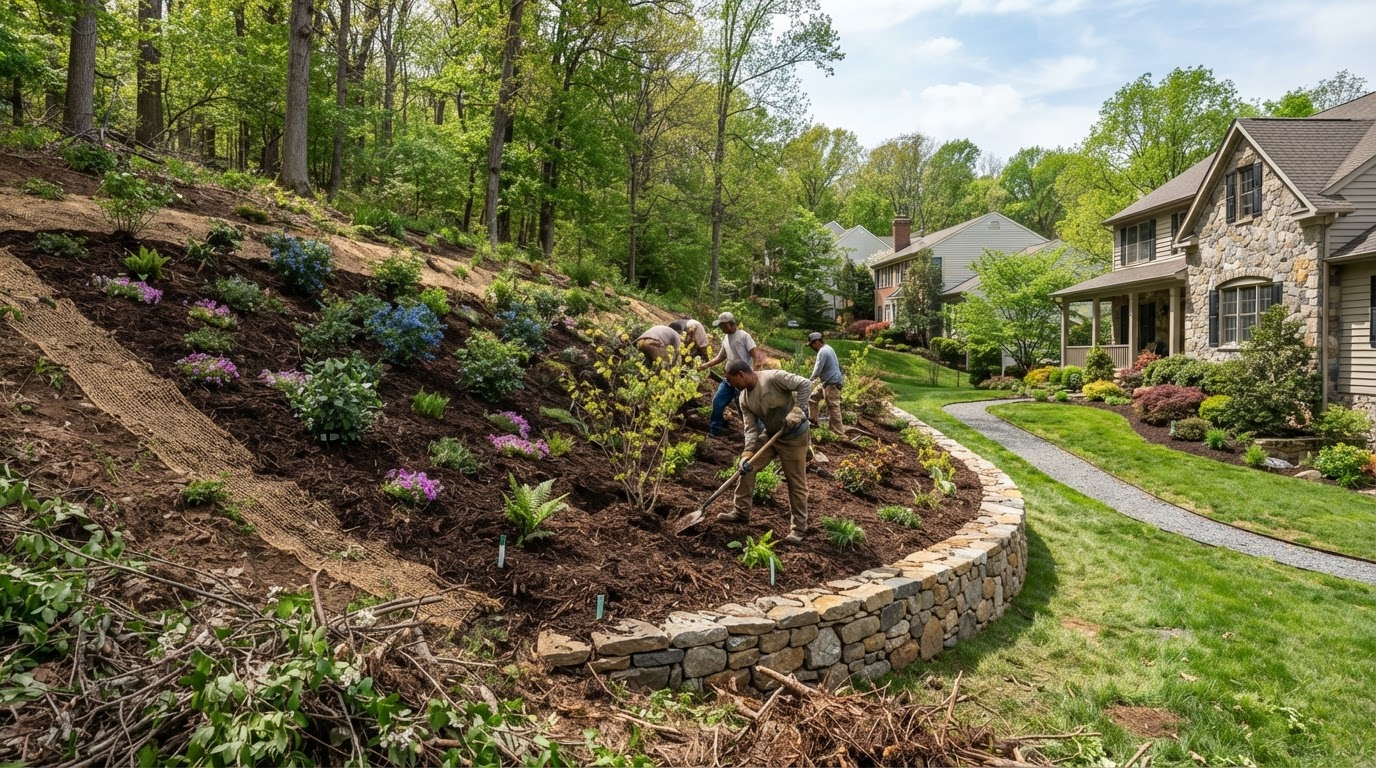
Concept visualization: Invasive plant removal and landscape restoration
Provenance: Concept visualizationScope, Applications, and Homeowner Goals
This service addresses the identification, removal or management, and restoration of areas affected by invasive vegetation. It includes identifying the species, understanding the affected area, growth form and regeneration potential, adjacent desirable plants, roots and nearby structures and utilities, access, appropriate removal or management options, disposal considerations, follow-up monitoring, and replanting and stabilization. Removal and restoration are planned together because clearing without replanting often leaves conditions that invite the same problem to return.
This page is distinct from the broad landscape renovation page, which addresses updating an existing landscape generally. Invasive plant removal is a specific restoration challenge that begins with accurate identification and requires follow-up management. Garden bed design and installation addresses new beds; this page addresses restoring areas where invasive growth has been removed.
One visit does not guarantee permanent eradication. Many invasive species regenerate from roots, seeds, or fragments, so follow-up monitoring and management are part of a complete approach. A plan that removes visible growth but does not address regeneration or replant the area is not a complete restoration.
Accurate identification
Distinguish invasive species from native plants that spread, overgrown ornamentals, or ordinary weeds.
Management approach
Plan removal, suppression, or management based on the species' growth form and regeneration potential.
Restoration
Replant the disturbed area with stable, site-appropriate cover to prevent re-invasion and erosion.
Follow-up
Plan monitoring and follow-up management because many invasive species regenerate after initial removal.
Materials, Methods, and Design Choices
Removal and restoration should be planned together. The decision guide below frames the sequence from identification through follow-up — not as a one-step process.
| Step | What it involves | Why it matters |
|---|---|---|
| Identification | Confirm the species and its invasive status | Determines the appropriate management approach |
| Management | Remove or suppress growth based on regeneration potential | Different species require different approaches |
| Restoration | Replant the disturbed area with stable cover | Prevents re-invasion and erosion of bare soil |
| Follow-up | Monitor for regeneration and re-treat as needed | Many species return from roots, seeds, or fragments |
Regeneration potential
Some invasive species regenerate from roots, rhizomes, or seeds left in the soil; follow-up management must address this.
Disposal considerations
Not all removed material can be composted or discarded the same way; some species require specific disposal to prevent spread.
Replanting and stabilization
Restoring the area with stable, site-appropriate planting helps prevent re-invasion and soil erosion.
Site Assessment and Project Planning
Before defining the work, several factors shape the approach: accurate species identification, the extent of the affected area, the growth form and regeneration potential of the invasive plant, adjacent desirable plants to protect, roots and nearby structures and utilities, access for removal, disposal considerations, and applicable restrictions on vegetation clearing or chemical treatment. Where protected areas, easements, or sensitive habitats may be involved, those restrictions must be checked before work begins.
Species identification
Accurate identification determines whether a plant is invasive, native but aggressive, or simply unwanted — each requires a different approach.
Regeneration potential
Understanding how the species regenerates — from roots, seeds, or fragments — determines whether one removal is sufficient or follow-up is needed.
Adjacent desirable plants
Removal must avoid damaging nearby plants worth retaining; the approach should protect desirable vegetation.
Disposal
Removed material disposal must prevent spread; not all species can be composted or discarded identically.
Restoration approach
Replanting with stable, site-appropriate cover helps prevent re-invasion and erosion of bare soil.
Restricted areas
Where easements, protected habitats, or local restrictions apply, clearing or chemical treatment may be limited or require approval.
Germantown Context and Related Services
Invasive plant pressure across Germantown and Montgomery County, MD varies by location, proximity to wooded areas, and disturbance history. Whether invasive removal is needed and what approach fits depends on accurate identification of the species at the property — not on a generic removal plan.
Related completed pages: landscape renovation addresses broader landscape updates, and landscape erosion control addresses soil movement that may accompany invasive removal. Native plant and conservation landscaping can guide the restoration planting after invasive growth is removed.
Related Completed Services
Invasive Plant Removal & Landscape Restoration Questions
Invasive plant removal and restoration should be planned together, not as separate steps. Call to talk through what is growing on your property and what restoration should follow, or request an estimate to begin evaluating the approach.
How is an invasive plant distinguished from other unwanted growth?↓
An invasive plant is a non-native species that spreads aggressively and causes environmental or economic harm. It differs from a native plant that spreads vigorously, an overgrown ornamental, or an ordinary weed. Accurate identification — confirmed through authoritative regional sources — determines the appropriate management approach.
Why can follow-up management be necessary?↓
Many invasive species regenerate from roots, rhizomes, seeds, or fragments left in the soil after initial removal. A single visit may clear visible growth but not prevent regrowth. Follow-up monitoring and re-treatment are part of a complete approach, not optional extras.
Should replacement planting be planned before removal?↓
Yes. Removing invasive growth without a restoration plan leaves bare soil that invites the same or new invasive species to return, and may cause erosion on slopes. Planning replanting alongside removal ensures the disturbed area is stabilized with stable, site-appropriate cover.
Can removal affect nearby desirable plants?↓
Yes. The removal approach must account for adjacent desirable plants to avoid damaging them during extraction. Some methods are more selective than others, and the approach should protect plants worth retaining while effectively removing the invasive species.
What determines the restoration approach?↓
The restoration approach depends on the site conditions — sun, shade, soil, slope — and the planting goals for the restored area. A stable, site-appropriate planting that prevents re-invasion and erosion is more effective than simply clearing the area and leaving it bare.
Discuss Your Project
Call our team based in Germantown, MD to talk through scope, site considerations, and next steps — or request an estimate and we will follow up.