
Patio Extension & Expansion Germantown
A patio that no longer fits how you use the yard can often be expanded rather than replaced. The challenge of an extension is not the new section — it is the seam where the new meets the old. Matching the existing paver texture, pattern, and elevation while extending the base beneath so the addition does not settle independently is what makes an extension read as one surface. Germantown Hardscape & Pavers extends patios in Germantown, MD by tying the new base and edge restraint into the existing, matching the stone, and integrating seating walls or steps where the expanded edge meets the grade.
The main decision is whether the existing patio surface and base are sound enough to extend from, or whether the settling or drainage that made it too small has also compromised it. A sound surface extends cleanly; a patio that has already settled or spread needs that repair folded into the extension so the new section does not inherit the old problems.
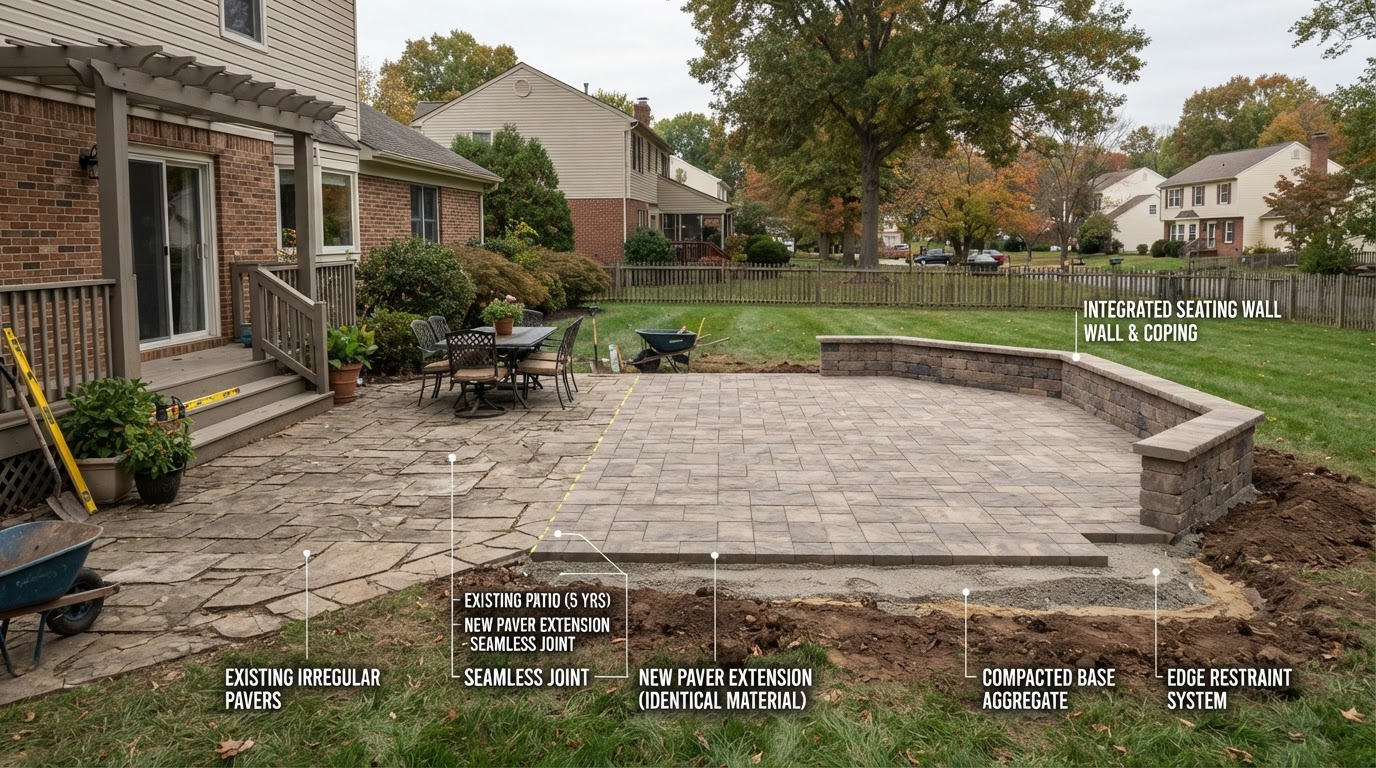
Concept visualization: Patio extension and expansion matching existing pavers
Provenance: Concept visualizationScope, Applications, and Homeowner Goals
This service addresses existing paver or stone patios that need more usable area — more seating, a dining zone, a fire feature, or room for an outdoor kitchen — by adding new paving tied into the existing surface. It includes extending the base foundation, matching the existing paver or stone, tying the new edge restraint into the old, and integrating seating walls, steps, or transitions where the expanded edge meets the grade.
This page is distinct from paver patio installation, which builds a new patio from scratch, and from sunken paver repair, which levels an existing surface without enlarging it. An extension is an enlargement that matches the existing; where the existing patio has settled or spread, that repair is folded in so the extension does not inherit the cause. Where the goal is a fully redesigned layout rather than an enlargement, landscape renovation is the broader scope.
Choosing between a like-for-like extension that matches the existing surface and a redesigned expansion that reworks the whole patio depends on whether the current layout is the right shape and just too small, or whether the layout itself needs to change. The extension matches what is there; the redesign reworks it.
Base foundation extension
The compacted crushed-stone base is extended beneath the new section and tied into the existing so the addition does not settle independently of the old surface.
Paver and stone matching
The new section matches the existing paver texture, color, and pattern so the extension reads as one continuous surface rather than an obvious add-on.
Edge restraint tie-in
The new perimeter restraint connects to the existing edge so the extended field stays interlocked and the seam between old and new does not spread.
Seating wall and step integration
Where the expanded edge meets a grade change, seating walls or steps are integrated so the extension transitions cleanly into the surrounding yard.
Materials, Methods, and Design Choices
The comparison below distinguishes a like-for-like extension from a full redesign — and why extending a surface without matching the base creates a visible settling seam.
| Consideration | Like-for-like extension | Full patio redesign | Add-on without base tie-in (not recommended) |
|---|---|---|---|
| What it does | Enlarges matching the existing | Reworks the whole layout | Adds paving, leaves the seam |
| Seam visibility | Minimal — matched texture | None — new surface | Visible — settles independently |
| When it fits | Current shape is right, too small | Layout itself needs to change | Never a real extension |
| Existing surface | Kept and matched | Replaced | Left as-is |
| What it cannot do | Does not change the layout | Higher cost and disruption | Does not tie in the base |
Matched paver or stone
The new section uses a paver or stone that matches the existing texture, color, and pattern. Where the original product is discontinued, the closest available match is selected so the extension reads as continuous.
Extended base foundation
The compacted base is extended beneath the new section and tied into the existing subgrade. A new section built on its own independent base settles at a different rate and creates a visible lip at the seam.
Integrated edge and transitions
The new edge restraint ties into the existing perimeter, and seating walls or steps integrate where the expanded edge meets a grade change so the extension transitions rather than terminating abruptly.
Site Assessment and Project Planning
Before defining the extension, several factors shape the approach: the condition of the existing surface and base, whether the existing paver or stone is still available to match, the grade at the expanded edge, and how the extension connects to drainage and access. Extending a patio whose base has already settled inherits that settling at the seam.
Existing surface condition
The existing patio is evaluated for settling, spreading, or drainage problems that should be repaired as part of the extension so the new section does not inherit them.
Base tie-in
The extended base is connected to the existing subgrade so the addition settles with the original rather than independently, which creates a lip at the seam.
Paver and stone match
The existing product is identified and matched — or the closest available substitute selected where the original is discontinued — so the extension reads as one surface.
Grade and transitions
Where the expanded edge meets a slope or grade change, seating walls, steps, or a retaining edge are planned so the extension transitions cleanly into the yard.
Drainage continuity
The extension's pitch and drainage tie into the existing surface drainage so water sheds across the whole patio rather than pooling at the new seam.
Access and use
How the expanded area will be used — dining, a fire feature, seating — is mapped so the size and integration of the extension fit the actual purpose.
Germantown Context and Related Services
Across Germantown and Montgomery County, MD, the most common patio extension mistake is adding paving without tying the new base into the existing subgrade, which creates a visible settling lip at the seam within a season or two. A sound existing surface extends cleanly; one that has already settled or spread needs that repair folded into the extension so the addition does not inherit the cause.
Related completed pages: paver patio installation covers the full new-build standard the extension matches, patio seating wall installation addresses the integrated walls at the expanded edge, and sunken paver repair handles the existing-surface problems that should be fixed before or as part of the extension.
Patio Extension & Expansion Questions
A patio extension is a matching and base-tie-in problem. Call to describe the existing surface, how much more area you need, and how you want to use it, or request an estimate to evaluate whether a like-for-like extension or a redesign fits your yard.
Can you match my existing pavers on the extension?↓
In most cases, yes. The existing paver texture, color, and pattern are matched so the extension reads as one continuous surface. Where the original product has been discontinued, the closest available match is selected and discussed before installation.
Why would the new section settle separately from the old patio?↓
If the new base is not tied into the existing subgrade, the addition compacts and settles at a different rate than the original, creating a visible lip at the seam. Extending the base and connecting it to the existing subgrade is what keeps the two surfaces level with each other.
Should I fix the existing patio before extending it?↓
If the existing surface has settled, spread, or has a drainage problem, that should be repaired as part of the extension so the new section does not inherit it. Extending a patio that is already failing builds the new problems into the seam.
Can the extension include a seating wall or steps?↓
Yes. Where the expanded edge meets a grade change, a seating wall or steps can be integrated so the extension transitions cleanly into the yard rather than terminating abruptly at a drop-off.
Is an extension cheaper than replacing the whole patio?↓
Usually, when the existing surface is sound and the right shape — just too small. If the layout itself needs to change or the existing patio is failing broadly, a full redesign may be the better value. The choice depends on whether the current shape is the right one.
Discuss Your Project
Call our team based in Germantown, MD to talk through scope, site considerations, and next steps — or request an estimate and we will follow up.