
Pond & Water Feature Installation Germantown
Pond and water feature installation brings the sound, movement, and visual appeal of water into the landscape — a garden pond, a freestanding fountain, or a recirculating waterfall with a concealed reservoir. These are decorative landscape features, not drainage systems or stormwater-management facilities, and their selection depends on the desired visual effect, available space, and the maintenance the homeowner is prepared to provide. Germantown Hardscape & Pavers helps property owners in Germantown, MD plan water features that suit their landscape and their maintenance expectations.
The main decision is what the feature should accomplish visually and audibly — a still reflecting pool, a bubbling fountain, a cascading waterfall, or a planted pond — and how the available space, viewing locations, and maintenance capacity shape the choice. Not every feature is maintenance-free, and not every property supports every type.
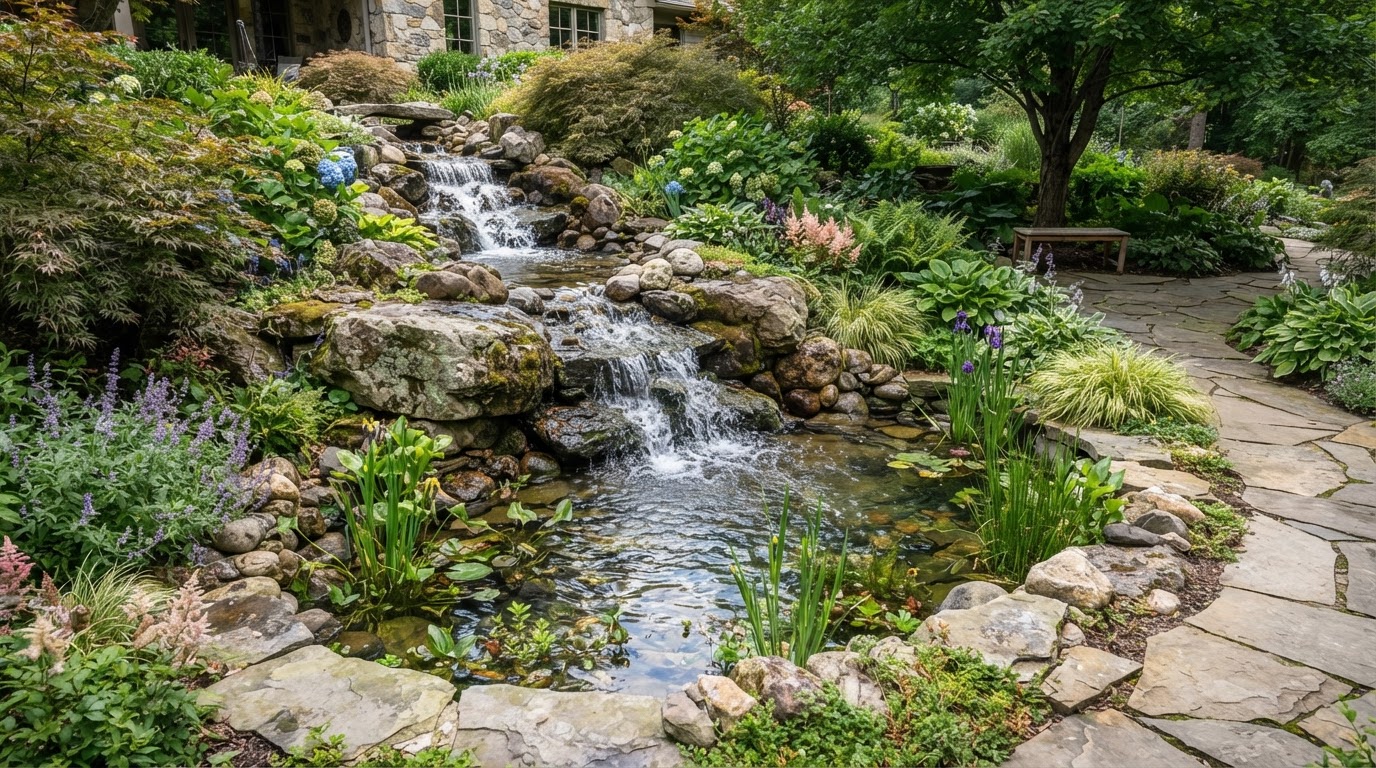
Concept visualization: Decorative water feature with natural stone and landscape integration
Provenance: Concept visualizationScope, Applications, and Homeowner Goals
This service covers decorative landscape water features — ponds, fountains, and recirculating waterfalls. It includes evaluating the desired visual effect and sound, available space, viewing locations, proximity to seating or windows, water visibility and access, basin or reservoir considerations, pumps and filtration where applicable, electrical supply and appropriate qualified involvement, water access, maintenance access, seasonal care, and planting integration. Each type of feature introduces different space, system, and maintenance considerations.
This page is distinct from the yard drainage solutions page because these are decorative features, not drainage systems. A water feature adds visual and auditory interest to the landscape; a drainage system manages stormwater. The two serve different purposes and should not be confused — a decorative pond does not solve a yard drainage problem, and a drainage system is not a water feature.
If fish or aquatic planting are part of the goal, these introduce additional habitat, maintenance, and system considerations beyond a purely decorative water feature. Not every decorative pond is designed for fish, and adding aquatic life increases the complexity of the system, the maintenance, and the planning. The homeowner's goals and maintenance capacity guide the type of feature that fits the property.
Visual effect and sound
The desired appearance — still water, falling water, or a bubbling fountain — and the desired sound level guide the type of feature selected. A reflecting pool, a waterfall, and a fountain create very different experiences.
Space and viewing location
The available space, the viewing angle from seating or windows, and the proximity to gathering areas all affect the feature's size, placement, and type. A small fountain and a pond with surrounding planting have different space requirements.
Basin, pump, and filtration
Most recirculating features need a basin or reservoir, a pump, and in some cases filtration. These system components are selected for the feature's size and type, and they introduce maintenance and access considerations.
Electrical and qualified involvement
Pumps and lighting require electrical supply and appropriately qualified electrical work. This is a separate scope consideration from the landscape and water feature itself, and the availability of power near the feature location is part of the planning.
Maintenance and seasonal care
Water features are not maintenance-free. Cleaning, pump upkeep, water level management, and seasonal shutdown or winterization are part of owning a feature, and the maintenance capacity of the homeowner guides what type of feature is appropriate.
Materials, Methods, and Design Choices
The key distinction is between a pond, a freestanding fountain, and a recirculating waterfall with a concealed reservoir. A pond creates a body of water that may support plants and, if designed for it, fish — but requires more space, water management, and maintenance. A freestanding fountain is a self-contained feature with a basin, suited to smaller spaces and lower maintenance. A recirculating waterfall with a concealed reservoir creates the sound and visual of falling water without an exposed pond, using a hidden basin that recirculates the water. The comparison below shows how these differ.
No water feature is maintenance-free, and the maintenance commitment varies with the type. Moving water does not guarantee the absence of mosquitoes — standing water in a pond can be a breeding site without proper management. A concealed reservoir does not eliminate all safety considerations, particularly for properties with small children. Decorative water features do not solve yard drainage problems, and not every feature supports fish or wildlife safely. Water use and operating costs are real considerations that depend on the feature's size, evaporation rate, and local conditions.
| Consideration | Garden pond | Freestanding fountain | Recirculating waterfall |
|---|---|---|---|
| Appearance | Reflecting water body | Vertical water display | Cascading water over stone |
| Space needs | Largest — pond area | Smallest — basin footprint | Medium — reservoir width |
| Water exposure | Open water surface | Limited — basin collection | Minimal — concealed reservoir |
| Sound | Gentle or still | Bubbling or splashing | Variable with drop height |
| Maintenance | Highest — water, plants, fish care | Moderate — cleaning, pump | Moderate — reservoir access |
Garden ponds
A body of water that may support aquatic plants and, if designed for it, fish — requiring the most space, water management, and maintenance of the three types. Ponds create a naturalistic water feature but introduce habitat and seasonal care considerations.
Freestanding fountains
A self-contained water feature with a basin that recirculates water — suited to smaller spaces and lower maintenance, offering a vertical water display and audible water movement without an open pond.
Recirculating waterfalls
A waterfall feature with a concealed reservoir that recirculates water over stone or a constructed cascade — creating the visual and sound of falling water without an exposed pond, with moderate maintenance and access needs for the reservoir and pump.
Site Assessment and Project Planning
A water feature assessment evaluates the available space, viewing locations, proximity to seating and windows, electrical supply availability, water access, and the maintenance the homeowner is prepared to provide. The assessment also considers safety — open water in a pond, even a shallow one, is a consideration for properties with small children, and a concealed reservoir does not eliminate all safety concerns. The type of feature selected should match both the site and the owner's maintenance capacity.
If fish or aquatic plants are part of the goal, the assessment addresses the additional system complexity — filtration, water quality management, and seasonal care that a purely decorative feature does not require. Electrical supply for pumps and lighting is evaluated as a separate scope consideration requiring appropriately qualified work. The assessment does not provide electrical wiring instructions, pump-sizing formulas, or excavation specifications, and does not claim the company performs engineering or electrical work in-house.
Available space and placement
How much space is available, and where will the feature be viewed from? A pond needs more area than a fountain, and the viewing angle from seating areas and windows affects the feature's size and orientation.
Electrical supply availability
Is power available near the feature location for pumps and lighting? Electrical work requires appropriately qualified involvement and is a separate scope decision from the landscape and water feature itself.
Maintenance capacity
How much maintenance is the homeowner prepared to provide? A pond with plants and fish requires more ongoing care than a self-contained fountain. The maintenance commitment should match the feature type selected.
Safety and water exposure
Does the property have small children or pets? Open water in a pond, even shallow, is a safety consideration. A concealed reservoir reduces but does not eliminate water-access concerns, and the feature's design should account for the property's users.
Fish or aquatic plants
If fish or aquatic plants are part of the goal, the feature needs additional system capacity — filtration, water quality management, and seasonal care. Not every decorative water feature is designed to support fish, and adding aquatic life increases complexity.
Planting integration
How does the water feature integrate with surrounding landscape and planting? A pond may support aquatic plants, and the surrounding landscape should complement the feature while allowing maintenance access to pumps and basins.
Germantown Context and Related Services
Properties in Germantown and across Montgomery County, MD vary in available space, sun exposure, soil conditions, and the relationship between water features and the surrounding landscape. Water feature selection is evaluated for the specific property — not from a universal design assumed to fit every yard. The available space, viewing locations, and maintenance capacity of the homeowner guide the type and size of the feature.
Water features often integrate with broader landscape plans. Related completed pages describe the coordinated landscape design that may include a water feature as part of a property-wide plan, the patio installation it may sit beside, and the landscape lighting that can extend enjoyment of the feature into the evening.
Pond & Water Feature Installation Questions
A water feature is a decorative landscape decision that depends on your space, viewing goals, and maintenance capacity. Call to talk through your water feature ideas, or request an estimate to begin planning a feature that fits your landscape and your maintenance expectations.
How should a water feature be selected for the available space?↓
By evaluating the space available, the desired visual effect and sound, the viewing angle from seating and windows, the proximity to gathering areas, and the maintenance the homeowner is prepared to provide. A pond needs more space and maintenance, a fountain suits smaller spaces, and a concealed-reservoir waterfall offers a middle ground. The site and the owner's goals guide the choice.
What is the difference between a pond and a concealed-reservoir feature?↓
A pond creates an open body of water that may support plants and fish but requires more space, water management, and maintenance. A concealed-reservoir feature — such as a recirculating waterfall — creates the visual and sound of falling water without an exposed pond, using a hidden basin that recirculates the water. The two have different space, safety, and maintenance profiles.
What maintenance should be considered before installation?↓
Cleaning, pump upkeep, water level management, and seasonal shutdown or winterization are part of owning a water feature. Ponds with plants or fish require more care than self-contained fountains. The maintenance commitment should match the feature type — no water feature is maintenance-free, and the owner's capacity to provide ongoing care should guide the selection.
Can a feature be planned beside an existing patio?↓
Yes. A water feature can be planned beside or integrated with an existing patio, but the placement should consider viewing angles, electrical supply for pumps, water access for filling, and maintenance access. The feature should complement the patio without obstructing circulation or creating safety concerns.
What changes if fish or aquatic plants are part of the goal?↓
Fish and aquatic plants introduce additional system requirements — filtration, water quality management, and seasonal care that a purely decorative feature does not need. Not every water feature is designed to support fish, and adding aquatic life increases the complexity, cost, and maintenance of the system. The feature's design must account for these needs from the start.
Does a decorative water feature replace a yard drainage solution?↓
No. A decorative water feature adds visual and auditory interest to the landscape. A yard drainage system manages stormwater runoff. They serve different purposes — a decorative pond does not solve a drainage problem, and a drainage system is not a water feature. If the property has a drainage issue, it should be addressed with an appropriate drainage approach, not a decorative feature.
Discuss Your Project
Call our team based in Germantown, MD to talk through scope, site considerations, and next steps — or request an estimate and we will follow up.