
Retaining Wall Drainage Repair Germantown
A retaining wall bulges, leans, or cracks most often not because the stone or block is weak, but because water has built up behind it with no way out. Hydrostatic pressure — the force of saturated soil pushing against the wall — exceeds what the structure was built to hold. Germantown Hardscape & Pavers repairs retaining wall drainage in Germantown, MD by relieving that pressure: clearing clogged weep holes, adding washed gravel backfill, and replacing crushed or absent drain pipes so water exits behind the wall instead of pushing against it.
The main decision is whether the wall can be salvaged with drainage relief or has already moved beyond its tolerance and needs structural repair. A wall that is still plumb but saturated benefits from drainage correction; a wall that has already leaned or cracked may need both the drainage fix and the structural restoration.
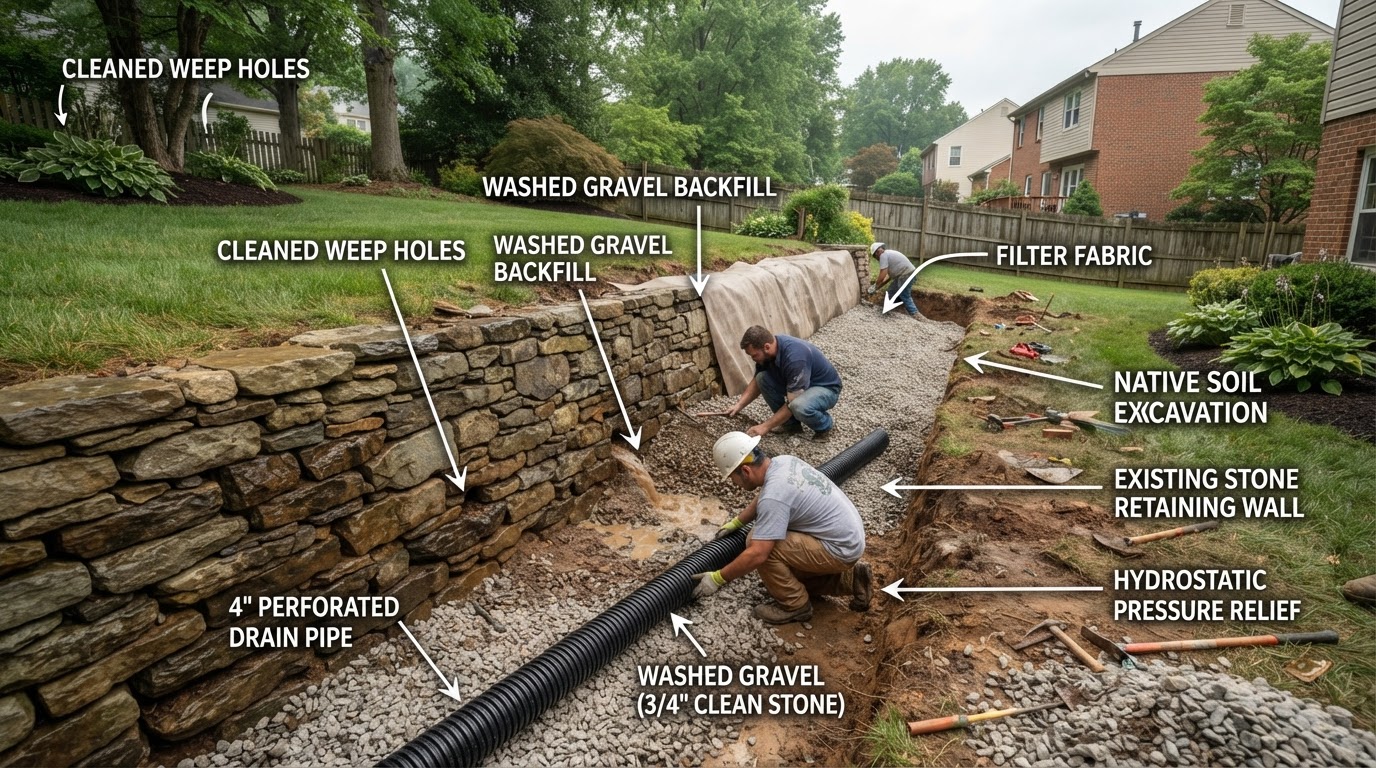
Concept visualization: Retaining wall drainage repair with hydrostatic relief
Provenance: Concept visualizationScope, Applications, and Homeowner Goals
This service addresses retaining walls — stone, block, or timber — that are saturated, bulging, leaning, or cracking because water has no path out from behind them. It includes evaluating the wall's current geometry, clearing or installing weep holes and drain outlets, replacing washed gravel backfill, and reinstalling the perforated drain pipe that carries water away from the base.
This page is distinct from retaining wall installation, which builds the structure and its drainage from scratch, and from retaining wall repair, which addresses structural failure — leaning, cracking, or collapsed sections. Drainage repair is the hydrostatic cause; wall repair is the structural effect. Where a wall has already moved, both may be needed, with the drainage fixed first so the structural repair is not undone.
Choosing between weep-hole relief alone, a full gravel-and-pipe rebuild behind the wall, and a drainage-plus-structural repair depends on how far the wall has moved and how much water it is holding. A wall still within tolerance usually needs drainage only; one already leaning needs both.
Weep hole clearing and installation
Clogged weep holes are cleared and missing outlets are installed so water has a path out from behind the wall at the base.
Washed gravel backfill
Fine soil that has migrated into the backfill is replaced with washed angular gravel so water moves freely to the drain rather than saturating the soil.
Drain pipe replacement
A crushed, clogged, or absent perforated drain pipe at the wall base is replaced so collected water is conveyed to a suitable outlet.
Structural tolerance check
The wall's lean, bow, and crack pattern are evaluated to confirm whether drainage relief is sufficient or whether structural wall repair must accompany it.
Materials, Methods, and Design Choices
The comparison below distinguishes the drainage repair from the structural repair — and why fixing drainage alone does not straighten a wall that has already moved.
| Consideration | Drainage repair only | Drainage + structural repair | Weep holes only |
|---|---|---|---|
| What it fixes | The hydrostatic cause | Cause and the lean/crack | A mild saturation point |
| Wall straightened | No — pressure is relieved | Yes — structure restored | No — partial relief only |
| When it fits | Wall still within tolerance | Wall has already leaned or cracked | Minor, early saturation |
| Disruption | Excavation behind the wall | Excavation plus wall rebuild | Lowest — outlet work |
| What it cannot do | Does not straighten a leaned wall | Higher cost and scope | Does not replace the drain pipe |
Washed gravel backfill
Angular washed gravel behind the wall lets water flow freely to the drain rather than saturating the soil. Fine soil that has migrated in is what clogs the drainage path and is replaced.
Perforated drain pipe
A perforated pipe at the base of the backfill collects water and conveys it to a suitable outlet. A crushed, clogged, or absent pipe is what leaves the wall holding water it cannot drain.
Weep hole outlets
Weep holes at the wall base give water an exit path even if the pipe is overwhelmed. Clogged or missing holes are cleared or installed so the wall has a redundant drainage path.
Site Assessment and Project Planning
Before defining the repair, several factors shape the approach: how far the wall has leaned or bowed, whether the drain pipe and weep holes exist and function, the condition of the backfill, and where a suitable drainage outlet lies. Relieving drainage behind a wall that has already moved beyond tolerance stops further failure but does not straighten it.
Wall geometry
The lean, bow, and crack pattern are measured to confirm whether the wall is still within tolerance for drainage-only repair or needs structural restoration as well.
Drain pipe condition
The existing perforated pipe — if present — is checked for crushing, clogging, or an absent outlet that leaves the wall saturated.
Backfill state
Fine soil that has migrated into the gravel backfill is what blocks drainage; the backfill is evaluated and replaced where it has degraded.
Weep hole function
Weep holes at the base are checked for clogging or absence and cleared or installed so the wall has a working exit path.
Drainage outlet
The pipe needs a suitable destination — a daylight outlet, storm connection, or gravel sump — so the collected water has somewhere to go.
Structural vs. drainage scope
Where the wall has already leaned or cracked, the structural wall repair scope is identified alongside the drainage fix so neither is done in isolation.
Germantown Context and Related Services
Across Germantown and Montgomery County, MD, retaining walls fail from hydrostatic pressure far more often than from material weakness. Spring saturation and freeze-thaw build water behind a wall that has no drain, and the wall bows or leans under the load. Fixing drainage behind a wall still within tolerance stops the failure; fixing drainage behind a wall already moved is necessary but not sufficient, and the most common mistake is draining a wall without straightening it — or straightening it without draining it.
Related completed pages: retaining wall installation covers the full new-build standard including drainage, retaining wall repair addresses the structural lean and crack restoration, and landscape erosion control handles the slope and runoff that often load the wall from above.
Related Completed Services
Retaining Wall Drainage Repair Questions
A bulging wall is a drainage problem before it is a structural one. Call to describe how far the wall has leaned and whether water pools behind it, or request an estimate to evaluate whether drainage relief or drainage plus structural repair fits your wall.
Why is my retaining wall bulging if the stones are intact?↓
The bulge is hydrostatic pressure — water has built up behind the wall with no drain path, and the saturated soil is pushing against the structure. The stones are fine; the drainage behind them has failed. Relieving that pressure is the repair.
Will fixing the drainage straighten my leaning wall?↓
No. Drainage repair relieves the pressure and stops further movement, but it does not pull a wall back into plumb. A wall that has already leaned needs both the drainage fix — so it stops moving — and the structural wall repair to restore it.
What's behind the wall that's holding the water?↓
Usually fine soil that has migrated into the gravel backfill and clogged the drainage path, plus a crushed or absent drain pipe at the base. The repair replaces the backfill with washed gravel and reinstalls the pipe so water exits rather than saturating the soil.
Do weep holes actually help on their own?↓
Weep holes give water an exit path and help with mild, early saturation, but they are a redundant path, not a complete drain. A wall holding significant water needs the gravel backfill and drain pipe restored, not just the holes cleared.
How do you know if the wall needs drainage only or drainage and structural repair?↓
The wall's geometry tells us. A wall still within tolerance — plumb or barely moved — usually needs drainage relief alone. A wall that has leaned, bowed, or cracked has already moved and needs the structural restoration alongside the drainage fix so the failure does not continue.
Discuss Your Project
Call our team based in Germantown, MD to talk through scope, site considerations, and next steps — or request an estimate and we will follow up.